



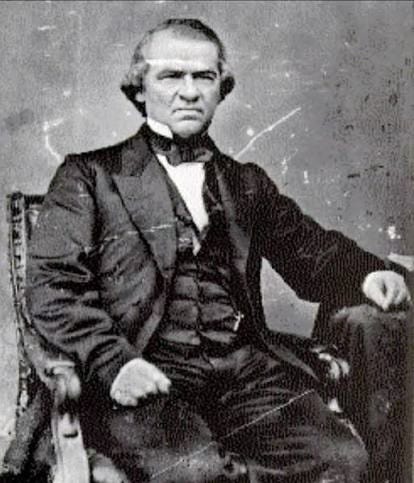
This Day in Legal History: Andrew Johnson Suspends Secretary Stanton
On August 12, 1867, President Andrew Johnson suspended Edwin Stanton, his Secretary of War, and installed General Ulysses S. Grant to run the department temporarily. It was a quiet-sounding personnel move that lit the fuse on one of the great constitutional confrontations in American history—and it turned on a question we still argue about: how much control a president has over the officials who serve beneath him.
The context was Reconstruction. Stanton was a close ally of the Radical Republicans in Congress, and as Secretary of War he controlled the Army’s presence across the defeated South, including the Freedmen’s Bureau—making him essential to Congress’s plans to remake the region and protect the newly freed. Johnson, who bitterly opposed that agenda, wanted Stanton gone. But Congress had anticipated exactly this: it had passed the Tenure of Office Act, which barred the president from removing a Senate-confirmed cabinet officer without the Senate’s consent. Johnson, trying to thread the needle while Congress was in recess, suspended Stanton rather than firing him outright. When the Senate later refused to concur and Johnson removed Stanton anyway in early 1868, the House impeached him—and he survived removal in the Senate by a single vote.
The significance of August 12, 1867 reaches all the way to the present. The Tenure of Office Act was eventually repealed and, decades later, the Supreme Court in Myers v. United States suggested it had been unconstitutional all along, endorsing a robust presidential removal power—the same removal-power debate that traces back to the very first Congress and runs through today’s fights over the independence of agencies and prosecutors. Johnson’s clash with Stanton is the original American showdown over whether a president can be checked in the control of his own executive branch. And on a day when we’ve got a story about the White House leaning on the Justice Department, that 159-year-old question feels remarkably current.
A federal appeals court has thrown out the government formula at the heart of the law meant to protect patients from surprise medical bills—handing a significant win to doctors and hospitals over insurers. Sitting en banc, all seventeen judges of the Fifth Circuit issued an unsigned opinion mostly siding with physicians and air-ambulance companies, and invalidating a federal rule as going beyond what Congress actually authorized in the No Surprises Act. Here’s how this works, because it’s less about patients than it sounds. The No Surprises Act protects you, the patient—if you get care from an out-of-network provider in an emergency, you only owe your normal in-network cost-sharing. The fight is over who pays the rest: the insurer or the provider. That gets decided in arbitration, and the key benchmark is something called the “qualifying payment amount,” or QPA. Whoever controls how the QPA is calculated basically controls who wins. The court found that federal agencies had let insurers game that number—by baking in so-called “ghost rates,” contracted amounts for services that providers never actually deliver, which dragged the benchmark down in insurers’ favor—and by improperly excluding bonus and incentive payments. The significance is twofold. Substantively, it rebalances a high-stakes payment fight away from insurers and toward providers. But the deeper theme is administrative law: this is a court holding that agencies rewrote a statute to favor one side beyond what Congress wrote—exactly the kind of post-Chevron scrutiny of agency rulemaking we’ve been tracking all summer. The patient protections stay; the multibillion-dollar question of who pays just got sent back to the drawing board.
US appeals court voids formula used to avert surprise medical bills | Reuters
American Medical Association · Bloomberg Law
A federal judge has blocked the U.S. Postal Service nationwide from enforcing the mail-in voting restrictions in President Trump’s executive order—and if this story sounds familiar to longtime listeners, it should. U.S. District Judge Indira Talwani in Boston expanded an order she first issued in June, which had covered 23 states, into a nationwide injunction. Under the executive order, the Postal Service was supposed to gather state lists of eligible voters and deliver absentee ballots only to people on those lists; Talwani’s ruling bars USPS from refusing to deliver mail ballots based on those new federal verification requirements. Her reasoning is the same principle we keep coming back to: the executive branch, she wrote, has no authority to regulate elections—that power belongs to the states under the Constitution. And she stressed the timing, noting it’s now less than 90 days before the November 3 midterms, which makes it especially important not to let the federal government change election rules on the eve of the vote. This connects to the entire voting-rights arc we’ve followed—the administration’s 0-and-21 losing streak on voter rolls, the Supreme Court emergency application, the Voting Rights Act anniversary. The significance is that the courts continue to hold a firm, near-unbroken line: however much the administration wants federal control over how Americans cast and count ballots, judges keep ruling that elections are run by the states, and the closer we get to November, the more urgently they’re saying it.
Judge blocks US Postal Service from restricting mail-in voting | Reuters
NPR · US News
The White House has reportedly asked the Justice Department to explore bringing new charges against David Hearn—the former Olympian in the Reflecting Pool case—just over a week after the department dropped the case because its own evidence showed he didn’t do it. Recall the sequence: Hearn was indicted on a felony for allegedly damaging the Lincoln Memorial Reflecting Pool, but prosecutors then moved to dismiss, telling the court that newly disclosed documents showed the damage came from a botched renovation, not vandalism. According to sources, President Trump was furious at U.S. Attorney Jeanine Pirro for dismissing the case, and the White House has since asked the department to examine whether there’s a basis for a new charge—possibly a misdemeanor. The talks are described as preliminary, with no decision made, and Congressman Jamie Raskin has already launched a probe into the whole affair. Here’s why this is legally striking. The decision to drop the case wasn’t a technicality—it was the government concluding, on the evidence, that the underlying premise was false. To now go looking for new charges against the same person, at the White House’s urging and reportedly out of the president’s personal anger, raises the specter of vindictive prosecution—using the charging power not to pursue justice but to punish. The significance goes to the core of prosecutorial independence, the theme running through the Blanche confirmation fight and beyond: charging decisions are supposed to be driven by evidence and law, not by a president’s displeasure that a case was dropped. It’s a live test of whether that line still holds.
Trump White House asked DOJ to explore new Reflecting Pool charges, sources say | Reuters
US News · MS NOW
And finally, the law graduates who suffered through California’s disastrous 2025 bar exam have reached a settlement in their class action against the company that administered it. You may remember the debacle: the February 2025 California bar exam, run by the vendor Meazure Learning, collapsed into login failures, software crashes, frozen screens, and lost answers, throwing thousands of aspiring lawyers into chaos on the single most important test of their careers. That fiasco spawned multiple lawsuits—the test-takers’ claims were consolidated into a class action in federal court—as well as a state audit and a legislative inquiry. This settlement resolves the graduates’ own case, and it’s distinct from the separate deal the State Bar itself reached with Meazure last month, in which the vendor agreed to pay the Bar $5.25 million and forgive $1.36 million in unpaid invoices. The significance connects directly to a story we covered a couple of weeks ago—the meltdown of the new NextGen exam in Washington State. Two different states, two different vendors and formats, the same underlying failure: the high-stakes gateway to the legal profession buckling under basic technology problems, and leaving the people trying to enter the profession to pick up the pieces. These settlements put a price on that failure—but they also intensify a growing question about whether the bar exam, as currently built and administered, is a reliable way to license lawyers at all.
Law grads reach settlement in class action over botched California bar exam | Reuters
Bloomberg Law · ICLG


