



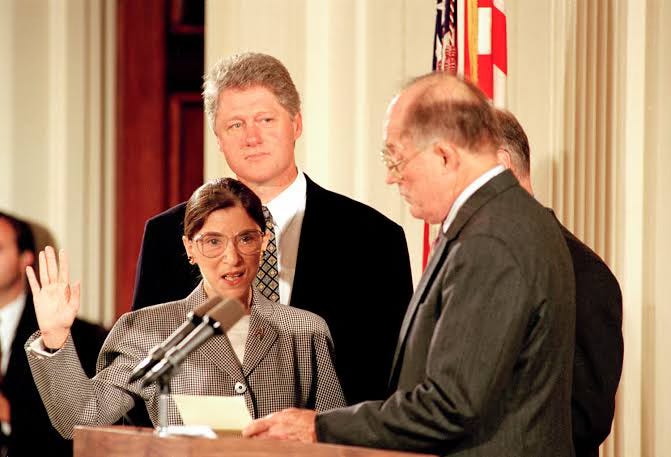
This Day in Legal History: Ruth Bader Ginsburg Joins the Court
On August 10, 1993, Ruth Bader Ginsburg was sworn in as an associate justice of the Supreme Court, becoming the second woman—and the first Jewish woman—ever to serve on it. She had been confirmed by the Senate just a week earlier by a lopsided 96 to 3, a margin that is almost unimaginable for a Supreme Court nominee today, and she took the seat vacated by the retiring Justice Byron White.
Ginsburg reached the Court after one of the most consequential legal careers of the twentieth century—much of it spent, as a litigator, dismantling sex discrimination brick by brick. In the 1970s, as head of the ACLU’s Women’s Rights Project, she argued a series of cases before the very Court she would later join, persuading an all-male bench to recognize that treating men and women differently under the law often rested on nothing but stereotype. She was strategic and incremental, sometimes choosing male plaintiffs to show that gender lines cut both ways. On the Court, she became known for landmark majority opinions like United States v. Virginia, striking down the male-only admissions policy at the Virginia Military Institute, and, later, for pointed dissents that made her an unlikely cultural icon.
The significance of August 10, 1993 is a fitting frame for today’s news, because it raises a question the Court is wrestling with right now: when justices come and when they go. Ginsburg famously declined to retire during President Obama’s second term, confident she could outlast the political moment; when she died in September 2020, President Trump filled her seat, shifting the Court’s balance for a generation. That episode turned “strategic retirement” from an academic debate into a live and painful one—and it’s the exact debate hanging over our second story today. Ginsburg’s life is a reminder both of how much a single justice can shape the law, and of how fraught the timing of a lifetime appointment has become.
The Senate has confirmed Todd Blanche as attorney general, ending one of the most bruising cabinet fights of Trump’s second term with a razor-thin 50-49 vote taken overnight on Saturday. We’ve followed this saga from the beginning—the tense confirmation hearing, the stalled committee vote, the eleventh-hour deal to rescind the anti-weaponization fund—and this is where it lands. Two Republicans, Susan Collins of Maine and Lisa Murkowski of Alaska, broke ranks and voted no, citing concerns ranging from the Epstein files to that $1.8 billion fund; Senator Bill Cassidy provided the decisive vote, saying Blanche was the best option the president was likely to offer. Blanche, you’ll recall, was Trump’s personal criminal defense lawyer before joining the Justice Department, and that’s the heart of why this was so contested: the concern that the nation’s top law-enforcement officer would serve the president personally rather than the law. The significance is twofold. First, the margin itself—a single vote, with defections from the president’s own party—signals just how uneasy even some Republicans were about Blanche’s independence. Second, remember what it took to get here: Blanche had to formally dismantle a controversial initiative to win confirmation. But as Democrats pointed out, that was an executive-branch promise, not a law, and the same executive branch can revisit it. So Blanche takes office as attorney general having made a concession whose durability is genuinely uncertain—confirmed, but on the narrowest possible terms and with the questions about his independence very much unresolved.
Senate Republicans narrowly confirm Todd Blanche as attorney general | Reuters
NPR · Washington Post
Justice Samuel Alito has put an end to a summer of retirement speculation, confirming that he intends to stay on the Supreme Court. “Obviously, I’m here for another term,” the 76-year-old justice said in an interview published in the Wall Street Journal’s editorial pages. The speculation had reached a fever pitch back in June, when a veteran Supreme Court reporter’s pre-written retirement story was published by mistake and then quickly retracted—but the talk never fully died down. What makes Alito’s statement legally and politically interesting is what he pushed back on. He explicitly rejected the suggestion that he should time his retirement strategically—stepping down now, while President Trump is in office and Republicans control the Senate, so that a younger conservative could be confirmed to replace him and hold the seat for decades. And that is exactly where today’s Ginsburg anniversary comes crashing in. Justice Ginsburg made the opposite bet: she declined calls to retire while President Obama could name her successor, and when she died in 2020, a president of the opposite party filled her seat and reshaped the Court. That history is precisely why so many now urge aging justices to retire strategically. Alito is declining to play that game—at least publicly. The significance is that this keeps a reliably conservative vote on the Court for now, but it also spotlights an uncomfortable feature of our system: lifetime tenure means the timing of a single retirement can shape constitutional law for a generation, and we increasingly expect justices to make that intensely personal decision with one eye on the electoral calendar.
Justice Alito says he is staying on Supreme Court for another term | Reuters
ABC News · Fortune
And finally, a federal judge has approved more than $2.5 billion in settlements that New Jersey reached with DuPont, Chemours, Corteva, and 3M to resolve claims over contamination from PFAS—the “forever chemicals” that have become one of the biggest environmental-liability stories of the decade. Chief U.S. District Judge Renée Marie Bumb signed off on Friday, ending a legal battle that began back in 2019. A quick primer: PFAS are a family of synthetic chemicals used in everything from nonstick coatings to firefighting foam, and they’re called “forever chemicals” because they essentially don’t break down in the environment or the human body, and they’ve been linked to serious health harms. New Jersey sued under a natural-resource-damages theory—the idea that these companies polluted the state’s shared resources, its water and land, and must pay to restore them. The numbers are substantial: DuPont, Chemours, and Corteva will pay $875 million over 25 years, clean up four former industrial sites, and fund a $1.2 billion remediation account; 3M will pay up to $450 million. The judge called the deal “fair, reasonable and adequate” and even an “impressive windfall” given the risks of taking such a case to trial. The significance is that this is one of the largest state PFAS recoveries yet, and it fits the mass-tort pattern we’ve watched all summer—from talc to Roundup—where companies, facing enormous litigation exposure, choose certainty over trial. But this one has an environmental twist: beyond the money, it forces the actual cleanup of contaminated sites, and it gives every other state attorney general eyeing PFAS litigation a $2.5 billion data point to bring to their own negotiating table.
New Jersey’s $2.5 billion ‘forever chemicals’ settlements with DuPont, 3M, others win court approval | Reuters
Philadelphia Inquirer · New Jersey Attorney General


