



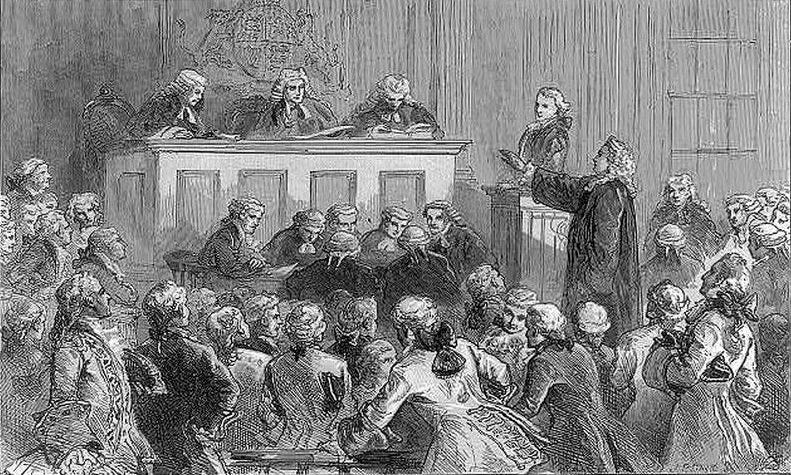
This Day in Legal History: The Acquittal of John Peter Zenger
On August 4, 1735, a New York jury acquitted printer John Peter Zenger of seditious libel—a verdict that planted one of the earliest seeds of freedom of the press in America. Zenger published the New York Weekly Journal, which had spent a year printing scathing criticism of the colonial governor, William Cosby. For that, Zenger was jailed for nearly ten months and put on trial for libeling the governor.
Here’s what made the case so important. Under the English common law of the time, truth was no defense to a charge of seditious libel—in fact, the more true the criticism, the more “dangerous” it was thought to be, because it was more likely to undermine the government’s authority. The judge instructed the jury accordingly: they were only to decide whether Zenger had published the words, and the court would decide whether they were libelous. But Zenger’s brilliant lawyer, Andrew Hamilton of Philadelphia, went over the judge’s head and appealed directly to the jury, arguing that they had the power to weigh the truth of what Zenger printed—and that truthful criticism of government could not be a crime. The jury agreed, and acquitted.
The Zenger verdict didn’t immediately change the formal law—truth wouldn’t be firmly established as a defense to libel for decades—but its influence was enormous. It established, in the American mind, two ideas that would prove foundational: that truth ought to be a defense to a charge of defaming the government, and that a jury of ordinary citizens could stand between the state and a critic it wanted to silence. Those principles run straight through the First Amendment and into modern press-freedom law, including New York Times v. Sullivan two centuries later. The significance of August 4, 1735 is that it’s a origin point for the American conviction that the freedom to criticize those in power is not a privilege the government grants, but a liberty the people hold—an idea that, as today’s stories show, is still very much contested.
Todd Blanche’s nomination to be attorney general has cleared its biggest obstacle: the Senate Judiciary Committee is set to advance him after he cut a deal with the Republican holdouts who had threatened to sink it. We’ve tracked this saga closely—the stalled vote, Senator Cornyn’s refusal, and then Blanche’s move over the weekend to formally rescind the $1.8 billion “anti-weaponization fund.” The final piece came in a deal struck late Sunday with Senators John Cornyn of Texas and Thom Tillis of North Carolina, who had demanded written assurances about the settlement of Trump’s lawsuit against the IRS over his leaked tax returns. With those assurances in hand, the committee’s Republicans are now expected to line up behind him. It’s worth noting the Democrats’ objection, because it’s a substantive legal point: they argue Blanche’s rescission order doesn’t actually prevent the administration from reviving the fund after he’s confirmed, and they’re calling for legislation to bar it permanently. In other words, an executive-branch promise can be undone by the same executive branch, which is exactly why they want a statute. The significance is that advice-and-consent worked as a real check—Blanche had to publicly dismantle a controversial initiative to win the votes—but it also exposed the limits of that check. A confirmation deal extracts a promise; it doesn’t write a law. The nation’s next top law-enforcement officer advances, having conceded the point, but with the durability of that concession still an open question.
Blanche set to clear nomination hurdle after deal wins senators’ vote | Reuters
US News (AP) · CNN
A coalition of two dozen Democratic-led states has sued to block a new federal policy that would let immigration authorities get their hands on personal data about low-income families enrolled in a cash-assistance program. The policy would allow the Administration for Children and Families—which runs welfare programs—to share detailed personal information about benefit recipients with other federal agencies, including the Department of Homeland Security, and it’s set to take effect August 11. The states’ legal theory is twofold. First, they argue the policy violates the Administrative Procedure Act—the law that requires federal agencies to follow proper procedures and not act arbitrarily—by ignoring existing data-sharing restrictions and slapping new conditions on federal funding. Second, they invoke the Constitution. And a separate suit filed in Brooklyn by civil-rights and privacy groups, including the Electronic Frontier Foundation, adds a Privacy Act claim—the federal statute that limits how the government can use and share the personal data it collects. Here’s why this matters beyond the courtroom. Programs like this cash-assistance program serve some of the most vulnerable families in the country, and the fear that applying for help could funnel your information to immigration enforcement produces a powerful chilling effect—people forgo food and cash aid they’re legally entitled to. It’s the same dynamic behind the “public charge” fights, and fittingly, today marks the anniversary of the 1882 immigration law that first tied benefits to immigration status. The significance is a collision between the machinery of the welfare state and the machinery of immigration enforcement, with data privacy law as the battleground—and courts once again asked whether the administration followed the rules before repurposing sensitive government data.
States sue over Trump policy of sharing benefits data with immigration authorities | Reuters
Detroit News (AP) · UPI
And a striking piece of accountability journalism: a Reuters investigation has found that judges in 75 separate cases have ruled that the Trump administration violated First Amendment rights—this despite the president campaigning as a free-speech champion who vowed to end what he called years of “government censorship.” The 75 rulings span the full range of First Amendment protections: freedom of speech, freedom of religion, and freedom of the press. According to the reporting, judges have repeatedly found that the administration chilled or suppressed the speech of citizens and groups who oppose its agenda—an unusually broad pattern of judicial pushback on constitutional grounds. A few caveats worth stating plainly, in fairness: many of these are trial-level rulings, some are preliminary, and the administration disputes them and is appealing in various cases, so not every one is a final word. But the sheer volume is the story. When dozens of federal judges, appointed by presidents of both parties, independently conclude that the same administration is infringing the First Amendment, that’s a signal that’s hard to wave away. The significance ties directly to today’s Zenger anniversary. The whole American tradition of free expression rests on the idea that the government cannot punish or silence its critics—and this reporting suggests that principle is being tested, and defended by the courts, on an extraordinary scale. It’s a reminder that the First Amendment is not self-enforcing; it lives or dies in the accumulation of individual rulings by judges willing to say no.
Trump vowed to ‘bring free speech back.’ Judges in 75 cases ruled that he has stifled it | Reuters
CNN · Yahoo News
And finally, in my column for Bloomberg Tax this week, I take on New York City’s brand-new pied-à-terre tax—the city’s first surcharge on high-value second homes—and my basic take is that it’s good policy being undermined by a messy rollout. The trigger for the piece is a striking number: the city’s initial roll flagged about 31,000 potentially liable properties, versus the roughly 10,000 officials had projected. That gap set off a backlash, and I wanted to separate the policy from the implementation.
On the policy, I come down in favor. High-value second homes are actually a really sensible tax base, because they represent concentrated, largely immobile wealth. That’s the key word—immobile. A wealthy person’s labor income or investments can pick up and leave, but a condo can’t reincorporate in Delaware or establish residency in West Palm Beach. It just sits there, and its value depends overwhelmingly on the city around it—the transit, the sanitation, the parks, the public safety, the cultural institutions. So a well-calibrated surcharge is really just asking people who hold significant, location-keyed wealth to return a share of the value the city itself creates and preserves. Across the OECD, the top wealth quintile holds roughly three-quarters of secondary-real-estate wealth, so this is a genuinely progressive base, and economists generally find recurring taxes on immovable property are among the least damaging to growth.
Where I get critical is the data and the process. That 31,000-property list isn’t a final bill—it’s a preliminary screening pool, and many of those owners will be winnowed out. But the size of it exposes how hard it is for City Hall to tell a true second home from a rental, a family residence, or a property held in trust, using fragmented government records. Property records can identify an expensive apartment; they’re much worse at revealing who’s actually sleeping in it, and when. My core recommendation is transparency: every formal notice should include a plain-language reason code explaining exactly why a property was flagged and what records produced that conclusion, and the city should publish aggregate data on how many determinations are screened out, appealed, reversed, and upheld. The burden of the government’s record gaps shouldn’t fall on homeowners forced to rebut an unexplained conclusion. So my bottom line is that a second-home surcharge can be progressive, economically sound, and administratively workable—but only if the government is willing to show, clearly, whom it means to tax and how it got there. Make the first two years a genuinely transparent implementation period, and the policy earns its legitimacy before the real revenue arrives.
New York City’s Second-Home Tax Is Good Policy With a Data Issue | Bloomberg Tax


