



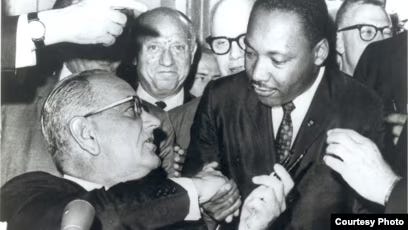
This Day in Legal History: The Voting Rights Act of 1965
On August 6, 1965, President Lyndon B. Johnson signed the Voting Rights Act, arguably the most effective civil-rights statute in American history. Johnson signed it at the Capitol, and after a ceremony in the Rotunda, he moved to the President’s Room near the Senate Chamber—the same room where Abraham Lincoln had signed a bill freeing enslaved people pressed into Confederate service—flanked by congressional leaders, Martin Luther King Jr., Rosa Parks, and others who had fought and bled for this moment.
The Act was a direct response to the machinery of disenfranchisement that Southern states had built after Reconstruction. For nearly a century, literacy tests, poll taxes, and outright intimidation had kept Black Americans from the ballot box despite the Fifteenth Amendment’s guarantee. The Voting Rights Act attacked that machinery head-on: it banned literacy tests, and—crucially—in Section 5, it required jurisdictions with the worst histories of discrimination to “preclear” any change to their voting rules with the federal government before those changes could take effect. It also authorized federal examiners to register voters directly. The impact was immediate and staggering: over a quarter-million new Black voters registered by the end of 1965 alone.
The significance of August 6, 1965 is that it transformed American democracy by finally making the promise of the Fifteenth Amendment real. But it’s also a living, contested statute, which is why it belongs in the news and not just the history books. In 2013, in Shelby County v. Holder, the Supreme Court effectively disabled the Section 5 preclearance requirement, holding that the formula for deciding which jurisdictions were covered was outdated. In the years since, fights over voting rules, voter rolls, and ballot access—many of which we’ve covered on this show—have unfolded on the terrain the Voting Rights Act created and that Shelby County reshaped. Sixty years on, the argument the Act tried to settle is still very much open.
A court filing has revealed the striking scale of the aftermath of one of the biggest separation-of-powers rulings in years: the U.S. government has already refunded about $100 billion in tariffs that the Supreme Court struck down. According to the filing in the U.S. Court of International Trade, roughly $100 billion in refunds—duties plus interest—had been completed as of the end of July, representing more than half of the $166 billion the government had collected under the invalidated tariffs. Here’s the backstory. After returning to office, President Trump used the International Emergency Economic Powers Act—a law meant for genuine national emergencies—to impose sweeping tariffs on trading partners. This February, the Supreme Court ruled he had exceeded his authority, holding that IEEPA doesn’t hand the president that kind of open-ended tariff power. Now the bill is coming due, and the refunds go to the importers who paid the duties in the first place. There’s a direct line from this to a story we covered last week: after losing the IEEPA tariffs at the Supreme Court, the administration reached for Section 338, a dormant 1930s trade statute, to hit Canada—a workaround that itself invites fresh legal challenge. The significance is a vivid, hundred-billion-dollar lesson in the cost of executive overreach. When a president stretches a statute past its limits and the courts say no, the consequences aren’t abstract—they’re measured in massive refunds and a scramble for new legal authority. It’s the separation of powers with a price tag attached.
US refunds $100 billion in tariffs struck down by Supreme Court, filing shows | Reuters
NBC News · US News
New data shows that entry-level hiring at the country’s largest law firms has fallen—and the reasons say a lot about where the profession is heading. According to the National Association for Law Placement, firms with more than 500 lawyers pulled back on hiring associates straight out of law school, and for the first time in memory, those firms brought in more lateral associates—attorneys with prior experience—than fresh graduates. Laterals made up about 49% of associate hires, while entry-level grads fell to roughly 38%, a sharp drop from the 46% share they’d held. Three forces are driving this, and the middle one should get your attention. First, clients increasingly want sophisticated, autonomous counsel who can hit the ground running. Second—and this is the newsy part—artificial intelligence is absorbing exactly the kind of tasks that used to be assigned to first-year associates: document review, initial research, first drafts. Third, there’s a deep pool of experienced lateral talent available to poach. The significance is both immediate and long-term. In the short run, it’s a harder market for new graduates entering six-figure debt into a profession that’s hiring fewer of them. But there’s a real structural risk the report flags: the junior-associate years are how firms train the next generation of partners. If AI hollows out entry-level work and firms stop hiring and mentoring juniors, they may find themselves, a decade from now, with no mid-level talent to promote—having automated away the bottom of the pipeline that feeds the top. It’s a preview of a question every knowledge profession is about to face.
Entry-level hiring at large US law firms declined for first time in a decade, data shows | Reuters
Law.com (American Lawyer) · NALP
New Mexico has sued the U.S. Justice Department for access to the unredacted files on Jeffrey Epstein, accusing the federal government of stonewalling the state’s own investigation. New Mexico’s attorney general, Raúl Torrez, reopened the state’s Epstein investigation earlier this year and requested the unredacted federal files to identify people—visitors and staff at Epstein’s Zorro Ranch property in New Mexico—who allegedly participated in or witnessed crimes. The state says the DOJ reneged on a 2019 arrangement under which New Mexico paused its own probe and turned evidence over to federal authorities in exchange for continued information-sharing. The Justice Department counters that under the Epstein Files Transparency Act and protective court orders, it is neither required nor permitted to disclose victim-identifying information, and that New Mexico has offered “no lawful basis” for such sweeping disclosures. Torrez put the stakes plainly: the state says it needs to see those files before it can decide whether to charge anyone. The significance is a genuine legal collision between two legitimate interests. On one side is a state prosecutor who says he can’t do justice—can’t bring charges—without evidence the federal government is holding. On the other are real statutory and court-ordered protections for the privacy of victims, which exist for good reason in a case defined by the sexual abuse of young women and girls. It’s also another chapter in the long-running, politically charged fight over transparency in the Epstein files, an issue that has repeatedly surfaced around this administration. A court will now have to weigh a state’s investigative need against federal victim-protection rules.
New Mexico sues US government for access to Epstein files | Reuters
Al Jazeera· UPI
And finally, OpenAI has asked a federal judge to throw out Apple’s lawsuit accusing it of stealing trade secrets—a case we covered when Apple filed it back in July. To recap, Apple alleged that OpenAI misappropriated its confidential information to jump-start its own push into consumer hardware, using former Apple employees, aggressive recruiting, and supply-chain connections. In its motion to dismiss, OpenAI calls the allegations “baseless” and makes a pointed argument: “OpenAI has no use, need, or desire for Apple’s trade secrets,” its lawyers wrote, insisting it’s “building something entirely new and different from anything at Apple.” OpenAI’s core defense is to reframe the story—not as theft of secrets, but as ordinary competition for talent. It says its real interest is in recruiting top engineers, many of whom simply chose to leave Apple for more exciting work. And that reframing goes right to the heart of trade-secret law. Hiring a competitor’s employees is completely legal—people are free to change jobs and use the general skills and knowledge they’ve built. What’s illegal is taking or using the former employer’s specific, protected confidential information. So the whole case turns on which side of that line the conduct falls: lawful talent raid, or unlawful secret-grab. The judge is set to hear arguments on October 1, and OpenAI faces an August 17 deadline to respond to Apple’s request for a preliminary injunction. The significance is that this is shaping up to be a marquee test of where the law draws the line between competing for people and stealing their knowledge—a question that will define a lot of fights in the AI talent wars.
OpenAI asks US judge to dismiss Apple’s trade secrets case | Reuters
Bloomberg · Axios


