



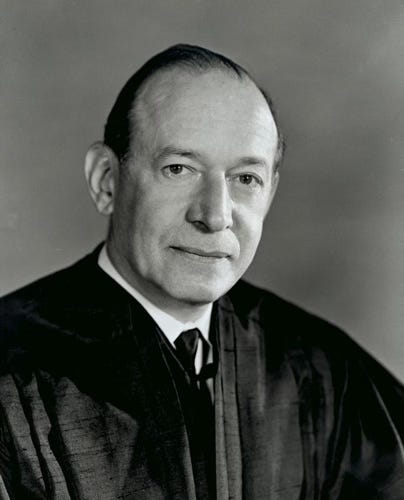
This Day in Legal History: Abe Fortas Resigns SCOTUS
On May 15, 1969, Justice Abe Fortas resigned from the United States Supreme Court, becoming the first justice to leave the Court under the threat of impeachment. Fortas had been appointed to the Court in 1965 by President Lyndon B. Johnson, a close friend and political ally. His reputation had already been damaged in 1968, when Johnson tried to elevate him to Chief Justice and the nomination failed after senators criticized his outside income and ties to the president. The controversy deepened when it became public that Fortas had accepted a financial arrangement from the family foundation of Louis Wolfson, a financier who was later convicted of securities violations. Although Fortas returned the money, the arrangement created the appearance that a sitting Supreme Court justice might be financially entangled with someone who had legal troubles. That appearance alone was enough to cause a major crisis for the Court’s legitimacy.
Members of Congress began discussing impeachment, and Fortas ultimately resigned before a formal impeachment process could remove him. His departure became an important example of how judicial ethics are not limited to actual corruption, but also include conduct that undermines public confidence in judicial independence. The episode also showed the tension between life tenure and accountability for federal judges. Article III judges are protected from political pressure through lifetime appointments, but they can still face removal through impeachment for serious misconduct.
Fortas’s resignation left a lasting mark on debates over Supreme Court ethics, outside income, recusals, and financial disclosure. More than fifty years later, the Fortas controversy is still cited when questions arise about whether Supreme Court justices should follow clearer and more enforceable ethics rules.
Closing arguments ended Thursday in Elon Musk’s federal trial against OpenAI, Sam Altman, Greg Brockman, and Microsoft, with the case now headed to a nine-member jury. Musk’s lawyer argued that OpenAI violated its charitable mission by shifting assets, employees, and value from its nonprofit structure into a for-profit enterprise now worth hundreds of billions of dollars. He focused heavily on Altman’s credibility, telling jurors that OpenAI’s defense depends on believing Altman and pointing to testimony and documents that Musk says show dishonesty, conflicts, and self-enrichment. Musk’s side also attacked Brockman’s large equity stake and cited old journal entries as evidence that OpenAI insiders were thinking about personal wealth while controlling a nonprofit mission. Microsoft was portrayed by Musk’s team as helping the alleged breach by investing billions and gaining major access to OpenAI’s intellectual property and business structure. OpenAI’s lawyers responded that Musk’s claims are late, unsupported, and driven by his status as a competitor rather than by concern for charitable law. They argued Musk’s donations were not legally restricted gifts, that he once sought control of OpenAI himself, and that he did not object to earlier restructuring documents. OpenAI also emphasized that the nonprofit remains in control and now holds a stake worth roughly $200 billion, which its lawyers described as enormous value created for the charity, not stolen from it. Microsoft’s lawyer argued the company did not know of any specific conditions on Musk’s donations and was not involved in the core events Musk complains about. In rebuttal, Musk’s lawyer said OpenAI and Microsoft were distracting the jury from documents and texts showing that Musk funded OpenAI based on a specific nonprofit safety mission. The jury is scheduled to begin deliberations Monday.
‘Who’s Telling The Truth?’ Musk-OpenAI Fight Goes To Jury - Law360 UK
Musk accused of ‘selective amnesia,’ Altman of lying as OpenAI trial nears end | Reuters
The Senate Banking Committee advanced the Clarity Act, a major crypto regulation bill that would set clearer rules for digital assets and define which regulators oversee different parts of the industry. The Republican-led committee approved the bill with support from all Republicans and two Democrats, Senators Ruben Gallego and Angela Alsobrooks, giving the measure a better chance of reaching the full Senate. Even so, both Democrats warned they may not support the final version unless negotiations change. The bill is important to the crypto industry because it would help determine when tokens are treated as securities, commodities, or something else, which companies say is necessary for growth and legal certainty. Several Democrats objected that the proposal does not go far enough on anti-money laundering protections and should do more to stop public officials from profiting from crypto ventures. Banks are also fighting part of the bill because they fear crypto companies could use stablecoin rewards to compete with traditional deposits. The dispute led to tense committee negotiations, including a late compromise that Chairman Tim Scott allowed while rejecting some other Democratic amendments. Crypto groups have pushed hard for the legislation after spending heavily to support pro-crypto candidates in 2024. The White House is also backing crypto reform, and the House already passed its version of the Clarity Act last year. Supporters see the committee vote as a milestone after years of work, while critics, including Senator Elizabeth Warren, warn the bill favors the crypto industry at the expense of consumers, investors, national security, and the financial system. The bill now moves to the full Senate, where lobbying from crypto companies, banks, and consumer-protection advocates is likely to intensify.
US Senate committee advances crypto bill in milestone for digital assets | Reuters
A federal appeals court in Washington heard arguments over the Trump administration’s attempt to revive executive orders targeting four major law firms: Perkins Coie, Jenner & Block, WilmerHale, and Susman Godfrey. The firms had previously won in lower court, where judges found the orders unconstitutional. The executive orders punished the firms over issues including their legal work, hiring practices, diversity policies, and political connections. They also sought to restrict the firms’ lawyers from federal buildings, cancel government contracts held by their clients, and remove security clearances from firm employees. The Justice Department argued that the firms’ business relationships and hiring decisions are not protected by the First Amendment, and that courts should not second-guess presidential decisions involving national security. Judges on the D.C. Circuit appeared skeptical of the administration’s broad view of presidential authority, especially the claim that security clearance decisions are unreviewable even when allegedly made for improper reasons. Paul Clement, arguing for the firms, said the orders threatened the First Amendment and the ability of lawyers to represent unpopular clients without government retaliation. He warned that accepting the administration’s theory could allow presidents to punish lawyers or firms based on political affiliation. Judge Neomi Rao, a Trump appointee, seemed more receptive to the administration’s argument that courts have limited power to review security clearance decisions. The case is part of a broader fight over presidential power and whether the government can use executive authority to punish lawyers and firms viewed as political opponents. The appeals court also heard a related case involving lawyer Mark Zaid’s security clearance. Any ruling from the D.C. Circuit could eventually be appealed to the Supreme Court.
US appeals court questions Trump’s push to punish major law firms | Reuters


