


This Day in Legal History: Chinese Exclusion Act
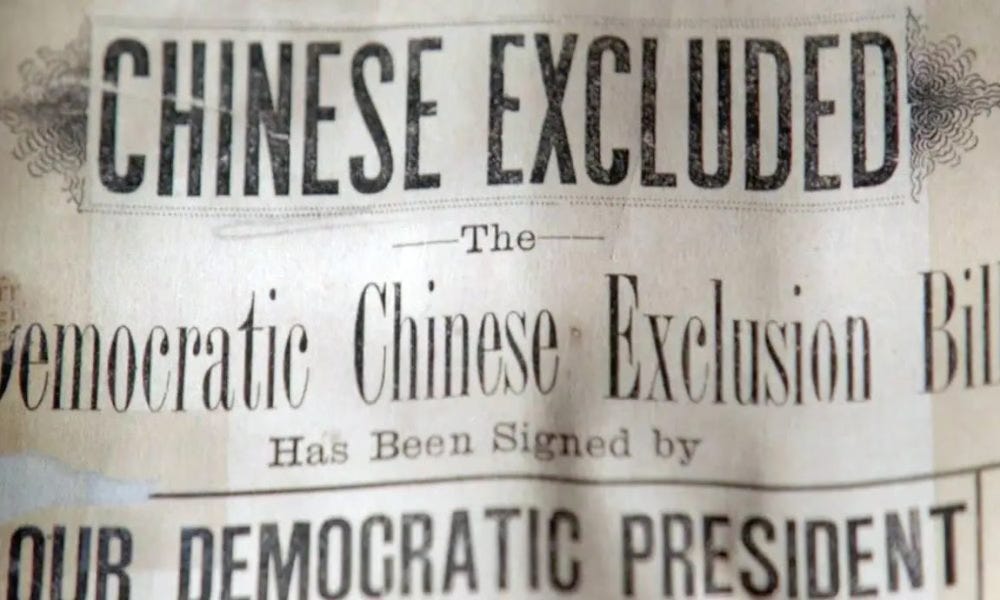
On May 6, 1882, President Chester A. Arthur signed the Chinese Exclusion Act into law. The law imposed a 10-year ban on the immigration of Chinese laborers to the United States. It also made Chinese immigrants already in the country ineligible for naturalized citizenship, marking a major turn toward federal immigration restriction. The National Archives describes it as the first significant U.S. law restricting immigration and notes that it targeted an ethnic working group on the theory that it threatened public order.
The law grew out of anti-Chinese racism and labor anxiety, especially in the American West, where Chinese workers were blamed for low wages and job competition. Although the Act formally applied to “Chinese laborers,” its enforcement burdened many Chinese people seeking entry, including those who claimed exempt status. The National Archives notes that the law helped create a broader framework for later race- and class-based exclusionary immigration policy.
The Act was not temporary in practice. Congress extended it through the Geary Act of 1892, later made the exclusion regime permanent, and did not repeal the ban until 1943, during World War II, when the United States and China were allies.
OpenAI president Greg Brockman testified in federal court that Elon Musk once supported changing OpenAI from a nonprofit into a for-profit company, but wanted full control of the organization as part of that shift. Brockman said Musk believed the nonprofit model could not raise enough money to build advanced AI systems. According to Brockman, Musk also said he needed an $80 billion stake to help fund a self-sustaining city on Mars. Brockman described a tense 2017 meeting where Musk allegedly rejected a proposed equity structure, became angry, took a painting made for him by Ilya Sutskever, and left while threatening to pause funding.
Musk’s lawsuit claims OpenAI and Sam Altman misled him into donating $38 million to a nonprofit that later abandoned its charitable mission in favor of profit. Musk is seeking $150 billion in damages for the nonprofit and wants Altman and Brockman removed from leadership. OpenAI argues that Musk is upset because he left before the company became highly successful and is now trying to gain control while also advancing his own AI company, xAI. Brockman also faced questions about his own financial interests, including testimony that his OpenAI stake is worth nearly $30 billion and evidence of an old diary entry about reaching $1 billion. OpenAI later created a for-profit unit controlled by the nonprofit, which helped it raise massive sums for computing power, hiring, and expansion.
Musk wanted $80 billion to colonize Mars, OpenAI president testifies at trial | Reuters
Publishers Elsevier, Cengage, Hachette, Macmillan, and McGraw Hill, along with author Scott Turow, sued Meta in federal court in Manhattan over its AI training practices. The lawsuit claims Meta used millions of copyrighted books and journal articles without permission to train its Llama large language models. The works allegedly included textbooks, scientific publications, and novels, such as books by N.K. Jemisin and Peter Brown. The publishers are seeking class-action status so they can represent a broader group of copyright owners. They are also asking for monetary damages.
Meta responded that AI training can qualify as fair use and said it plans to fight the case. The publishers argue that using allegedly pirated copies of creative and scholarly works is not the same as lawful innovation. The case joins a growing wave of lawsuits by authors, news organizations, artists, and other creators against AI companies, including Meta, OpenAI, and Anthropic. These lawsuits largely turn on whether using copyrighted works to train AI models is legally protected because the resulting systems create something new and transformative. Courts have not yet settled the issue, and early rulings have pointed in different directions. Anthropic previously resolved one major author lawsuit for $1.5 billion, showing how financially significant these disputes can become.
Major publishers sue Meta for copyright infringement over AI training | Reuters
The U.S. Supreme Court allowed its recent Louisiana voting-rights ruling to take effect earlier than usual, clearing the way for political and legal consequences before the November midterm elections. The Court’s April 29 decision had struck down a Louisiana congressional map that created a second Black-majority district. That ruling weakened a major part of the Voting Rights Act by limiting challenges to maps that allegedly dilute minority voting power. Normally, the Supreme Court waits 32 days before issuing its formal judgment, giving the losing side time to seek rehearing. Here, the Court agreed to speed up the process after a request from the voters who had won the case.
The move helps Louisiana Republicans pursue a new congressional map and may weaken lawsuits challenging Governor Jeff Landry’s decision to delay the state’s May 16 congressional primaries. Some challengers had argued that Landry acted too soon because the Supreme Court’s ruling had not formally taken effect yet. Justice Ketanji Brown Jackson dissented, saying the Court’s accelerated action had created disorder in Louisiana. The case is part of a broader national fight over redistricting, especially as both parties seek advantages in House races. The dispute began after Louisiana drew a second majority-Black district in 2024 to address a prior court ruling that the old map harmed Black voters under the Voting Rights Act. The Supreme Court later held that the replacement map relied too heavily on race, violating equal protection principles.
US Supreme Court lets Voting Rights Act ruling take effect ahead of schedule | Reuters


