


This Day in Legal History: Christmas is Canceled in Massachusetts
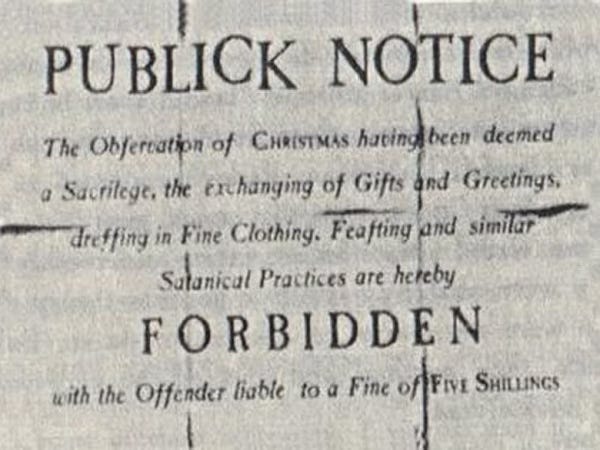
On May 11, 1659, the Massachusetts Bay Colony passed a law making it illegal to celebrate Christmas. The law imposed a fine of five shillings on anyone who observed the holiday by feasting, taking the day off from work, or engaging in other forms of celebration. To modern readers, this can sound like a strange kind of anti-holiday law, but it reflected the religious and legal culture of Puritan New England. Many Puritans rejected Christmas because they believed it had no clear biblical foundation and was associated with Catholic tradition, disorderly public behavior, and old English customs they considered improper. In their view, the law was not merely about stopping a party; it was about enforcing a disciplined religious society.
The colony’s leaders used law as a tool to shape public morality, religious practice, and daily life. This was common in early colonial legal systems, where civil authority and religious authority were often closely connected. The Christmas ban also shows how different early American ideas of “religious liberty” could be from later constitutional understandings. Rather than protecting a broad right to celebrate or worship differently, the Massachusetts Bay Colony often used law to preserve a particular religious order. The five-shilling fine was not enormous, but it was meaningful enough to signal that Christmas observance was legally disfavored.
The law remained part of a broader colonial effort to regulate conduct that officials believed threatened communal discipline. Over time, attitudes toward Christmas changed, especially as New England became more religiously diverse and less strictly Puritan. The episode stands as a reminder that American legal history includes not only the expansion of rights, but also earlier moments when law was used to suppress customs now considered ordinary.
The legal industry added 2,400 jobs in April, bringing total sector employment to about 1.24 million, according to seasonally adjusted data from the U.S. Bureau of Labor Statistics. That was a rebound from a small decline in March and placed legal employment slightly above both March and February levels. Compared with the same time last year, the sector had 20,800 more jobs. The legal sector numbers include lawyers, paralegals, and other legal-related professional roles.
The rebound follows a long stretch of legal industry growth that was interrupted by March’s dip. Two major firms recently announced job cuts: McDermott Will & Schulte is trimming a small number of associates, while Allen Overy Shearman Sterling is reducing roles in its business services team. Across the broader U.S. economy, employers added 115,000 jobs in April, while the unemployment rate stayed at 4.3%.
Legal Industry Bounces Back, Gaining 2,400 Jobs In April - Law360
Virginia’s Supreme Court struck down a Democratic-backed congressional map that had been designed to improve the party’s chances in four Republican-held U.S. House districts. The court ruled 4-3 that Democratic lawmakers failed to follow the proper process when they moved quickly to put the redistricting plan before voters. The map had been approved by voters in an April special election, but Republicans challenged the measure, arguing that the required intervening election had not properly occurred before the second legislative approval. The court’s majority agreed, emphasizing that more than 1.3 million early votes had already been cast by the time lawmakers first approved the proposed constitutional amendment.
Democrats criticized the ruling as overriding the will of voters, while Republicans celebrated it as a major win ahead of the midterm elections. Virginia Democrats said they would seek emergency review from the U.S. Supreme Court. The ruling could make it harder for Democrats to regain control of the U.S. House, where Republicans hold a very narrow majority. The dispute is part of a broader national fight over mid-cycle redistricting, with both parties seeking favorable maps before the November elections. Republican-led states in the South are pursuing their own redistricting efforts after a recent U.S. Supreme Court decision weakened a key part of the Voting Rights Act. Election analyst Kyle Kondik said the Virginia ruling improves Republican odds, though broader political conditions could still affect the outcome in November.
Virginia court tosses Democratic map, dealing major blow to party’s midterm hopes | Reuters
Instructure, the company behind the Canvas learning management platform, is facing at least seven proposed class actions after disclosing unauthorized activity in its system. Canvas is widely used by schools and universities to manage coursework, grades, assignments, and communications. Instructure first announced the incident on May 1, then later reported more unauthorized activity connected to the same breach and temporarily took Canvas offline. The company has since restored much of the platform, but its Free-for-Teacher accounts remain disabled because Instructure believes a vulnerability there may have been exploited.
The lawsuits, filed in Utah and New York federal courts, accuse Instructure of failing to adequately protect personal information belonging to students, teachers, and staff. The data allegedly at risk includes names, email addresses, student ID numbers, private messages, enrolled courses, and confidential communications with teachers. The complaints say the hacking group ShinyHunters claimed to have accessed information tied to more than 275 million users.
Plaintiffs argue Instructure should have used stronger safeguards, including better encryption, access controls, employee training, monitoring, and protocols for handling sensitive data. They also claim affected users now face loss of control over their information and a heightened risk of identity theft. One New York plaintiff also sued KKR, which acquired Instructure in 2024, and argued the breach was foreseeable in light of earlier major attacks on education software companies. Instructure has said it is investigating, communicating with affected customers, and strengthening protections around access, permissions, token management, monitoring, and related workflows.
EdTech Platform Canvas Accused Of Lax Security After Breach - Law360
The Trump administration appealed a U.S. Court of International Trade ruling that rejected its use of a 1970s trade law to impose a 10% global tariff. The court ruled 2-1 that Section 122 of the Trade Act of 1974 was not designed to address trade deficits caused by the United States importing more goods than it exports. The decision only blocked the tariffs as applied to the three plaintiffs who sued: two small businesses and the state of Washington. Even though the tariffs were temporary and set to expire in July unless Congress extended them, the ruling marked another legal setback for the administration’s broader tariff agenda.
The case followed a separate Supreme Court decision that invalidated earlier Trump tariffs imposed under the International Emergency Economic Powers Act. After that loss, the administration turned to Section 122 as a replacement authority for a 10% import tariff. President Trump criticized the trade court’s ruling, while U.S. Trade Representative Jamieson Greer said the administration expected to win on appeal. The dispute could lead to another major fight over tariff refunds, potentially involving billions of dollars. The timing is also significant because the ruling came shortly before Trump was scheduled to meet Chinese President Xi Jinping to discuss trade tensions.
The administration is separately pursuing broader tariffs under Section 301 of the Trade Act, which addresses unfair trade practices and has survived past legal challenges.
Trump administration appeals latest court loss on tariffs | Reuters


