



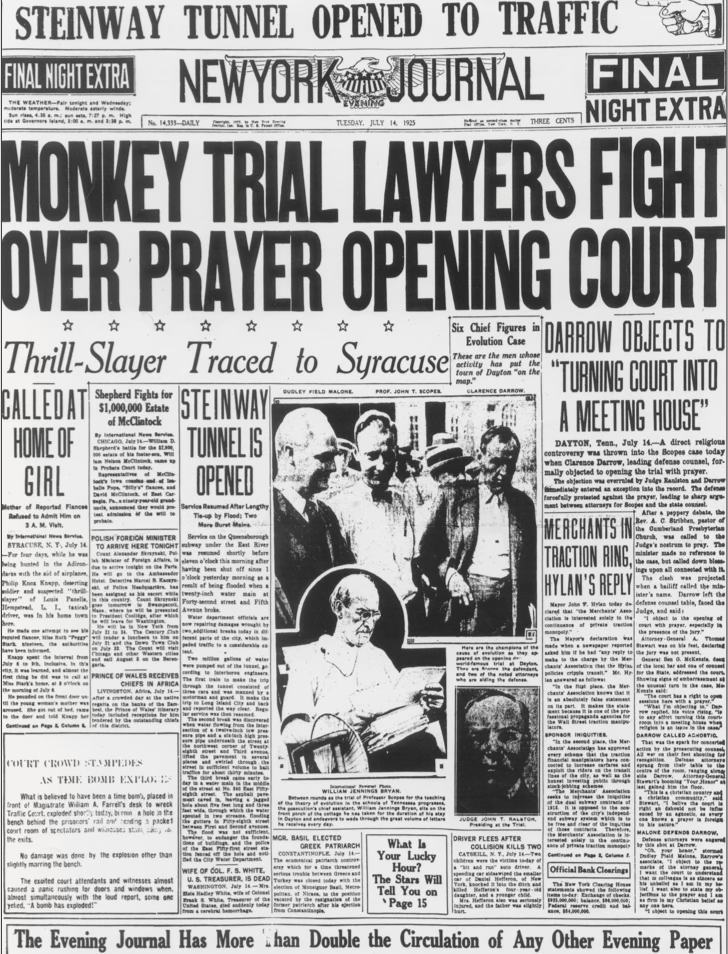
This Day in Legal History: The Scopes “Monkey Trial” Opens
On July 10, 1925, the trial of John T. Scopes opened in the sweltering courthouse of Dayton, Tennessee. Scopes, a young high school teacher, stood accused of violating the state’s Butler Act, which made it a crime to teach human evolution in public schools. The case became one of the most famous trials in American history—less because of what happened to Scopes, who was a willing test defendant recruited by the ACLU, than because of the collision it staged between two national figures and two worldviews.
On one side was William Jennings Bryan, three-time presidential candidate and champion of the anti-evolution cause, who argued for the prosecution. On the other was Clarence Darrow, the era’s most celebrated defense attorney, who took the case to defend academic freedom and the teaching of science. The trial’s most dramatic moment came when Darrow called Bryan himself to the stand as an expert on the Bible and cross-examined him mercilessly on its literal interpretation. Scopes was convicted and fined $100—a verdict later overturned on a technicality—so in the narrow legal sense, the anti-evolution side won.
But the significance of Scopes lies elsewhere. It was one of the first trials broadcast live on national radio, a spectacle that turned a local misdemeanor into a referendum on faith, science, education, and the reach of the state into the classroom. It sharpened the enduring constitutional questions—about what government may compel or forbid teachers to teach—that would return decades later in cases like Epperson v. Arkansas, which finally struck down anti-evolution laws under the First Amendment. Scopes is a reminder that some trials matter less for their judgments than for the arguments they force a country to have out loud.
The Justice Department has sued Maryland, alleging that the state’s sanctuary policies unlawfully obstruct federal immigration enforcement. The suit targets Maryland’s Community Trust Act, which limits how state and local officials may cooperate with federal immigration authorities—for example, by declining to honor routine detainer requests to hand people over. The government’s core theory is preemption: it argues that under the Supremacy Clause, states can’t erect policies that interfere with federal immigration law. Maryland and Attorney General Anthony Brown will counter that states have no obligation to affirmatively help enforce federal law—a principle known as anti-commandeering. This is the twenty-first such suit the administration has filed against sanctuary jurisdictions, part of a coordinated campaign, and it teed up the recurring constitutional question of where federal supremacy ends and a state’s right to withhold its own resources begins.
DOJ sues Maryland, alleges state policies interfere with immigration crackdown | Reuters
Proposed rule changes would require greater public disclosure when federal grand juries refuse to indict—an unusually pointed reform prompted by a string of rejected charges. Grand juries almost never decline to indict; the old line is that a prosecutor could get one to “indict a ham sandwich.” Yet over the past year, grand juries in Chicago, Los Angeles, and Washington rejected charges in politically sensitive cases, including a failed effort to indict six sitting members of Congress. In response, the federal court in Chicago adopted a rule filing a redacted version of the foreperson’s rejection form on the public docket, and D.C.’s chief judge ordered that the judiciary be notified whenever a grand jury turns the administration down. Because grand jury proceedings are ordinarily secret, “no true bill” outcomes usually vanish without a trace. The significance is transparency: these measures would let the public see how often the government tries to charge people and fails—turning the grand jury’s quiet power to say no into something visible.
Proposed rules call for DOJ disclosure when grand juries reject indictments | Reuters
The elite law firm Simpson Thacher & Bartlett is heading into a rare legal-malpractice trial in Florida next week, defending against claims seeking more than $200 million. The case comes from former Patriot National CEO Steven Mariano, who alleges the firm botched its legal work on a corporate stock transaction more than a decade ago; Simpson Thacher denies liability and argues that market forces, not its advice, caused the losses. What makes this notable is simply that it’s going to a jury at all. Malpractice claims against top-tier firms are almost always settled quietly or dismissed before trial, because both sides have strong incentives to avoid airing the details of a soured client relationship in open court. A verdict here could ripple outward—shaping how firms handle risk, how professional-liability insurers price transactional work, and how future clients frame malpractice claims against their own lawyers.
Simpson Thacher prepares for rare malpractice trial in Florida next week | Reuters
And finally, President Trump has removed the last sitting members of the U.S. Election Assistance Commission, the bipartisan federal agency that helps states administer elections. All three commissioners were pushed out at once—the two Democratic members fired by email, the Republican member asked by phone to resign—leaving the four-seat commission entirely empty. That vacancy is the whole point: with no commissioners, the EAC cannot take official action, and because replacements require Senate confirmation, the agency could be sidelined for months heading into the midterms. The EAC isn’t a powerhouse—it sets voluntary voting-system guidelines and distributes election funding—but it’s a piece of the federal election infrastructure, and emptying it entirely is unprecedented. Voter-advocacy groups and Democratic election officials called the move reckless, and it raises the same structural question running through this week’s news: how much a president may reshape or disable the machinery that oversees elections in the run-up to a vote.
Trump terminates Election Assistance Commission members | Reuters


