


This Day in Legal History: Vermont Bans Slavery
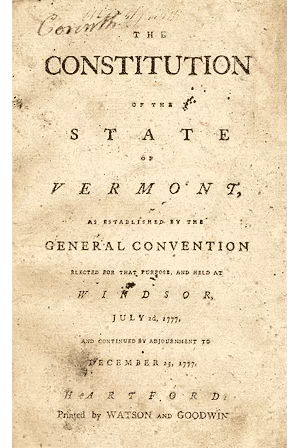
On July 8, 1777, delegates meeting in Windsor adopted the Constitution of the Vermont Republic—and in doing so, Vermont became the first place in North America to write the prohibition of slavery into its founding law. At a moment when the newly declared United States tolerated and protected human bondage, a small, unrecognized republic on the frontier put a very different principle on paper.
The relevant language was striking for its era. The Vermont constitution declared that all people are born equally free and independent, and it provided that no adult could be held as a servant, slave, or apprentice against their will—specifically, no man over twenty-one and no woman over eighteen. It was not a complete abolition; the age limits meant the document did not immediately free everyone, and enforcement in practice was uneven and incomplete for years afterward. But as a matter of constitutional text, it was the first time on this continent that a government’s foundational law declared slavery inconsistent with the very idea of being born free.
The context matters. In 1777, Vermont was not yet a state—it wouldn’t join the Union until 1791—and it existed in a kind of legal limbo, claimed by both New York and New Hampshire and recognized by neither. That outsider status may have given its drafters room to be bolder than their contemporaries. While the framers of the national government were negotiating the compromises that would embed slavery in American law for another four generations—the three-fifths clause, the fugitive slave clause, the twenty-year protection of the slave trade—Vermont’s drafters wrote the opposite conviction into their first article.
The significance of July 8, 1777 is partly symbolic and partly practical. Symbolically, it established that abolition was not some later invention imposed on a reluctant founding generation, but a principle that existed at the founding itself, chosen by people who could see the contradiction between declaring all men free and holding some in bondage. Practically, Vermont’s provision became an early data point in the long argument that would run through the Northwest Ordinance, the gradual emancipation statutes of the northern states, the abolitionist movement, the Civil War, and finally the Thirteenth Amendment. It’s a reminder that constitutional law is not just handed down from the most powerful actors—that sometimes the boldest legal principles come from the margins, from a place that wasn’t even sure it counted as a state, writing down what it believed the law ought to be.
A former Milwaukee County judge, Hannah Dugan, has been sentenced in federal court after being convicted of obstructing an immigration arrest outside her courtroom—a case that became a flashpoint in the fight over the Trump administration’s use of courthouses to stage immigration enforcement. Dugan, who is 67 and was an elected circuit court judge, was found guilty of obstructing a federal proceeding, though a jury acquitted her of a lesser concealment charge.
Federal immigration agents came to Dugan’s courthouse to arrest Eduardo Flores-Ruiz, a Mexican man who was scheduled to appear before her on misdemeanor assault charges. Prosecutors said Dugan directed him out through a non-public “jury door” in an effort to help him avoid the agents waiting in the public hallway. It didn’t work—Flores-Ruiz walked through a public hallway with his attorney anyway, and agents arrested him outside after a brief foot chase. But the government charged Dugan criminally for what she did inside the courthouse, and a federal jury convicted her in December.
Think about the competing principles colliding here. On one side is the idea that no one, not even a judge, gets to physically obstruct federal law enforcement carrying out its duties. On the other is a real institutional worry that animated a lot of the coverage: if immigration agents stake out courthouses, people with pending cases—victims, witnesses, defendants—may stop showing up at all, which grinds the ordinary work of the state courts to a halt. Dugan’s defenders framed her actions as protecting the functioning of her courtroom; prosecutors framed them as obstruction of a federal operation. The jury sided with the government on the core charge.
At sentencing, the two sides were far apart. Federal prosecutors declined to recommend a specific term but argued the guidelines called for fifteen to twenty-one months in prison. Dugan’s lawyers disputed that calculation and asked U.S. District Judge Lynn Adelman for time served—no prison at all. The significance of the case goes well beyond one judge. It’s a marker of how aggressively the administration is willing to pursue anyone perceived to interfere with immigration enforcement, up to and including a sitting judge, and it sends a message to state and local officials everywhere about the personal legal risk of getting between federal agents and their targets.
Ex-Wisconsin judge to be sentenced for obstructing immigration arrest | Reuters
Bayer is moving to bring an end to the sprawling federal litigation over its Roundup weedkiller, following a significant win at the Supreme Court. Late last month, the Court ruled 7-2 in Bayer’s favor, and the company is now trying to convert that decision into the dismissal of the failure-to-warn claims that have driven nearly a decade of lawsuits.
Thousands of plaintiffs have sued Bayer alleging that Roundup, and specifically its active ingredient glyphosate, caused their non-Hodgkin lymphoma, and that the company violated state law by failing to warn them of that cancer risk. Bayer’s winning argument was about federal preemption—the principle that when federal and state law conflict, federal law wins. Bayer argued that because the Environmental Protection Agency has concluded glyphosate poses no cancer risk and requires no cancer warning on the label, plaintiffs can’t use state failure-to-warn law to demand a warning the federal regulator affirmatively says isn’t needed. The Supreme Court agreed, overturning a $1.25 million Missouri verdict in the process.
Consider why this is such a powerful tool for Bayer. A failure-to-warn claim says, in essence, “you should have told me this was dangerous.” But if the federal agency in charge has studied the product and decided no warning is warranted, then a state jury ordering the company to warn anyway would effectively be overriding the federal regulator. Preemption resolves that conflict in favor of the federal standard. The practical effect is that the single most common theory in the Roundup litigation—failure to warn—is now largely off the table in the cases this ruling reaches.
The significance is real but, importantly, not total. This should let Bayer dismiss current warning-based claims and block future ones, which is exactly why the company is now pressing courts to wind down the federal litigation, and it’s pairing that push with a proposed $7.25 billion class-action settlement to sweep in remaining Roundup users. But the decision doesn’t make every claim disappear. Plaintiffs may still pursue theories that don’t depend on a failure to warn—like defective design—and the settlement obligations remain. So this is a milestone in Bayer’s long campaign to contain its liability, not the final word. It’s also a notable example of how federal regulatory findings can become a shield against state tort law, a doctrine with implications well beyond weedkiller.
Bayer seeks end to federal Roundup litigation after Supreme Court win | Reuters
Federal judges are sounding skeptical of a California law that bans employers from forcing workers to attend so-called “captive audience” meetings—mandatory gatherings where a company shares its views on political or religious matters, most often its opposition to unionizing. The law has already been blocked by a district court, and the signs from the bench suggest that skepticism may carry through on appeal.
Here’s what a captive audience meeting is and why it’s contested. When a union organizing drive is underway, employers have long held mandatory meetings where attendance is required and workers listen to management make the case against unionizing. Unions call these coercive; employers call them protected speech. California’s SB 399 tried to ban compelling attendance at meetings covering “political matters,” a category defined broadly enough to include unionization. Judge Daniel Calabretta of the Eastern District of California blocked the law, and his reasoning is the crux of the whole fight.
He gave two independent grounds, and it’s worth separating them. The first is federal preemption—the same principle at work in the Bayer story. Calabretta found that the National Labor Relations Act, which governs labor relations nationwide, occupies this field and preempts California’s attempt to regulate it under the Machinists and Garmon preemption doctrines. The second ground is the First Amendment: he held that the law was a content-based restriction on employer speech, singling out “political” and “religious” topics, and that it couldn’t survive strict scrutiny—the most demanding test in constitutional law, which almost nothing passes. In his view, banning all speech on those topics in mandatory meetings swept far too broadly.
The significance here is that this is a collision between the labor movement’s priorities and employers’ free-speech claims, and right now the free-speech and preemption arguments are winning in court. A number of states have passed captive-audience bans, so how the Ninth Circuit ultimately rules—California and Attorney General Rob Bonta are expected to appeal—will shape whether this entire category of worker-protection law survives. It’s a reminder that even popular labor legislation has to run a gauntlet of federal preemption and the First Amendment, and that employer speech, including anti-union speech, gets substantial constitutional protection.
US judges leery of California ban on workplace captive-audience meetings | Reuters


