


This Day in Legal History: Civil Rights Act of 1964
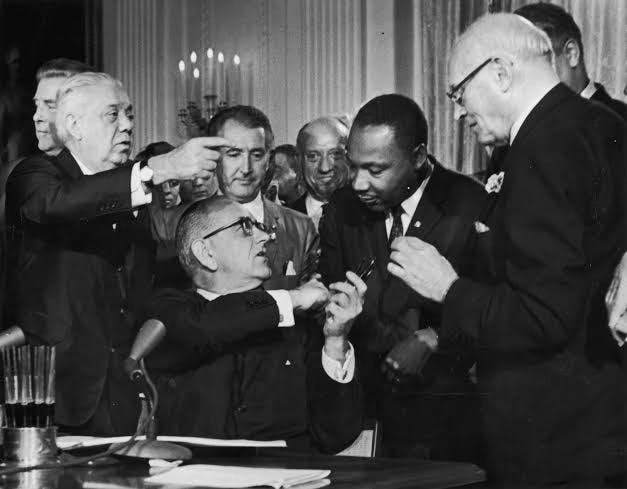
On July 2, 1964, President Lyndon B. Johnson signed the Civil Rights Act of 1964 into law. It was one of the most important pieces of legislation in American history, and it fundamentally transformed the legal landscape by banning discrimination based on race, color, religion, sex, or national origin in public accommodations, employment, education, and programs receiving federal funding.
The Civil Rights Act was the product of the Civil Rights Movement—years of courageous activism by Black Americans and their allies who marched, protested, and demanded that the law recognize their equal humanity and their constitutional rights. The movement included iconic figures like Martin Luther King Jr., Rosa Parks, John Lewis, and countless others whose names we’ll never know but whose courage changed America.
The Act made it illegal for hotels, restaurants, theaters, and other public places to refuse service based on race. It made employment discrimination illegal. It empowered the federal government to withhold funding from schools and institutions that discriminated. It created the Equal Employment Opportunity Commission to investigate and remedy workplace discrimination.
Before the Civil Rights Act, the law itself endorsed discrimination. Southern states had explicit “Jim Crow” laws that required racial segregation. “Whites only” signs hung on businesses, schools, water fountains, and bathrooms. The law said Black Americans couldn’t use the same facilities as white Americans. The Civil Rights Act said that’s unconstitutional and illegal. It didn’t end racism—racism persisted and persists today—but it transformed the law from a tool of discrimination into a tool of protection. The Act represented a moral and legal turning point. It affirmed that the Constitution’s promise of equal protection applies to everyone, regardless of race. It showed that the law can change when people demand justice. It demonstrated that the Civil Rights Movement’s sacrifice—the beatings, the arrests, the deaths, the long struggle—could actually transform American law and create a more just society.
The Civil Rights Act remains one of the most important achievements in American legal history. Every civil rights protection we have today—protection against employment discrimination, housing discrimination, educational discrimination—traces back to that law signed on July 2, 1964. It’s a reminder that legal change comes from struggle, from people willing to demand their rights, and from a government finally willing to recognize the dignity and equality of all its citizens.
The Supreme Court’s use of its “shadow docket”—an informal process for issuing emergency decisions with minimal explanation—has expanded dramatically, and the justices are sharply divided over whether this is appropriate.
The Supreme Court has a formal process for cases: parties file briefs, the Court hears oral arguments, justices deliberate, and then the Court issues a written opinion explaining its reasoning. This is the public docket. But the Supreme Court also has an emergency process called the “shadow docket” for last-minute requests for emergency relief. For example, if someone is about to be executed and files an emergency request for a stay, the Court needs to decide quickly. Traditionally, the shadow docket was used only for these genuine emergencies. But in recent years, particularly under the current Supreme Court, the shadow docket has been used for major constitutional decisions. The Court will issue orders on the shadow docket with little or no explanation, effectively deciding important cases without full briefing, oral arguments, or written opinions.
Imagine if a school made major policy changes through emergency procedures meant only for fire drills, without explaining the policy or letting people comment on it. That’s what’s happening with the Supreme Court’s shadow docket. Conservative justices defend the practice, saying the Court needs flexibility to respond to emerging issues. Liberal justices are furious, arguing that major constitutional decisions require full briefing and transparent reasoning. They point out that decisions on the shadow docket often don’t explain the Court’s reasoning, making it impossible for lower courts to apply the law or for Americans to understand their constitutional rights. The shadow docket has been used for decisions affecting voting rights, abortion, immigration, and religious freedom—major constitutional questions that deserve full public deliberation.
The shadow docket allows the Supreme Court to reshape constitutional law without public explanation or accountability. It enables the conservative majority to implement a constitutional agenda without transparent reasoning. It divides even the justices—a sign that this practice is controversial even at the highest level. The shadow docket represents a concerning shift toward less transparent, less democratic judicial decision-making on matters of profound constitutional importance.
US Supreme Court supercharges its ‘shadow docket,’ dividing the justices | Reuters
The Minnesota Attorney General has shut down its unit dedicated to reviewing and overturning wrongful convictions, citing budget constraints. The decision has shocked criminal justice advocates who view wrongful conviction review as a core function of government. Here’s the context: Innocent people sometimes go to prison. Witnesses misidentify them. Evidence is planted or fabricated. Police coerce false confessions. Lawyers provide inadequate representation. DNA evidence may later prove innocence. Many states have created units—often within the Attorney General’s office—dedicated to reviewing cases where there’s evidence of wrongful conviction and seeking to overturn convictions when appropriate. These units have freed hundreds of innocent people from prison. In Minnesota, this unit reviewed cases, worked with innocence organizations, and petitioned courts to overturn convictions when evidence showed innocence. Now that unit is being shut down.
If you discovered you had been wrongly convicted and imprisoned for a crime you didn’t commit, you would want the government to help free you. You would want the justice system to correct its own mistakes. Wrongful conviction units exist to do exactly that—to correct serious errors in the criminal justice system. When the government shuts down its wrongful conviction unit, it’s saying it will no longer systematically look for innocent people who have been wrongly imprisoned. Think of the human cost. People serving decades in prison for crimes they didn’t commit may never have their convictions reviewed. Their appeals for help will go unanswered. The government agency that should be most interested in justice—the Attorney General—has decided it can’t afford to help innocent prisoners.
This decision signals a deprioritization of wrongful convictions and prisoner justice. It means innocent people will remain in prison because the state won’t investigate their claims. It undermines public faith in the criminal justice system. It suggests that budget concerns are more important than freeing innocent people. Criminal justice advocates worry this is part of a broader pattern: reduced funding for public defenders, reduced funding for innocence organizations, and now elimination of the state’s own wrongful conviction review unit. The decision raises a fundamental question: Do we actually care about justice, or do we only care about convictions?
A federal judge has blocked the U.S. Postal Service from implementing restrictions that would have made mail-in voting more difficult. The ruling is a significant victory for voting rights advocates.
The Postal Service proposed new restrictions on how mail-in ballots could be delivered. These restrictions would have required mail-in voters to meet stricter deadlines, reduced ballot processing times, and imposed other requirements that voting rights groups argued would disenfranchise voters, particularly voters in rural areas and voters with disabilities who rely on mail-in voting. Voting rights advocates sued, arguing that the restrictions would violate the right to vote. The federal judge agreed and blocked the restrictions.
The right to vote is fundamental to democracy. Mail-in voting is a way many Americans exercise that right—people who are elderly, disabled, working on election day, or living in areas far from polling places depend on mail-in voting. When the government imposes restrictions that make mail-in voting harder, it’s making it harder for people to vote. The Postal Service argued it needed to implement restrictions for operational reasons. The judge said operational concerns can’t be used to interfere with voting rights. If the Postal Service needs to adjust its operations, it has to do so in ways that don’t undermine the right to vote.
This decision protects mail-in voting access at a time when voting rights are under increasing attack. It affirms that the right to vote can’t be sacrificed for bureaucratic convenience. It signals that courts will step in if government agencies try to restrict voting access. As more Americans rely on mail-in voting, protecting mail-in voting access is essential to protecting voting rights. The decision reflects a judicial recognition that voting is a fundamental right and that restrictions on voting deserve strict scrutiny, not deference to government agencies.
Judge blocks US Postal Service’s proposed restrictions on mail-in voting | Reuters


