



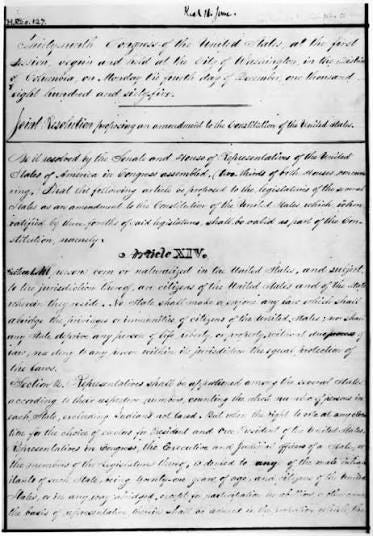
This Day in Legal History: The Fourteenth Amendment Is Ratified
On July 9, 1868, South Carolina and Louisiana became the final two states needed to push the Fourteenth Amendment over the three-quarters threshold, and with their votes the amendment was ratified into the Constitution. It is, by almost any measure, the most consequential of the Reconstruction amendments and arguably the most important addition to the Constitution since the Bill of Rights.
The amendment was written to answer the central question left open by the Civil War and the abolition of slavery: what did freedom actually mean, and who was entitled to it? Its first section does an enormous amount of work in a single sentence. It establishes birthright citizenship—declaring that all persons born or naturalized in the United States, and subject to its jurisdiction, are citizens of both the nation and their state. It then forbids any state from abridging the privileges or immunities of citizens, from depriving any person of life, liberty, or property without due process of law, and from denying any person the equal protection of the laws. Those three clauses—privileges or immunities, due process, and equal protection—became the constitutional text on which vast stretches of modern American law are built.
The historical purpose was direct. The framers of the amendment, led in the House by John Bingham, wanted to overrule Dred Scott, which had held that Black Americans could not be citizens, and to constitutionalize the civil rights protections Congress had already tried to enact by statute—putting them beyond the reach of any future hostile Congress or Southern legislature. They understood that emancipation without citizenship and equal protection would be a hollow victory, and they wrote a guarantee that applied against the states, not just the federal government.
The significance of July 9, 1868 is hard to overstate, because so much of what we argue about today runs directly through this text. The Equal Protection Clause is the basis of Brown v. Board of Education and school desegregation, of Loving v. Virginia striking down bans on interracial marriage, and of Obergefell recognizing marriage equality. The Due Process Clause became the vehicle for incorporating most of the Bill of Rights against the states, so that free speech, free exercise, and protections for the criminally accused bind state governments too. And the Citizenship Clause is the reason that birthright citizenship is a constitutional guarantee rather than a policy preference—as the Supreme Court reaffirmed just this past term. When you hear debates about who counts as a citizen, what process the government owes a person before it takes something from them, or whether a law treats people equally, you are hearing an argument about the amendment ratified on this date.
A federal judge in Florida has ordered the Department of Homeland Security to keep giving four Republican-led states—Florida, Iowa, Indiana, and Ohio—access to a federal database those states use to check whether registered voters are citizens. The order, from U.S. District Judge T. Kent Wetherell II in Pensacola, lets the states continue using the system while the underlying legal fight plays out.
The database is called SAVE—Systematic Alien Verification for Entitlements—a federal system historically used to verify immigration status for benefits. After a revamp last year, it became far more powerful for election purposes: users could search many records at once, and it exposed individuals’ Social Security numbers. Several Republican-led states began comparing their voter rolls against SAVE and canceling the registrations of people the database flagged as noncitizens. The problem is what happens when the database is wrong or out of date—people who are in fact citizens can get flagged and purged.
That risk is exactly why this ruling sits in tension with another one. Just weeks earlier, on June 22, a different federal judge in Washington, D.C., restricted broader use of the database, warning that relying on it could result in eligible voters being wrongly stripped from the rolls. So you now have two federal courts pointing in different directions—one worried about wrongful purges and limiting the database’s use, and one ordering DHS to keep the spigot open for these four states. When trial courts split like this, the disagreement typically has to be resolved higher up, and it means the rules can differ depending on which state and which courtroom you’re standing in.
The significance is that this is a live fight over the machinery of voter-roll maintenance heading into a midterm election year. There’s a genuine and legitimate interest in keeping noncitizens off the voter rolls—but there’s an equally real risk that a blunt, error-prone matching process disenfranchises actual citizens who then have to fight to get back on. This ruling tilts toward giving states the verification tool; the D.C. ruling tilts toward protecting against wrongful removals. Watch the appellate courts, because the boundary between list maintenance and unlawful voter purging is about to get drawn more sharply.
US judge orders four states be given access to citizenship data for voter checks | Reuters
In a closely related development, the Justice Department has sent letters to all fifty states warning that state and local election officials could face criminal prosecution if they allow noncitizens to remain on their voter rolls. The letters, from Harmeet Dhillon, who leads the Department’s Civil Rights Division, give officials just five days to respond with a plan to comply.
The federal government does have statutes on the books aimed at protecting the integrity of elections and barring noncitizens from voting, and the letters invoke several of them. But the ordinary way these laws work is that you prosecute a person who actually votes illegally, or who knowingly facilitates fraud. What’s unusual here is the target: the letters put state and local election administrators—the people who maintain the rolls—on notice that they personally could be charged. That reframes routine election administration as potential criminal exposure for the officials doing it.
Think about the position this puts an election official in. Maintaining accurate voter rolls is genuinely hard—people move, die, naturalize, and occasionally register in error—and every state already has processes for it. Now imagine being told by the U.S. Department of Justice that if the federal government later decides your rolls were inadequate, you could be a criminal defendant, and you have five days to send in a compliance plan. Even if few or no prosecutions ever materialize, the threat itself is designed to change behavior—to push officials toward more aggressive purging out of fear of personal liability. Critics call that coercion; the Department frames it as enforcement.
The significance is about federal pressure on the decentralized American election system. Elections in this country are run by states and localities, deliberately, so that no single national authority controls the vote. Democratic officials in states like Michigan pushed back hard, noting they’ve already taken extensive steps to ensure only eligible voters can vote. The letters, arriving alongside the SAVE database fight, are part of a coordinated push ahead of the midterms, and they raise a serious question about the line between legitimate federal enforcement of election laws and using the threat of prosecution to lean on the officials who administer them.
And in a very different kind of case, a former Olympic canoe racer, David Hearn, pleaded not guilty in D.C. Superior Court to a felony charge of deliberately damaging the recently renovated Lincoln Memorial Reflecting Pool. Hearn, who is 67 and competed in three Summer Olympics, entered his plea through an attorney at his first court appearance, and his lawyers have described the prosecution as an abuse of power built on what they call a “concocted narrative.”
The Reflecting Pool sits on the National Mall between the Lincoln Memorial and the Washington Monument and had just undergone a roughly $16 million renovation. Hearn has said he was stopped by National Guard troops and U.S. Park Police and detained for about five hours after pausing at the pool during a 64-mile bike ride in June. He was later indicted on a single felony count of property destruction. The top federal prosecutor for D.C., U.S. Attorney Jeanine Pirro, said six other people were arrested on misdemeanor charges connected to damage at the same site.
The legal question worth watching is the gap between the charge and the conduct. Property-destruction law generally requires proof that the defendant intentionally caused the damage, and a felony charge usually turns on the dollar value of that damage. Hearn’s defense is essentially that the government has manufactured intent and seriousness out of an innocent encounter—that a man pausing on a bike ride has been turned into a felony defendant. The judge apparently agreed there was little flight or danger risk: Hearn was released without court supervision pending an August 5 status hearing, which tells you something about how the court currently views the threat he poses.
The significance here is less about one damaged pool and more about the exercise of prosecutorial discretion. Deciding whom to charge, and whether to charge a felony versus a misdemeanor versus nothing at all, is one of the most powerful and least reviewable choices in the legal system. When critics call a prosecution politically motivated or an abuse of power, they’re pointing at that discretion. Whether this case is a legitimate property-crime prosecution (it isn’t) or an overreach (it is) is exactly what the coming proceedings will test—and it’s a useful reminder that the same charging power that holds genuine wrongdoers accountable can also be aimed in ways that raise real fairness concerns.
Former US Olympian pleads not guilty in Reflecting Pool vandalism case | Reuters


