



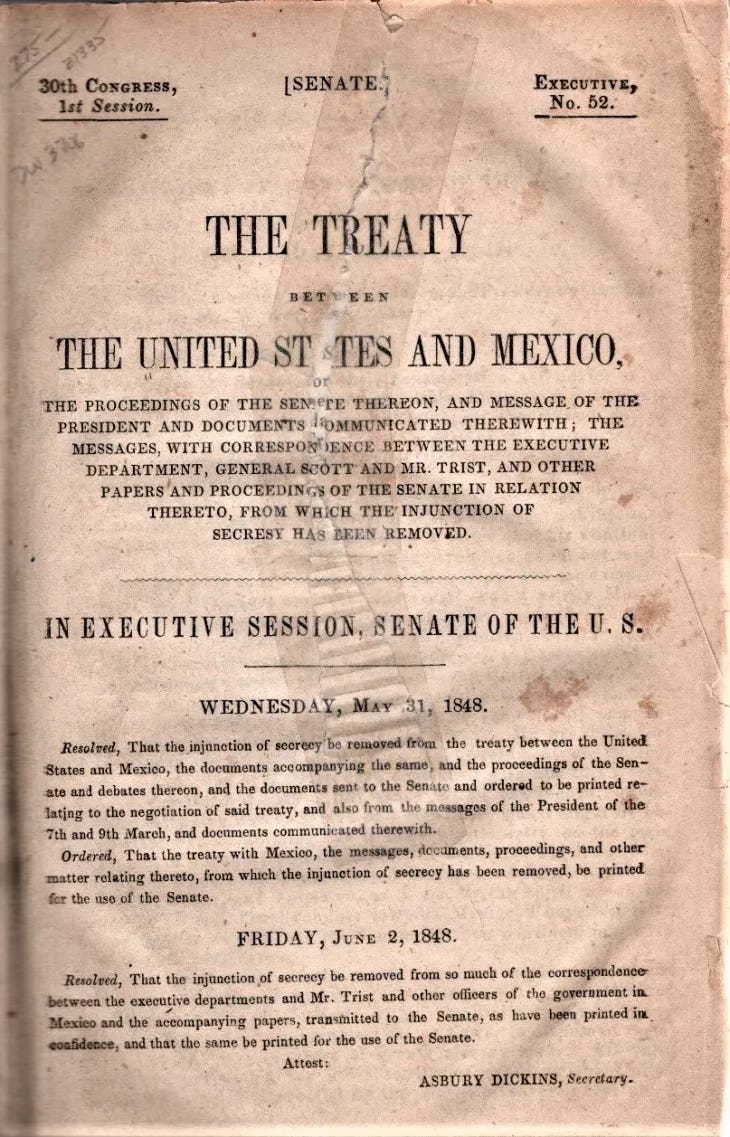
This Day in Legal History: Treaty of Guadalupe Hidalgo
On February 2, 1848, the Treaty of Guadalupe Hidalgo was signed, officially ending the Mexican-American War and significantly altering the legal and territorial landscape of the United States. The treaty ceded vast swaths of land to the U.S., including present-day California, Arizona, New Mexico, and parts of several other western states—about half of Mexico’s territory at the time. In exchange, the U.S. paid Mexico $15 million and assumed $3.25 million in claims by American citizens against Mexico. Legally, the treaty promised to protect the property rights and civil liberties of Mexican nationals living in the newly acquired territories, but these promises were inconsistently honored in practice.
The treaty’s ratification triggered significant legal and constitutional debates about the extension of slavery into new territories, setting the stage for the intensifying sectional conflicts that led to the Civil War. It also marked the beginning of long-standing disputes over land grants and water rights that would shape western property law. Moreover, the treaty’s vague wording left many issues—such as tribal sovereignty and citizenship—unresolved, leading to future litigation and policy struggles.
The treaty was signed in the town of Guadalupe Hidalgo, near Mexico City, and ratified by the U.S. Senate in March 1848. It remains a foundational document in U.S. legal history, frequently cited in discussions of land rights, citizenship, and the limits of treaty enforcement.
Our first story today is a bit off topic.
In today’s digital world, every click, swipe, and login happens under a legal regime you didn’t negotiate—Terms of Service, Privacy Policies, and community guidelines that quietly shape your rights and obligations online. These documents form a system of private lawmaking, where companies act as legislators, drafting rules users must follow, often with little recourse or transparency. You don’t sign them, but courts often treat them as binding contracts. Clauses about arbitration, content ownership, surveillance, and data sharing carry real legal weight. Yet these terms can change overnight, unilaterally, and without notice.
TOSTracker was created to bring transparency to this ecosystem. It’s a non-commercial research tool that tracks and archives the evolution of digital contracts over time. With over 150 companies and nearly 250 historical versions of key documents thus far, TOSTracker offers timestamped, hash-verified, and citable records of how these texts change. It provides full version histories, detects redlines at the word and section level, and supports programmatic access through an API. Whether you’re studying arbitration creep, GDPR compliance, or how moderation rules evolve, TOSTracker gives you the empirical backbone to do it.
All content is normalized and archived via the Internet Archive’s Wayback Machine, with cryptographic hashes ensuring document integrity. Importantly, it doesn’t interpret the law—it captures the text and structure so you can. For legal researchers, privacy advocates, and anyone concerned with digital governance, this is a window into how private law is made, revised, and enforced online. It’s not a product; it’s a dataset, an archive, and a call to look more closely at the legal architecture of everyday tech.
We’re also actively seeking contributors to help expand the archive. If you come across a consumer-facing legal document—like a Terms of Service, Privacy Policy, community guidelines, or EULA—that isn’t already tracked, you can submit it directly through the site. This includes documents behind logins, from smaller platforms, or covering underrepresented industries and regions. Submissions help close coverage gaps, diversify the dataset, and improve the foundation for legal research into how digital rights are defined and redefined over time. Your input directly supports transparency in an area where the law is often invisible.
Check it out at tostracker.app if your research overlaps with digital contracts, user rights, or the evolving boundary between public law and platform governance.
The U.S. Federal Trade Commission (FTC) has sent warning letters to 42 major law firms over concerns that their diversity, equity, and inclusion (DEI) hiring practices may be anticompetitive. The FTC emphasized that firm-wide agreements to meet diversity benchmarks—particularly those tied to programs like Diversity Lab’s certification—could unlawfully restrict competition in the legal labor market by influencing hiring, compensation, or promotions. These letters arrive amid a broader rollback of DEI initiatives under President Donald Trump’s administration, which has eliminated related programs in government and targeted private sector efforts.
Firms such as Paul Weiss, WilmerHale, Perkins Coie, Skadden Arps, and Latham & Watkins—some of which had previously been challenged by Trump-era executive orders—are among those named. Some reached compromises with the White House, offering pro bono legal work in exchange for eased scrutiny, while others fought and won legal challenges against the orders. The FTC’s scrutiny centers on participation in Diversity Lab’s voluntary DEI certification, which encourages firms to ensure at least 30% of leadership candidates are from underrepresented groups. Though previously upheld in court as non-discriminatory, the FTC now frames such collective DEI practices as potentially violating competition law.
US Federal Trade Commission warns law firms about DEI hiring | Reuters
Immigrant rights groups filed a federal lawsuit in Boston challenging a new U.S. Immigration and Customs Enforcement (ICE) policy that allows agents to enter homes without judicial warrants. The suit, brought by the Greater Boston Latino Network and the Brazilian Worker Center, targets a May 2025 memo—recently revealed via a whistleblower complaint—that permits ICE officers to use administrative warrants instead of warrants signed by a federal judge. These administrative forms, issued internally by the Department of Homeland Security, were previously insufficient for home entries under longstanding practice.
The plaintiffs argue that using such warrants for home arrests violates the Fourth Amendment, which guards against unreasonable searches and seizures. Legal advocates claim the policy removes a crucial constitutional safeguard just as ICE ramps up enforcement tactics in states like Minnesota, where multiple recent actions have already been deemed unlawful by judges. The lawsuit comes after fatal incidents in Minneapolis during anti-ICE protests, intensifying scrutiny of federal immigration operations.
ICE officials defend the policy, asserting that individuals subject to removal have already received due process. However, the lawsuit challenges that rationale, pointing out that due process does not override constitutional protections against warrantless home intrusions.
Lawsuit challenges ICE ability to enter homes without warrants from US judges | Reuters
Former CNN anchor Don Lemon is facing federal charges over his role in covering a protest at a Minnesota church opposing President Trump’s immigration crackdown. The protest, which disrupted a church service in St. Paul on January 18, was livestreamed by Lemon and targeted the church because one pastor was allegedly also an ICE official. Lemon was arrested by the FBI, spent a night in custody, and appeared in court where he confirmed he plans to plead not guilty. He and six others, including independent journalist Georgia Fort, were indicted under laws prohibiting obstruction of access to houses of worship—a legal framework typically used against abortion clinic protests.
Free press advocates and constitutional lawyers are raising concerns about the charges, framing them as part of a broader pattern of the Trump administration targeting critics, including journalists. Lemon’s attorneys argue this is a political prosecution meant to suppress press freedom and distract from ongoing crises. In the archived livestream, Lemon is seen documenting the protest rather than leading it, further fueling First Amendment concerns. The DOJ’s case hinges on a controversial interpretation of laws rarely, if ever, used to prosecute journalists for protest coverage after the fact. Legal experts say there is no clear precedent for the charges, and press freedom groups are warning of escalating threats to constitutional protections.
Ex-CNN journalist Don Lemon faces Minnesota protest charges | Reuters


