


This Day in Legal History: Dyer Anti-Lynching Bill
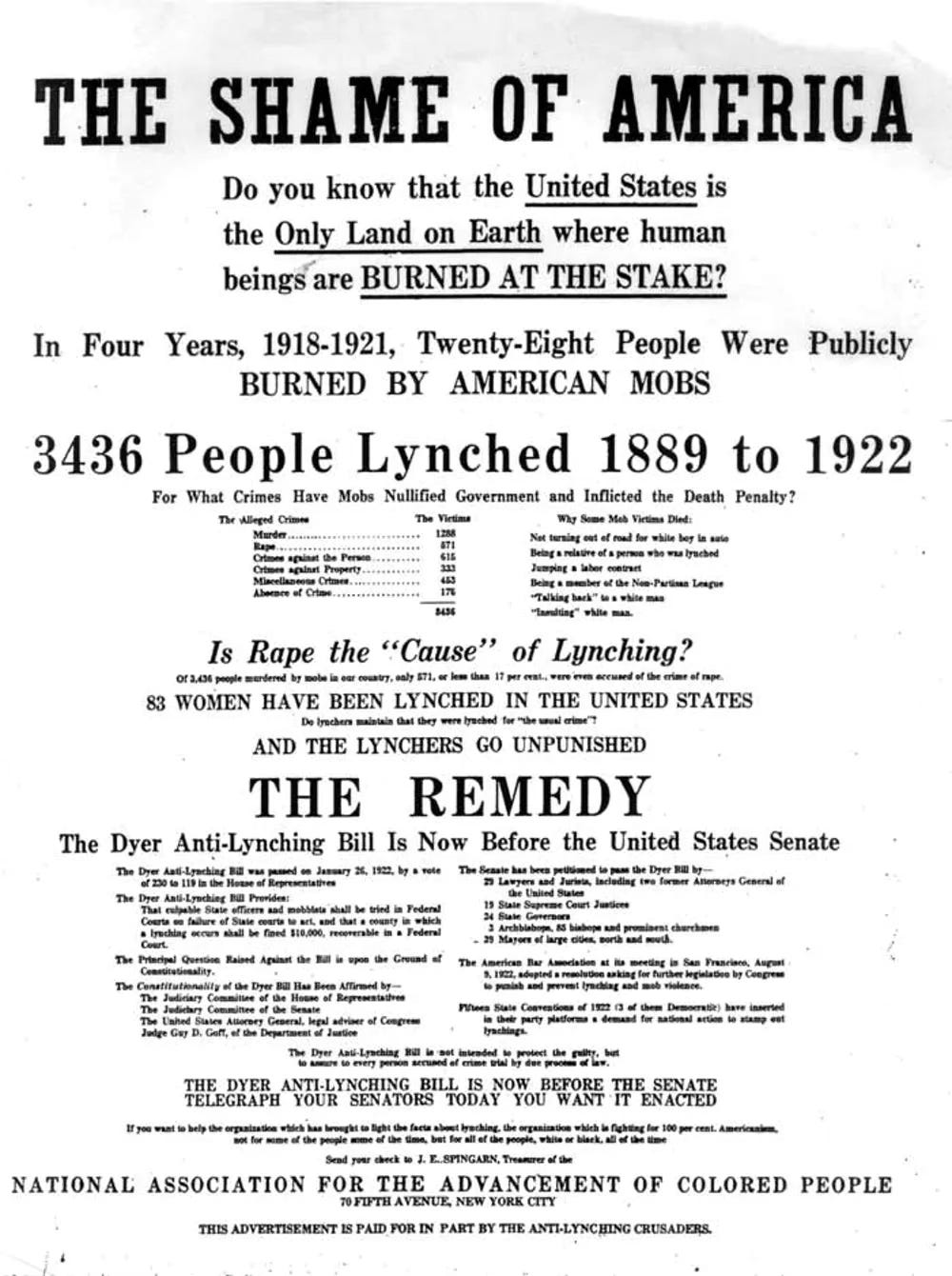
On January 26, 1922, the U.S. House of Representatives passed the Dyer Anti-Lynching Bill, a landmark but ultimately thwarted attempt to make lynching a federal crime. Introduced by Missouri Republican Congressman Leonidas C. Dyer, the bill was drafted in response to the widespread and brutal practice of lynching—acts of racial terror largely aimed at Black Americans, often carried out with impunity. The measure sought to impose fines and prison terms on local officials who failed to protect individuals from mob violence, directly challenging the systemic neglect of justice in the Jim Crow South.
Though the House approved the bill by a wide margin, it met a coordinated and racist blockade in the Senate, where Southern Democrats employed the filibuster to prevent a vote. The bill’s failure underscored both the power of white supremacist interests in Congress and the federal government’s unwillingness to confront racial violence. It would take a full century—100 years—for the U.S. to finally enact a federal anti-lynching law.
That moment came in March 2022, when the Emmett Till Antilynching Act was signed into law, making lynching a federal hate crime. The staggering gap between the Dyer Bill’s passage in the House and the eventual success of anti-lynching legislation—exactly 100 years and two months later—is a sobering reminder of how recent, and how halting, legal progress on racial justice has been. From a historical perspective, 1922 is not ancient history; many living Americans had parents or grandparents who witnessed the Dyer Bill’s failure.
The Dyer Bill remains a powerful example of how legal change, even when urgent and necessary, can be obstructed for generations. It also reveals how the law, far from being a neutral instrument, often bends to the political will of those in power. The slow arc toward justice in this case wasn’t just theoretical—it was measured in innocent lives lost and justice denied.
The murder of Minnesota nurse Alex Pretti by ICE agents has sent shockwaves through Congress and thrown federal budget negotiations into chaos just days before a January 30 funding deadline. What had been a carefully arranged plan to pass remaining appropriations bills now faces collapse, raising the real possibility of a partial government shutdown. Senate Democrats, already uneasy about funding the Department of Homeland Security, have hardened their opposition in response to the killing and are demanding investigations and new limits on ICE. Several Democrats who previously helped avert a shutdown now say they will not support any bill that includes ICE funding under these circumstances.
Even lawmakers known for deal‑making, including Sen. Patty Murray, have withdrawn support, arguing that federal agents cannot commit murder without accountability. Republicans warn that blocking DHS funding risks undermining national security, but cracks are appearing within their ranks as well. Sen. Bill Cassidy called the killing “disturbing” and urged a joint federal‑state investigation, a rare public break with the administration. Meanwhile, logistical hurdles—including winter storms and congressional recesses—are shrinking the window for compromise. With both parties dug in and tensions escalating nationwide, the shutdown threat has grown sharper by the day.
Minnesota Shooting Inflames Tensions in Congress, Risks Shutdown
Meta, TikTok, and YouTube are set to face trial this week in Los Angeles County over claims that their platforms contributed to a youth mental health crisis by fostering social media addiction. The case centers on a 19-year-old plaintiff, K.G.M., who alleges she became addicted to the apps at a young age, leading to depression and suicidal thoughts. It marks the first time these major tech companies will have to defend their platforms in court, rather than in congressional hearings. The jury will be asked to determine whether the companies were negligent and whether their products were a substantial factor in harming K.G.M.’s mental health.
This trial is seen as a bellwether for dozens of similar cases expected to follow. Meta CEO Mark Zuckerberg and Snap CEO Evan Spiegel were both expected to testify, though Snap recently settled with the plaintiff. YouTube plans to argue that its platform is fundamentally different from other social media services, distancing itself from TikTok and Instagram. Meanwhile, these companies have been aggressively promoting parental control features and safety programs in schools and youth organizations to shift public perception.
Despite these efforts, critics argue the tech giants are leveraging their influence—legal, financial, and cultural—to avoid accountability. Attorneys representing the companies have experience in other high-profile addiction-related litigation, including the opioid crisis and video game cases. As the trial unfolds, the question of corporate responsibility for digital harm to minors will be tested in court for the first time.
Meta, TikTok, YouTube to stand trial on youth addiction claims | Reuters
The Supreme Court appears unlikely to grant President Trump’s request to immediately remove Federal Reserve Governor Lisa Cook but also seems disinclined to issue a sweeping ruling on the broader constitutional or statutory questions at play. Legal analysts suggest the justices are leaning toward a narrow, procedural decision—one that would preserve a lower court’s injunction against Cook’s removal while sending the case back to trial court for further fact-finding. This approach would allow the Court to sidestep defining what constitutes “cause” for firing a Fed governor or how far presidential removal powers extend, particularly in relation to the Federal Reserve’s legal independence.
The justices expressed concern about the rushed pace of the case and the thin evidentiary record, with Justice Alito questioning whether key documents were even part of the case file. Trump argues that Cook committed mortgage fraud, but Cook and her legal team contend the firing attempt is a pretext for punishing her resistance to his demands for aggressive rate cuts. Several justices highlighted the potential economic fallout of removing a Fed official, with economists warning of recession risks if the court acts hastily.
This case underscores that the Court is never obligated to resolve constitutional issues in broad strokes—it may always choose a minimalist path that focuses on the facts before it. Legal scholars note that even if the Court rules for Cook, it could do so narrowly by emphasizing procedural due process rather than affirming a general principle of Fed independence. The outcome is expected by June but may arrive sooner.
Supreme Court may leave big questions unresolved on Trump bid to fire Fed’s Lisa Cook | Reuters


