


This Day in Legal History: First Speed Limit Law
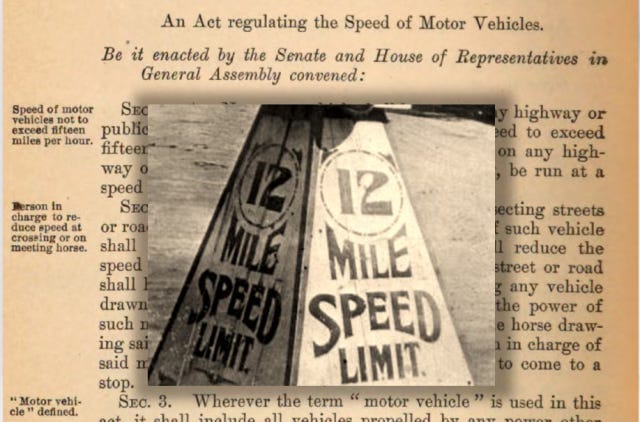
On May 21, 1901, Connecticut became the first U.S. state to pass a law regulating the speed of motor vehicles. The law set a speed limit of 12 miles per hour in cities and 15 miles per hour on country roads. That may sound almost comically slow now, but at the beginning of the twentieth century, the automobile was still a new and disruptive technology. Roads were shared by pedestrians, horses, carriages, bicycles, and early automobiles, often without clear rules about who had priority or how fast anyone could travel. Connecticut’s law reflected a growing legal problem: the common law of negligence could punish dangerous driving after an accident, but legislatures increasingly saw the need to prevent danger before it happened. Speed limits were one of the earliest ways states tried to turn automobile use from a private novelty into a regulated public activity. The law also showed how technological change often forces legal systems to create new categories of public safety regulation.
Before automobiles, road law had developed around animals, wagons, and local travel; cars introduced greater speed, heavier machinery, and new risks of injury. By setting numerical limits, Connecticut moved toward a more modern model of traffic law, where drivers could know in advance what conduct was illegal. This kind of rule also made enforcement easier for police and courts because the question was no longer only whether someone drove “recklessly,” but whether they exceeded a stated limit. Other states and municipalities soon followed with their own automobile rules, licensing systems, registration requirements, and broader traffic codes. The Connecticut statute is a reminder that everyday legal rules often begin as responses to unfamiliar technologies. What started as a modest speed limit helped lay the groundwork for the complex system of motor-vehicle regulation that now shapes daily life on American roads.
The U.S. Commodity Futures Trading Commission has sued Minnesota to stop the state from enforcing a new law banning prediction markets. Minnesota became the first state to enact a total ban on platforms such as Kalshi and Polymarket, which let users trade contracts based on the outcome of future events, including sports and elections. Governor Tim Walz signed the law on May 18, 2026, and it is scheduled to take effect on August 1. The CFTC argues that Minnesota’s law conflicts with federal authority because prediction-market contracts are derivatives regulated by the agency under federal law. CFTC Chairman Michael Selig said the law would effectively turn lawful market operators and users into criminals.
Minnesota Attorney General Keith Ellison said his office is reviewing the lawsuit and raised concerns that prediction markets can be addictive and harmful, especially to young and low-income people. Kalshi and Polymarket both welcomed the federal challenge, arguing that state bans undermine the federal regulatory system and may push users toward offshore platforms. The dispute is part of a broader fight between state gambling regulators and prediction-market companies over whether these products are financial contracts or illegal wagering. The CFTC has also sued other states to block enforcement actions against prediction-market operators. It recently obtained an order stopping Arizona from pursuing a criminal case against Kalshi, while Nevada remains the only state with a court-enforced ban against Kalshi. Massachusetts is also considering whether to uphold an injunction that would block Kalshi from offering sports-event contracts there.
US regulator sues to block Minnesota’s first-in-nation ban on prediction markets | Reuters
Two police officers who defended the U.S. Capitol during the January 6, 2021 attack have sued to stop a nearly $1.8 billion fund created under President Donald Trump’s administration. Former Capitol Police officer Harry Dunn and Metropolitan Police Department officer Daniel Hodges filed the lawsuit in federal court in Washington, D.C. They argue that the fund is an improper use of taxpayer money and could be used to compensate January 6 defendants or groups tied to political violence. The complaint describes the fund as a “slush fund” and seeks a court order blocking any payments from it. The fund was created after Trump settled a lawsuit against the Internal Revenue Service over the leak of his tax returns during his first term.
As part of that settlement, the Justice Department established a fund to compensate people who claim they were victims of political “weaponization.” Acting Attorney General Todd Blanche told lawmakers that the fund is not limited to January 6 defendants and could apply to people from any political party. He also said the eligibility standard is broad and tied to claims of having experienced political weaponization. Dunn has publicly described the physical and racist abuse he faced during the Capitol attack, as well as his later struggles with PTSD. Hodges was seriously assaulted during the riot in an incident captured on widely circulated video and has also testified before Congress about his experience.
Police officers who guarded Capitol sue to block Trump’s $1.8 billion ‘slush fund’ | Reuters
Lee Mendelson Film Productions, the company behind A Charlie Brown Christmas, has sued GameMill Entertainment in Manhattan federal court over music used in the video game Snoopy & The Great Mystery Club. The company claims GameMill copied or closely imitated Vince Guaraldi’s well-known Peanuts music without getting the proper license. According to the lawsuit, GameMill had permission to use Peanuts characters in the game but not Guaraldi’s compositions.
The complaint focuses on music that allegedly resembles “Linus and Lucy” and “Skating,” two songs strongly associated with the 1965 holiday special. Mendelson argues that GameMill wanted the emotional and nostalgic effect of the original Peanuts soundtrack while avoiding the cost of licensing it. The lawsuit says the game’s background music is substantially similar to Guaraldi’s work and could make players think they were hearing the actual songs or recordings. A Charlie Brown Christmas remains a major part of American holiday culture, and Guaraldi’s soundtrack has sold millions of copies. GameMill’s game, released in 2025, follows Snoopy as he solves mysteries. The production company is accusing GameMill of copyright infringement and is seeking monetary damages. Neither side had immediately commented on the complaint when the article was published.
‘A Charlie Brown Christmas’ maker sues over music in ‘Snoopy’ video game | Reuters


