



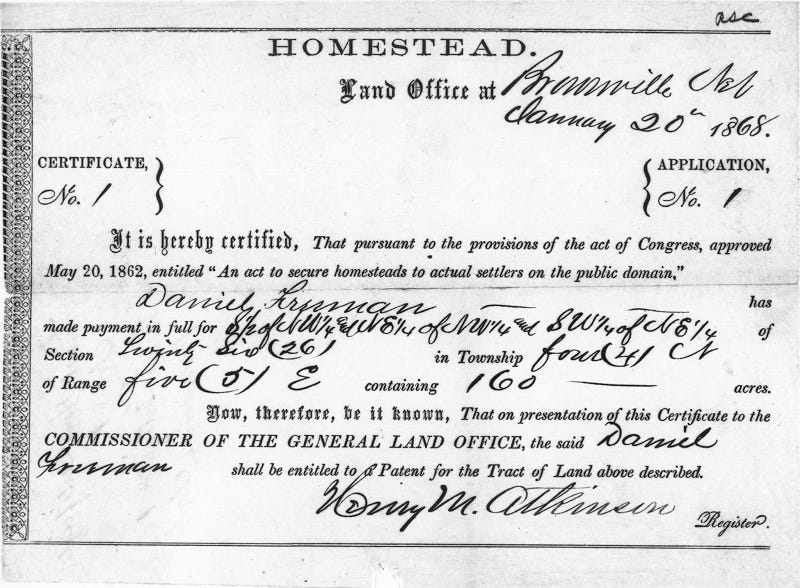
This Day in Legal History: Homestead Act
On May 20, 1862, President Abraham Lincoln signed the Homestead Act into law, creating one of the most consequential land distribution systems in American history. The statute allowed eligible settlers to claim 160 acres of federal land, so long as they lived on it, improved it, and cultivated it for a required period of time. At a basic level, the law treated land ownership as something that could be earned through residence and labor rather than purchased outright. That idea made the act especially powerful for many farmers, immigrants, formerly enslaved people, and poor white settlers who otherwise had limited access to property. But the promise of “free land” was never as simple as it sounded.
Much of the land made available under the Homestead Act had already been occupied, used, or governed by Native nations, and federal land policy often operated alongside removal, broken treaties, and military force. The act therefore expanded private property rights for some while deepening dispossession for others. It also reflected the federal government’s growing role in shaping settlement, agriculture, and economic development across the West. By requiring claimants to improve and farm the land, Congress used property law to encourage a particular vision of citizenship: independent, landowning, agricultural, and tied to national expansion. Over time, the law transferred vast amounts of public land into private hands. By the 1930s, roughly 270 million acres had been distributed under the Homestead Act, about 10% of the land area of the United States. Its legal legacy can be seen in debates over public lands, Indigenous sovereignty, property ownership, and the federal government’s power to define who gets access to opportunity.
Acting Attorney General Todd Blanche told senators that a nearly $1.8 billion “Anti-Weaponization Fund” tied to President Trump’s IRS settlement is “not a slush fund,” but there are several reasons to treat that assurance cautiously. The DOJ says Trump, his sons, and the Trump Organization will accept only a formal apology and no direct damages, while the fund will be available to other people who claim they were victims of government “weaponization” or “lawfare.” The problem is that DOJ has not clearly defined who qualifies, what proof is required, or what would disqualify someone from receiving money. When Sen. Chris Van Hollen asked whether people who assaulted police officers on January 6 could apply, Blanche did not rule it out and instead said anyone could apply if they believed they were a victim. Blanche also said he would not personally write the eligibility rules, though senators noted he will appoint most of the commissioners who will oversee the fund. DOJ’s public announcement says the fund was created as part of Trump’s settlement with the IRS after Trump agreed to drop his lawsuit over the leak of his tax documents.
The comparison to the Obama-era Keepseagle settlement is shaky. Keepseagle involved a discrimination case brought by Native American farmers and was approved by a federal judge, while this fund appears to be created through a settlement involving the sitting president and the IRS, without the same kind of judicial approval described here. Democrats also objected that Obama was not personally a plaintiff in Keepseagle, while Trump is directly connected to this settlement. The most legally significant part may be the addendum saying the IRS is permanently barred from examining certain Trump-related tax matters, including returns filed before the settlement’s effective date. That makes the deal look larger than a privacy settlement over leaked tax documents, because it may also limit future tax enforcement. Even Senate Majority Leader John Thune said there are “a lot of questions” the administration will have to answer, which is a notable sign that concern is not limited to Democrats.
$1.8B IRS Deal Fund ‘Not Slush Fund,’ Blanche Tells Senators - Law360
Workers at another Wells Fargo branch have moved to drop their union, showing that a once-fast-moving labor campaign inside the bank has lost momentum. The Communication Workers of America gave up representing nine employees at a Wilmington, Delaware, branch after one worker sought a vote to decertify the union. That branch had voted unanimously to unionize in early 2024 and was part of a broader organizing push that brought hundreds of Wells Fargo workers at 28 locations into the union. The campaign was notable because union representation is extremely rare in U.S. banking, where less than 1% of workers are unionized. Organizers had focused on complaints about understaffing, flat wages, sales pressure, and the lingering effects of Wells Fargo’s fake-accounts scandal.
The recent Delaware development is the fifth Wells Fargo branch where workers have ousted the union, with other decertifications in Florida, New Jersey, and North Carolina, and another petition pending in Wyoming. Wells Fargo said it supports employees’ right to choose whether they want union representation. The anti-union National Right to Work Legal Defense Foundation, which has helped workers challenge union representation, framed the decertifications as evidence that employees are rejecting CWA involvement. The CWA, for its part, has blamed Wells Fargo for slowing contract talks and has accused the bank of retaliating against union supporters and cutting benefits at unionized branches. Wells Fargo denies wrongdoing and says delays are tied partly to the difficulty of negotiating some of the first union contracts in retail banking. The broader context is also unfavorable for unions, with fewer union elections held in 2025 than in 2024 and labor advocates arguing that changes at the National Labor Relations Board under President Trump have made organizing harder.
Wells Fargo workers nix another union as tide turns in novel labor campaign | Reuters
Anthropic is challenging the Defense Department’s decision to label it a supply chain risk and bar it from government contracting, arguing that the move was an extreme response to a contract dispute over how its Claude AI models could be used. The dispute began during negotiations over the department’s GenAI.mil platform, where the government wanted contract terms allowing all lawful uses of Claude, while Anthropic sought exceptions for mass domestic surveillance and fully autonomous weapons systems. Anthropic argued that the department’s main theory was wrong because once Claude was deployed on the department’s classified network, it would be air-gapped and Anthropic could not secretly interfere with it during a military operation. The company also said the government had less drastic options, such as declining to buy future Claude models, instead of using a blacklisting authority that had apparently never been used this way before. One D.C. Circuit judge seemed strongly skeptical of the government’s action, calling the supply-chain-risk designation a major overreach. Other judges were less certain, asking whether the opaque and unpredictable nature of AI models could justify the government’s concern that hidden limits might affect military uses.
The government argued that Anthropic’s own proposed red lines created a real operational risk, especially if the company expected officials to seek real-time exceptions during military activity. But the judges also pressed the government on why it needed such broad freedom to use AI, including for fully autonomous weapons, given known concerns about AI reliability. They also questioned why the department went straight to a supply-chain-risk designation instead of simply ending or narrowing the relationship. Anthropic said the government skipped required procedural steps, including a joint recommendation and a 30-day response period, before issuing the designation. The government claimed it had to act quickly because Claude was already being used on several Defense Department platforms. Anthropic countered that this urgency argument was weakened by the department’s decision to phase out Claude over six months rather than immediately remove it.
Anthropic Says Defense Dept. Smeared It Over AI Red Lines - Law360
A Massachusetts judge refused to let Morgan & Morgan lawyer T. Michael Morgan appear in civil litigation against Harvard Medical School over the theft and sale of body parts from donated cadavers. The judge said Morgan’s earlier sanction in a Wyoming case, where court filings included fake AI-generated case citations, showed a failure to meet basic ethical duties. Morgan had disclosed the prior sanction when asking to appear as an out-of-state lawyer in the Harvard case, but the judge said he did not explain enough about how he had changed his practices to prevent the same problem from happening again. The judge also criticized Morgan for procedural problems with the Massachusetts application, including not having local counsel submit it and paying the wrong fee.
Morgan & Morgan said Morgan had accepted responsibility for the earlier mistake and that the firm had added safeguards around AI use. The underlying Harvard litigation involves families who say Harvard mishandled donated bodies after its former morgue manager, Cedric Lodge, stole and sold body parts; Harvard has condemned Lodge’s actions but denies civil liability. Lodge was sentenced to eight years in prison in December. The ruling adds to a growing line of cases where lawyers have been sanctioned or warned for relying on AI tools without verifying the accuracy of legal citations.
Lawyer barred from Harvard morgue scandal case over fake AI citations | Reuters


