



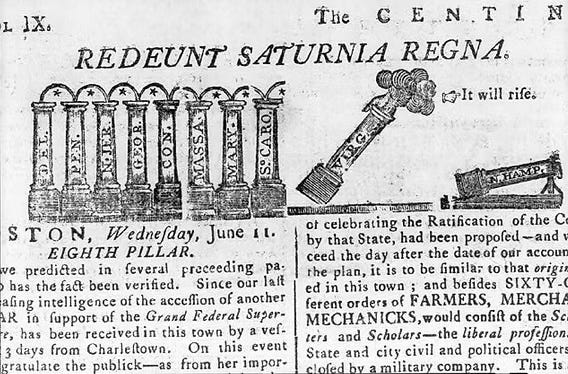
This Day in Legal History: Maryland Ratifies the Constitution
On April 28, 1788, Maryland became the seventh state to ratify the United States Constitution. The state’s ratifying convention met in Annapolis from April 21 to April 28, ending with Maryland’s formal approval of the new federal charter. This was a major legal step because Article VII of the Constitution required ratification by nine states before the Constitution could take effect. Maryland’s vote therefore brought the country within two states of replacing the Articles of Confederation with a stronger national government.
The decision also mattered because Maryland occupied an important position between northern and southern states, giving its approval broader political weight. Unlike some states where ratification debates were bitter and closely divided, Maryland approved the Constitution by a wide margin. Its delegates accepted the proposed structure of separated powers, a bicameral Congress, a single executive, and a federal judiciary. They also accepted the Constitution’s grant of greater national authority, including the power to tax, regulate interstate commerce, and enforce federal law. For supporters of ratification, Maryland’s approval showed that the Constitution was gaining momentum beyond the earliest Federalist strongholds. For opponents, it underscored how quickly the new framework was becoming a legal and political reality.
Maryland’s ratification did not itself put the Constitution into force, but it helped make that outcome increasingly likely. By June 1788, New Hampshire became the ninth state to ratify, satisfying Article VII and allowing the new constitutional government to begin. Maryland’s April 28 vote thus stands as one of the key legal milestones in the transition from confederation to constitutional union.
The U.S. Supreme Court formally reinstated a Texas congressional map that could help Republicans gain seats in the U.S. House in the 2026 midterm elections. The ruling made official an earlier interim decision from December, when the Court allowed Texas to use the map while the litigation continued. The map had been approved by the Republican-controlled Texas legislature in August 2025 and signed by Governor Greg Abbott.
Reuters reports that the map could shift as many as five Democratic-held House seats toward Republicans. A lower court had previously blocked the map after finding that it was likely racially discriminatory and potentially violated constitutional protections. The Supreme Court reversed that lower court decision, with the three liberal justices dissenting. The case comes amid a broader fight over mid-decade redistricting, in which both Republican- and Democratic-led states have redrawn maps outside the usual once-a-decade cycle for partisan advantage. California, for example, was allowed by the Supreme Court in February to use a new map designed to benefit Democrats after the Texas redistricting effort. The stakes are high because Republicans hold narrow majorities in Congress, and a shift in either chamber could affect President Trump’s legislative agenda and congressional oversight. The ruling does not end the larger national debate over when redistricting crosses the line from lawful political mapmaking into unconstitutional discrimination.
US Supreme Court formally reinstates pro-Republican Texas voting map | Reuters
The United States has agreed to adjust its Venezuela sanctions so the Venezuelan government can pay for Nicolás Maduro’s defense lawyer in his U.S. drug trafficking case. Maduro and his wife, Cilia Flores, were taken from Caracas by U.S. special forces on January 3, brought to New York, and charged with offenses including narcoterrorism conspiracy. Both have pleaded not guilty and are being held in Brooklyn while awaiting trial. Maduro’s lawyer, Barry Pollack, had asked U.S. District Judge Alvin Hellerstein to dismiss the case, arguing that sanctions blocking Venezuela from paying legal fees interfered with Maduro’s constitutional right to the lawyer of his choice. The defense said neither Maduro nor Flores could afford private counsel without Venezuelan government support. Prosecutors argued that the sanctions served national security and foreign policy interests, and that courts should not force the Treasury Department to change sanctions because foreign policy belongs mainly to the executive branch.
Judge Hellerstein appeared unwilling to dismiss the case, but he also questioned whether blocking payment was justified when Maduro and Flores were already in U.S. custody and U.S.-Venezuela relations had improved after Maduro’s ouster. The government’s decision to allow the payments removes a procedural obstacle that could have complicated or delayed the prosecution. The case remains politically charged, with U.S. officials accusing Maduro of corruption and drug trafficking, while Maduro denies the allegations and says they are a pretext for U.S. control over Venezuela’s oil resources. The dispute shows how sanctions, criminal prosecution, and constitutional criminal procedure can collide when a foreign former leader is brought into a U.S. courtroom.
US to let Venezuela pay Maduro’s lawyer in drug trafficking case | Reuters
My column for Bloomberg this week argues that the IRS’s potential settlement with President Donald Trump and his family over leaked tax data presents a legitimacy problem as much as a legal one. The agency may be able to resolve the case through ordinary settlement procedures, but this is not an ordinary plaintiff: Trump is the head of the executive branch that ultimately oversees the IRS. That creates a serious perception risk, because the public may view the dispute as the administration negotiating with itself. The column argues that any settlement should be tied clearly to remedies available under Section 7431 of the Internal Revenue Code, which governs civil damages for unauthorized tax disclosures. It also stresses that similarly situated taxpayers affected by the same IRS contractor’s leak should be treated consistently, or at least that any differences in treatment should be publicly explained.
The concern is that a major payout to Trump or his family could appear to create a two-tier tax system, even if the technical legal process is defensible. I compare the risk to the Teapot Dome scandal, where public confidence suffered because people believed insiders were benefiting from a different set of rules. The column also points to another high-profile tax leak case involving a billionaire, where the resolution focused on apology, acknowledgment of policy failures, and stronger data safeguards rather than a massive damages award. That prior case provides a useful benchmark, even though not every case must settle the same way. To protect credibility, I argue that DOJ recusal, an independent arbiter, or similar safeguards may be necessary so the process has visible independence. The larger point is that the IRS depends heavily on voluntary compliance, and voluntary compliance depends on taxpayers believing the system is fair. If the agency appears to give special treatment to the most powerful taxpayer in the country, the long-term cost may be far greater than any settlement amount.


