



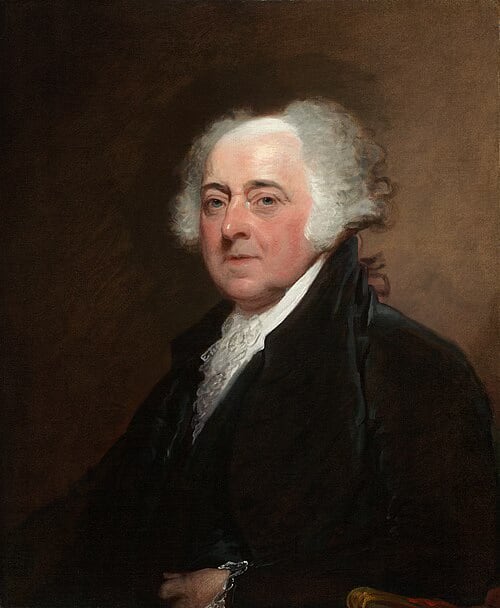
This Day in Legal History: John Adams Sworn in as VP
On April 21, 1789, John Adams was sworn in as the first Vice President of the United States, becoming one of the earliest officials to assume office under the newly ratified U.S. Constitution. His inauguration followed the formation of the new federal government and helped signal that the Constitution was not merely theoretical but fully operational. At the time, the role of Vice President was not yet clearly defined, leaving Adams to shape many of its early norms through practice rather than precedent. The Constitution assigned him the duty of presiding over the Senate, placing him at the intersection of the executive and legislative branches. This hybrid function raised early questions about separation of powers, a core principle embedded in the constitutional structure. Adams himself reportedly found the position frustrating, as it carried limited executive authority while restricting his participation in Senate debates. Despite these limitations, his service helped establish procedural expectations for how the Vice President would engage in legislative affairs.
The peaceful assumption of office by Adams also reinforced the legitimacy of the new constitutional system at a time when its durability was uncertain. It demonstrated that leadership transitions could occur within a stable legal framework rather than through upheaval or force. This moment contributed to the broader development of constitutional governance by modeling adherence to formal legal processes. Early officeholders like Adams played a critical role in translating the Constitution’s text into functioning institutions. His tenure also highlighted ambiguities in the document, many of which would later be addressed through political practice and constitutional amendments. Over time, the vice presidency evolved into a more active executive role, but its foundation was laid during this initial transition period. Adams’s swearing-in remains a key example of how early constitutional actors shaped the practical meaning of the nation’s governing document.
The U.S. Court of Appeals for the District of Columbia Circuit directed the U.S. Securities and Exchange Commission to revisit its denial of a whistleblower award to an anonymous claimant. The court granted a partial win to the individual, sending the case back to the agency for a clearer explanation of its reasoning. Although the court’s full opinion remains sealed, earlier oral arguments suggested the judges were focused on whether the claimant’s actions met the legal definition of “voluntary” under Dodd-Frank Act. The SEC had previously rejected the claim, stating that it only learned of the information after contacting the individual, who had first shared allegations with the media. The claimant argued that this sequence should not disqualify them from receiving an award.
Whistleblower awards under Dodd-Frank apply when provided information leads to enforcement actions with penalties exceeding $1 million, with awards ranging from 10% to 30% of collected sanctions. Because of this structure, the denied award in this case could amount to a significant financial loss. The court’s decision signals concern that the SEC may not have adequately justified its interpretation of the law. The ruling does not guarantee the claimant will receive an award but requires the agency to reconsider and better articulate its position. The case highlights ongoing tension over how strictly the SEC defines eligibility requirements for whistleblowers. It also underscores the importance of transparency in agency decision-making when financial incentives and legal protections are at stake.
DC Circ. Orders SEC Rethink Of Whistleblower Claim - Law360
A Reuters investigation found that Tesla, Inc. has paid little to no U.S. federal income tax over most of its history, including reporting a zero-dollar tax bill for 2025 despite generating substantial revenue. While some of these low tax obligations are explained by earlier business losses and government incentives for clean energy, the report highlights another major factor: profit shifting through foreign subsidiaries. Specifically, Tesla units in the Netherlands and Singapore recorded about $18 billion in profits that were not taxed in those countries and likely avoided U.S. taxation as well. Experts cited in the report estimate this strategy may have reduced Tesla’s U.S. tax burden by more than $400 million.
The mechanism appears tied to transferring intellectual property rights to overseas entities, allowing profits tied to those assets to be recorded in lower-tax jurisdictions. One Dutch-linked entity, structured as a partnership, reportedly had no employees and functioned mainly as a conduit for income. These arrangements are legal and commonly used by multinational corporations, though they remain controversial and are often criticized as exploiting gaps in international tax systems. The findings contrast with past public comments by Elon Musk, who has expressed skepticism about using aggressive tax loopholes. The report found no evidence that Tesla violated tax laws, but it underscores ongoing debates about corporate tax practices and transparency.
A federal judge has temporarily blocked the $6.2 billion merger between Nexstar Media Group and Tegna Inc., finding that challengers are likely to prove the deal would harm competition. The ruling came from a California federal court, which issued a preliminary injunction stopping the companies from integrating while lawsuits from DirecTV and several state attorneys general move forward. The court said the merger could lead to higher fees for distributors, fewer choices for consumers, and reductions in local journalism. It also warned that combining the companies would increase leverage to threaten “blackouts,” where broadcasters pull channels during fee disputes, potentially leaving viewers without access to sports and local news.
The judge emphasized that Nexstar must keep Tegna operating as an independent competitor for now, noting that further integration could cause irreversible harm, including layoffs and station closures. Although the deal had already received approval from regulators like the Federal Communications Commission and the Department of Justice, the court found that oversight did not sufficiently address antitrust concerns. State officials and DirecTV argue the merger would create the largest local TV station owner in the U.S., reaching a vast majority of households and concentrating too much control in one company. Nexstar has said it will appeal the decision and continues to defend the merger as beneficial for local broadcasting.
To understand the stakes, it helps to know what these companies control. Nexstar is already the largest owner of local TV stations in the U.S., operating more than 200 stations affiliated with major networks like NBC, CBS, ABC, and Fox, and it also owns the cable network NewsNation. Tegna owns dozens of local TV stations across major markets, many of which also carry network programming and produce local news. DirecTV, while not a broadcaster, distributes these channels to subscribers and would be directly affected by any increase in fees. Together, Nexstar and Tegna would control over 250 stations nationwide, raising concerns about pricing power, reduced competition, and the future of local news coverage.
Nexstar-Tegna Deal Blocked Amid DirecTV, AGs’ Challenge - Law360
My column for Bloomberg this week argues that states rushing to tax prediction markets are trying to regulate something they haven’t yet clearly defined. That uncertainty creates a real risk: policymakers could end up taxing the wrong base entirely. Until there is clarity about what these platforms actually are, restraint is the more defensible approach.
Prediction markets have grown rapidly, with trading volume skyrocketing in just a few years. That growth has drawn attention from lawmakers at both the state and federal levels, but the central question remains unresolved. If these platforms are gambling, then state sports betting frameworks might apply. If they function more like financial instruments, they fall under the jurisdiction of the Commodity Futures Trading Commission. And if they are neither, forcing them into an existing category may create more confusion than clarity.
I explain that the case for treating them like gambling platforms is understandable, since users are effectively betting on real-world outcomes. But the comparison breaks down when you look at how these platforms operate. Unlike sportsbooks, they don’t act as “the house” or take on risk. Instead, they function more like exchanges, matching users who take opposite sides of a contract and earning revenue through transaction fees rather than betting outcomes.
This distinction matters for tax policy. Sportsbooks are typically taxed on gross gaming revenue, which reflects the house’s winnings after payouts. That model assumes operators profit from users losing bets. Prediction markets don’t fit that structure, because they don’t generate meaningful gaming revenue in the traditional sense. Treating trading volume as taxable revenue risks overstating the size of the tax base.
At the same time, the CFTC has asserted federal authority and begun challenging state efforts in court. As these disputes move through the judiciary, there is a growing possibility of conflicting rulings that could ultimately require resolution by the Supreme Court of the United States. Even if states succeed in the short term, their tax systems could rest on shaky legal ground.
I also emphasize that prediction markets are inherently borderless digital platforms, which makes fragmented state-by-state regulation difficult to sustain. If they are closer to financial exchanges than local gambling operations, a coherent federal framework may be more appropriate.
A more durable solution would be a federal system that taxes platform fees rather than mischaracterized gaming revenue. But that approach would require policymakers to explain why prediction markets deserve distinct treatment from other financial intermediaries. Once the gambling analogy is set aside, that justification becomes harder.
None of this eliminates a role for states, particularly in areas like consumer protection and fraud enforcement. But the core questions—what prediction markets are, how they generate income, and how they should be taxed—are national in scope and should be treated that way.


