



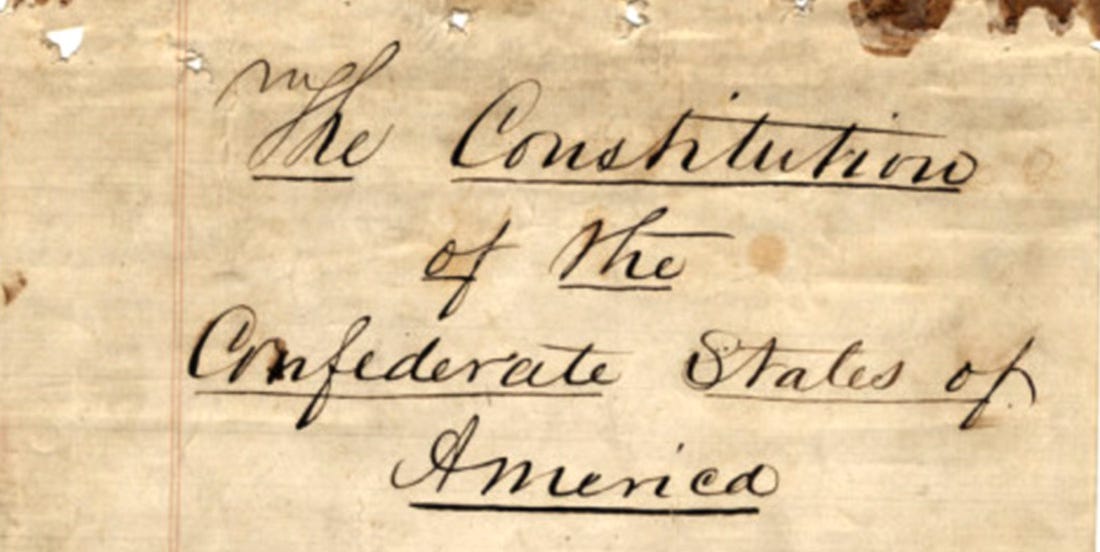
This Day in Legal History: Confederate States Constitution
On March 11, 1861, delegates of the newly formed Confederate States adopted the Constitution of the Confederate States of America in Montgomery, Alabama. The document closely resembled the United States Constitution in structure, language, and institutional design, reflecting the Confederacy’s claim that it was preserving the original constitutional order rather than rebelling against it. But the similarities masked a fundamental and disturbing difference: the Confederate Constitution explicitly protected and entrenched slavery. Unlike the U.S. Constitution, which used indirect language around the institution, the Confederate document openly required that slavery be recognized and protected in Confederate territories. It also prohibited any law impairing the right of property in enslaved people, making the protection of slavery a central constitutional commitment rather than a political compromise.
The constitution also attempted to limit certain federal powers, reflecting long-standing Southern arguments about states’ rights and suspicion of centralized authority. For example, it restricted tariffs and internal improvements, policies many Southern leaders believed favored Northern industrial interests. The document also changed the structure of the executive branch by providing for a single six-year presidential term instead of allowing reelection. These provisions were intended to prevent what Confederate leaders viewed as excessive federal power or political manipulation. Despite these structural adjustments, the document largely replicated the American constitutional framework while placing slavery at its legal core.
The legal significance of the Confederate Constitution lies in how clearly it reveals the central constitutional dispute of the Civil War era. While defenders of the Confederacy often framed secession as a fight over federalism or states’ rights, the constitutional text itself makes clear that preserving slavery was a primary objective. By embedding the protection of slavery directly into its governing charter, the Confederacy transformed the defense of human bondage into a foundational legal principle. The document therefore stands as a stark example of how constitutional law can be used not only to secure liberty, but also to entrench injustice.
Federal judicial officials announced plans to speed up development of a new electronic case management system after a major cyber breach exposed weaknesses in the courts’ existing technology. The decision was discussed during a closed meeting of the Judicial Conference, the federal judiciary’s main policymaking body, held at the U.S. Supreme Court building. Judge Michael Scudder, who leads the conference’s information technology committee, said recent cyber intrusions made it clear that modernization can no longer proceed at its previous pace. The breach, disclosed in July 2025, raised concerns that foreign actors may have accessed sensitive materials, including sealed files and information about confidential informants. The incident followed an earlier cybersecurity breach involving the federal courts in 2020.
In response, the judiciary plans to begin testing components of the upgraded system in six courts during 2026. Officials hope to begin rolling out parts of the new system to federal district courts nationwide next year. Appellate and bankruptcy courts would receive updates afterward. Judiciary leaders now expect that most of the modernization work could be completed within two to three years, a faster timeline than originally planned. The project also aims to improve the search tools used in PACER, the public database that allows users to access federal court filings. Despite long-standing criticism from lawmakers and transparency advocates, the judiciary does not currently plan to eliminate PACER’s user fees. Court officials say those fees provide roughly 85 percent of the funding for the modernization effort.
US judiciary to fast-track court records system upgrade after hacking | Reuters
Federal and state lawmakers are considering measures that could reshape lawsuits involving the weedkiller Roundup as Bayer continues to face large-scale litigation over the product. In Kansas, legislators debated a bill supported by Bayer that would prevent individuals from suing pesticide manufacturers for failing to warn that their products might cause cancer or other illnesses. The proposal is part of a broader legislative strategy by the company, which has supported similar bills in roughly a dozen states. These efforts come as Bayer prepares a proposed $7.25 billion settlement aimed at resolving most of the roughly 65,000 remaining lawsuits alleging that Roundup caused non-Hodgkin lymphoma.
Bayer inherited the litigation when it purchased Monsanto for $63 billion in 2018. Since then, the company has faced extensive legal costs and large verdicts, contributing to significant financial losses. Supporters of the Kansas bill argue that without such protections, pesticide manufacturers might remove widely used products from the market or raise prices, which could affect farmers and agricultural businesses. Critics, however, question the Environmental Protection Agency’s conclusion that glyphosate—the main ingredient in Roundup—is unlikely to cause cancer and argue the legislation would shield companies from accountability.
The debate is occurring alongside other legal developments. The U.S. Supreme Court is scheduled to hear arguments in April about whether federal pesticide law requires Bayer to warn consumers about potential cancer risks. Meanwhile, members of Congress are considering a farm bill provision that would require uniform pesticide labels nationwide, preventing states or local governments from mandating warnings different from those approved by the EPA. A Missouri judge has also given preliminary approval to Bayer’s proposed $7.25 billion class-action settlement, with a final decision expected later this year.
Bayer takes its multi-front battle on pesticide liability to Kansas | Reuters
A federal judge in Manhattan is set to review a proposed agreement that would end the U.S. government’s criminal prosecution of Turkey’s state-owned Halkbank. The case accused the bank of helping Iran bypass U.S. economic sanctions through financial transactions. Prosecutors and the bank reached a deferred prosecution agreement, which would pause the case while the bank demonstrates compliance with new restrictions. Under the proposal, Halkbank must avoid transactions benefiting Iran and hire an independent monitor to review its sanctions and anti-money-laundering controls.
The agreement does not require the bank to pay a fine or admit wrongdoing. If Halkbank complies with the conditions, the criminal charges would likely be dismissed after the monitoring period. Prosecutors have asked the judge to pause the proceedings for 90 days so the bank can begin demonstrating compliance. Although judges generally have limited authority to reject deferred prosecution agreements, the court may still review the deal to ensure it follows established legal precedent.
The resolution could ease tensions between the United States and Turkey, which had been strained by the case. U.S. officials indicated that resolving the prosecution also carried diplomatic importance during negotiations related to Turkey’s role in securing a ceasefire between Israel and Hamas in 2025. The announcement of the deal caused Halkbank’s share price to rise sharply. Turkish President Recep Tayyip Erdoğan had previously criticized the case as politically motivated.
Judge to weigh Halkbank, US prosecutors’ resolution to criminal case | Reuters


