


This Day in Legal History: Texas City Disaster
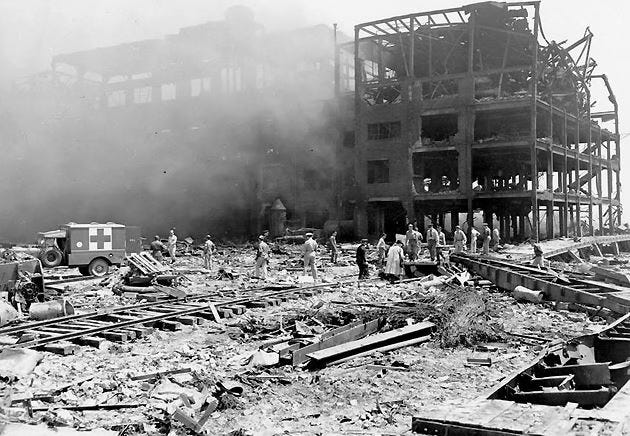
On April 16, 1947, a catastrophic industrial disaster struck Texas City, Texas, when a ship loaded with ammonium nitrate exploded, killing nearly 600 people and injuring thousands more. The blast devastated the surrounding area, leveling buildings and igniting fires that burned for days. In the aftermath, victims and their families turned to the courts, seeking accountability from the federal government for its role in overseeing the shipment and handling of the hazardous material. Their claims were brought under the Federal Tort Claims Act, a relatively new law at the time that allowed private citizens to sue the government for certain negligent acts.
The resulting litigation eventually reached the U.S. Supreme Court in Dalehite v. United States, a case that would shape the boundaries of government liability for decades. Plaintiffs argued that federal officials had been negligent in the planning and execution of the fertilizer export program that led to the explosion. The government, however, maintained that its actions involved policy decisions protected from liability. In a closely watched decision, the Supreme Court sided with the government, holding that the challenged conduct fell within the “discretionary function” exception of the statute. This exception shields the government from lawsuits based on decisions grounded in public policy considerations.
The Court’s ruling effectively barred recovery for many victims, drawing criticism for limiting access to remedies in cases of large-scale harm. At the same time, the decision established an enduring legal principle: not all government actions, even if harmful, are subject to judicial review through tort claims. The case has since been cited frequently in disputes involving regulatory decisions, disaster response, and federal oversight. Its legacy continues to influence how courts distinguish between operational negligence and protected policy judgment.
A Manhattan federal jury found that Live Nation Entertainment and its subsidiary Ticketmaster unlawfully maintained monopoly power in the concert ticketing market. Jurors concluded that the companies controlled primary ticketing services for major venues and used exclusionary tactics to limit competition. One key finding was that Live Nation tied access to its large amphitheaters to the use of its promotional services, restricting competitors. The jury also determined that this conduct harmed competition across dozens of states and led to measurable overcharges for some consumers.
The lawsuit was brought by a coalition of states and originally included the U.S. Department of Justice, which settled during the trial. That settlement proposed structural changes, including making Ticketmaster’s technology available to rivals and limiting certain exclusive venue agreements. It also included a financial component, though many states rejected the deal and continued litigating. The jury ultimately found violations of multiple state laws and confirmed anticompetitive effects in the live entertainment industry.
Despite the verdict, key issues remain unresolved, including how much damages the companies will owe and whether structural remedies—such as forcing a sale of Ticketmaster—will be imposed. Live Nation has indicated it will challenge the ruling and pursue post-trial motions and appeals. The case is significant because it addresses how vertical integration across ticketing, promotion, and venues can influence market power.
Jury Finds Live Nation Monopolized Concert Ticketing - Law360
Freedom Forever, a California-based home solar installer, filed for Chapter 11 bankruptcy in Delaware with more than $500 million in debt. The company reported liabilities between $500 million and $1 billion, compared to assets estimated between $100 million and $500 million. Among its largest creditors are affiliates of Mosaic, which are owed about $114 million in unsecured claims.
Founded in 2011, Freedom Forever has completed over 150,000 residential solar installations across 32 states and employs roughly 3,000 workers. Its bankruptcy comes amid broader financial strain in the home solar industry, where several companies have recently filed for Chapter 11. Industry-wide challenges include declining demand driven by higher interest rates, which make financing solar projects more expensive, and the expiration of a key federal tax credit for residential solar installations.
Other major solar companies, including SunPower and Sunnova, have also faced financial distress in recent years. The case highlights ongoing instability in the residential solar sector as companies struggle with shifting economic conditions.
Solar Co. Freedom Forever Hits Ch. 11 With Over $500M Debt - Law360
John Eastman, a former lawyer for Donald Trump, was disbarred by the California Supreme Court for his role in efforts to overturn the 2020 presidential election. The decision followed earlier findings by the State Bar of California that he violated professional ethics rules by making false statements and misleading courts. Although the court has not yet issued a full written opinion, it upheld conclusions that his legal arguments lacked factual and legal support.
Eastman had promoted theories that then–Vice President Mike Pence could refuse to certify certain electoral votes, a position Pence rejected as unconstitutional. He also filed unsuccessful litigation seeking to invalidate election results in multiple states and spoke at the rally preceding the January 6 Capitol attack. These actions were central to the findings that he breached his duty of honesty and undermined the legal system.
Eastman plans to appeal the disbarment to the U.S. Supreme Court and has pleaded not guilty to related criminal charges in Arizona and Georgia, some of which have since been dropped. The ruling underscores that attorneys can face severe professional consequences for advancing unsupported legal claims, particularly in matters affecting democratic processes. At the same time, disbarment is a professional penalty rather than a criminal one, meaning Eastman is facing significantly less severe consequences than individuals in past attempts to overturn the government—such as participants in the Confederacy—who were met with far harsher legal and historical repercussions.
Trump ally John Eastman is disbarred over bid to overturn 2020 election | Reuters


