



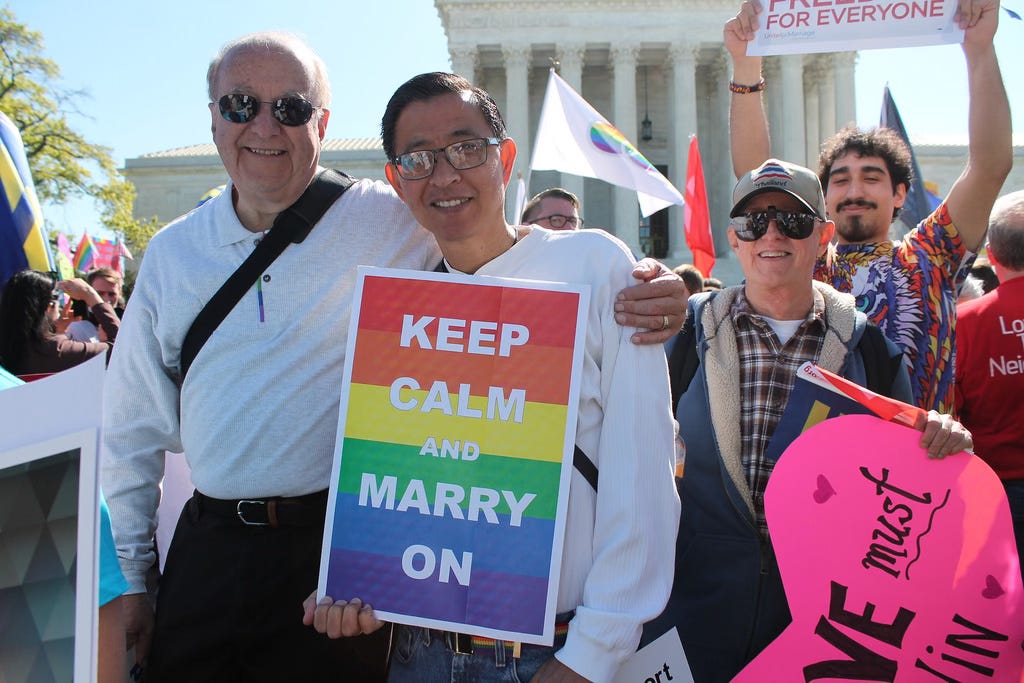
This Day in Legal History: Windsor and Obergefell
On two separate June 26ths, exactly two years apart, the Supreme Court made history by recognizing marriage equality as a constitutional right. These decisions fundamentally transformed American law and represented victories for millions of Americans.
On June 26, 2013, in United States v. Windsor, the Supreme Court ruled 5-4 that Section 3 of the Defense of Marriage Act (DOMA) was unconstitutional. DOMA had defined marriage, for federal law purposes, as a union only between one man and one woman. This meant that even though some states had legalized same-sex marriage, the federal government refused to recognize those marriages for tax purposes, immigration, federal benefits, and countless other legal matters. Edith Windsor, a woman who had been married to her female partner for over 40 years, faced a massive federal estate tax bill after her wife’s death because the federal government refused to recognize their marriage. She sued, arguing that DOMA violated the Constitution’s guarantee of equal protection. The Court agreed. Justice Anthony Kennedy wrote that DOMA “violates basic due process and equal protection principles applicable to the federal government.” The decision meant that same-sex couples legally married under state law now had to be recognized by the federal government. It was a stunning victory—but not a complete one, because some states still didn’t allow same-sex marriage at all.
Two years later, on June 26, 2015, in Obergefell v. Hodges, the Supreme Court took the final step. In a 5-4 decision, the Court ruled that same-sex couples have a constitutional right to marry under the Fourteenth Amendment. This was different from Windsor. Windsor said the federal government must recognize marriages that states allowed. Obergefell said states must allow same-sex couples to marry in the first place. The decision meant that in all 50 states, same-sex couples could get married and have their marriages recognized and protected by law. Justice Kennedy again wrote the majority opinion, describing marriage as “the foundation of the family” and emphasizing that the right to marry has been recognized as vital in our history and tradition. He wrote about the personal dignity of same-sex couples and their commitment to each other: “It would misunderstand these men and women to say they disrespect the idea of marriage. Their plea is that they do respect it, respect it so deeply that they seek to find its fulfillment for themselves.”
For most of American history, the law told millions of Americans they weren’t allowed to marry the person they loved. The law denied same-sex couples basic rights that heterosexual couples took for granted—hospital visitation, inheritance, tax benefits, the ability to make medical decisions for each other. Windsor and Obergefell said that’s unconstitutional. They affirmed that equal protection of the law means you can’t be denied basic rights because of who you love.
These two decisions, decided on the same date two years apart, represent one of the most dramatic shifts in constitutional law in decades. They show how the Constitution evolves to protect fundamental rights, and they demonstrate that the arc of justice, though long, bends toward equality. Millions of same-sex couples across America now have the legal right to marry, to have their marriages recognized, and to be treated equally under the law. For many, these decisions represented not just legal victories but personal affirmations that their relationships, their love, and their families matter.
The Supreme Court has signaled its approval of restrictive immigration policies, suggesting the Trump administration will succeed in making immigration law more difficult for immigrants and more favorable to enforcement.
The Supreme Court has been reviewing several immigration cases involving Trump administration policies designed to restrict immigration. Based on recent oral arguments and the Court’s questioning during those arguments, many observers believe the Court will side with the Trump administration on immigration issues. This represents a significant shift. For decades, the courts have sometimes limited executive power over immigration, recognizing that even though the President has broad authority over immigration, the Constitution still applies. Immigrants have constitutional rights, including due process protections before being deported. But the current Supreme Court appears skeptical of these limitations.
The President does have significant power over immigration—deciding who can enter the country and who must leave. But the Constitution doesn’t disappear just because immigration is involved. People facing deportation deserve notice, a chance to be heard, and due process. The Supreme Court appears to be tilting toward giving the Trump administration even broader immigration power, with fewer constitutional protections for immigrants. This signals that restrictive immigration policies will likely succeed in the courts.
If the Court rules in favor of the administration’s immigration policies, it will embolden more restrictive immigration enforcement. Immigrant communities will face greater risks of deportation. The ruling will signal that courts defer heavily to the Executive Branch on immigration matters, even when constitutional rights are at stake. This represents one of the most significant shifts in immigration law in decades, moving away from judicial protection of immigrants’ constitutional rights and toward deference to executive immigration enforcement.
On immigration, Supreme Court accedes to Trump’s restrictive agenda | Reuters
The Supreme Court has ruled to expand Second Amendment protections and has indicated it intends to take more gun rights cases in the coming years. This signals a fundamental shift in how the Court views the right to bear arms.
For decades, the Second Amendment was interpreted as primarily protecting gun ownership for militia purposes. But in 2008, in the case District of Columbia v. Heller, the Supreme Court ruled that the Second Amendment protects an individual’s right to own guns for lawful purposes like self-defense. That decision was controversial—it overturned decades of precedent and limited gun regulations. Since Heller, courts have struggled with the question: If people have a constitutional right to own guns, what gun regulations can the government still impose? The Supreme Court has now signaled it’s willing to expand Second Amendment protections even further. The Court has indicated it will hear more gun rights cases, and recent decisions and comments suggest the Court will protect gun ownership rights broadly.
The Constitution protects free speech, but you can still have laws against yelling “fire” in a crowded theater. The question with the Second Amendment is: What reasonable regulations can the government impose while still respecting the constitutional right? Gun rights advocates say any regulation is an unconstitutional restriction. Gun safety advocates say common-sense regulations like background checks and waiting periods are reasonable. The Supreme Court is signaling it will take the gun rights side of that debate and will continue expanding Second Amendment protections beyond what was previously recognized.
This signals that many gun regulations that have existed for years—regulations that public opinion supports—may be struck down as unconstitutional. States will lose authority to regulate firearms. The Court’s expansion of Second Amendment rights will make it harder for the government to pass gun safety legislation. This represents a dramatic constitutional shift away from allowing gun regulations and toward treating gun ownership as a nearly absolute right. It will likely lead to more mass shooting deaths if gun safety measures are struck down, but it reflects the current Supreme Court’s deep commitment to gun rights.
US Supreme Court expands Second Amendment rights, eyes more gun cases | Reuters
A federal judge has ordered that settlement records in a real estate class action case be unsealed and made available to the public. The ruling represents a victory for transparency and accountability.
In class action lawsuits, many companies settle rather than go to trial. The settlement typically includes both money paid to class members and a “confidentiality agreement” that keeps the details of the settlement secret. These confidentiality clauses often protect the company’s reputation by keeping the details of what went wrong hidden from the public. In this real estate class action, a federal judge decided that the public’s right to know outweighs the company’s interest in keeping the settlement secret.
If a company deceives consumers or engages in unfair practices, and then settles the lawsuit while keeping the details secret, the public never learns what happened. Other consumers stay in the dark about the company’s practices. The company’s wrongdoing goes unexamined. The judge found that when a company settles a public lawsuit involving alleged harm to consumers, the public has a legitimate interest in knowing what the company did and what it agreed to pay. Transparency protects consumers and holds companies accountable. Settlements should not be used as a tool to hide corporate wrongdoing. The order to unseal the settlement records means the public can now read the details of what the company allegedly did, what harm it caused, and what it agreed to pay.
This ruling protects the public’s right to information about corporate misconduct. It makes it harder for companies to settle lawsuits while keeping their wrongdoing secret. It encourages companies to settle in ways that are fair, because they know the details will be public. As more settlement records are unsealed, companies will face pressure to behave more honestly, knowing their practices may be exposed in court documents. This decision represents an important check on corporate power and a protection of consumer interests.
US judge orders unsealing of settlement-related records in real estate class action | Reuters


