



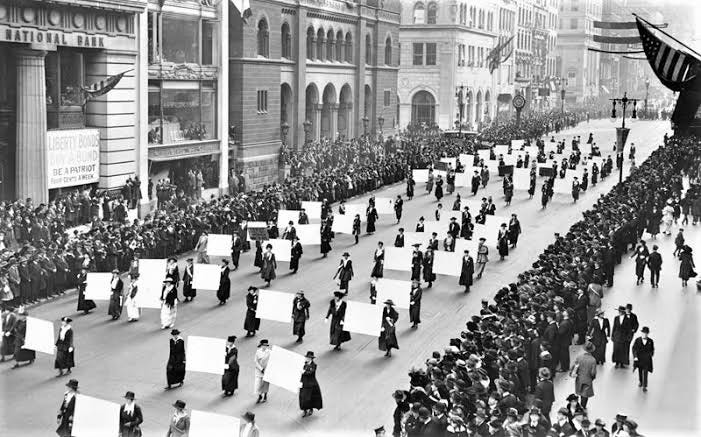
This Day in Legal History: The Nineteenth Amendment Is Ratified
On August 18, 1920, Tennessee became the thirty-sixth state to ratify the Nineteenth Amendment—the final state needed to reach the three-quarters threshold—and with that vote, the constitutional guarantee that the right to vote could not be denied on account of sex became part of American law. It enfranchised, at a stroke, roughly half the adult population of the United States.
The story of how it happened is almost unbelievably close. Tennessee’s state senate had ratified comfortably, but the house was deadlocked, tied 48 to 48. The decisive vote belonged to a 24-year-old representative named Harry Burn, who had a red rose on his lapel signaling opposition to the amendment—and a letter in his pocket from his mother, Phoebe, urging him to “be a good boy” and vote for suffrage. He did. His single vote broke the tie, Tennessee ratified, and the amendment was certified into the Constitution days later. A generational struggle turned, in the end, on a young man listening to his mother.
The significance of August 18, 1920 is best understood as the payoff to a story we told on this show back in July. When we covered the Seneca Falls Convention and its 1848 Declaration of Sentiments—the founding document of the American women’s rights movement, which dared to demand the vote—I noted that it would take seventy-two years to win the ballot. This is that day. The distance from Seneca Falls to Nashville is the distance from a bold, ridiculed demand to a line in the Constitution. And like the Fifteenth Amendment before it, the Nineteenth didn’t instantly deliver on its promise—many women of color, in particular, remained effectively disenfranchised for decades until the Voting Rights Act. But it permanently changed who “the people” are in a democracy. It’s a reminder, on a day full of stories about the law’s unfinished business, that some of the most fundamental rights we now take for granted were won slowly, against fierce resistance, and sometimes by a single vote.
A landmark trial has begun in California federal court that could reshape the most popular apps on the planet: a bipartisan coalition of 29 states has put Meta on trial, alleging it deliberately designed Instagram and Facebook to addict and harm children. This is the big one we’ve been building toward all summer—the federal counterpart to the state cases in New Mexico and Tennessee. The states, led by Colorado, California, New Jersey, and Kentucky, told the court that Meta engineered features like infinite scrolling, notifications, “likes,” visual filters, and algorithmic recommendations to drive compulsive use, and misled the public about the platforms’ safety for young people. Here’s an important procedural wrinkle: while there’s an eight-person jury in Oakland, it’s serving only in an advisory capacity—the case will ultimately be decided by U.S. District Judge Yvonne Gonzalez Rogers. That’s because this is largely an equitable case, and what the states are really after isn’t just money but sweeping changes to how the platforms work: stronger age verification, restrictions on algorithms trained on children’s data, limits on notifications, and the removal of features like infinite scroll. On damages, Meta itself has floated the staggering figure of $1.4 trillion as its potential exposure, though the states haven’t named a number and legal experts consider an award anywhere near that scale unlikely. The significance is that this trial could force concrete, structural redesign of Instagram and Facebook for young users—not a settlement negotiated in private, but a judge’s findings after a public trial. Everything we’ve tracked, from the multistate penalties to the New Mexico verdict to the Ninth Circuit clearing these suits, has been leading here. This is where the social-media reckoning gets its fullest public airing yet.
Meta faces 29-state trial that could reshape Instagram and Facebook | Reuters
Yahoo Finance · anews
The Justice Department has opened a civil-rights investigation into the College of William & Mary, alleging the Virginia public university runs scholarship and mentorship programs that unlawfully discriminate in favor of minority students. The Department’s Civil Rights Division announced a “compliance review” under Title VI of the Civil Rights Act—which bars race discrimination by institutions that receive federal funding—targeting several specific programs: a fellowship in the education school that gives preference to Hispanic or Latina women with financial need, a doctoral mentorship program for “future education leaders of color,” and a law-school scholarship program. Here’s the legal backdrop that makes this a national trend and not a one-off. After the Supreme Court’s 2023 decision in Students for Fair Admissions v. Harvard ended race-conscious admissions, the fight didn’t end—it moved. The administration is now using Title VI to argue that race-conscious scholarships, fellowships, and pipeline programs are themselves a form of unlawful discrimination, framing programs designed to expand opportunity for underrepresented groups as illegal “discrimination in favor of minorities.” Supporters of these programs say they’re lawful efforts to remedy historic exclusion and build diverse professions; critics say any use of race, even to help, runs afoul of the post-SFFA legal landscape. It’s worth being precise: this is a compliance review, an investigation, not yet a lawsuit or a finding of wrongdoing. The significance is that this is part of a systematic campaign we’ve tracked against universities—from Harvard to Columbia—and it signals that the enforcement frontier after affirmative action has shifted from the admissions office to the financial-aid office. Every race-conscious scholarship in the country is now, potentially, a legal target.
DOJ probes College of William & Mary alleging discrimination in favor of minorities | Reuters
Bloomberg · Fox News
A federal judge has ordered the release of a woman charged with vandalizing the World War II Memorial in Washington—and the top federal prosecutor there, Jeanine Pirro, is not happy about it. The defendant, 41-year-old Melissa Farris of Kentucky, was arrested last week and charged with two felony counts after the memorial’s fountain was filled with soap suds and the words “Clean hands Dirty $” were spray-painted across a surface in red and green. A judge ordered her released on conditions—surrendering her passport and not leaving the continental U.S. without approval—and Pirro publicly criticized that decision. Let’s unpack the legal pieces, because there are two distinct ones. First, pretrial release: in the American system, the default is that a defendant awaiting trial should be released unless the government shows they’re a flight risk or a danger, with conditions used to manage any risk. A judge ordering release with conditions is the system working as designed—the presumption of innocence is not an empty phrase—even when a prosecutor would prefer detention. Second, the underlying conduct: Farris reportedly said on social media that she acted to protest tax dollars not being spent on ordinary Americans and alleged corporate wrongdoing. But political motivation doesn’t convert property destruction into protected speech—you can hold the message and still prosecute the spray paint. The significance ties into a thread we’ve followed: this is the same U.S. Attorney, Jeanine Pirro, at the center of the Reflecting Pool saga, again clashing over how a memorial-vandalism case should be handled—this time frustrated that a judge released a defendant rather than that a case was dropped. A preliminary hearing is set for September 3, and it’s a reminder that the everyday machinery of bail and pretrial release keeps operating regardless of how politically charged the underlying act may be.
US judge orders release of woman accused of vandalism at World War Two Memorial | Reuters
Washington Post · CBS News
And finally, in my column this week, I take on a well-intentioned proposal to tax artificial intelligence in order to help the workers it displaces—and argue that, while the instinct is right, the mechanism is wrong. The proposal in question is Representative Greg Casar’s AI Tax and Work Protection Act. Its premise is sound: if firms are capturing the gains from replacing human workers with AI while pushing the costs—unemployment, lost tax revenue—onto workers and society, those costs look like an externality, the same way pollution does. And we tax externalities all the time: cigarettes, gasoline, carbon. So taxing AI to fund worker protections is a reasonable idea in principle.
My problem is with the particulars. Casar’s bill doesn’t actually tax worker displacement—it taxes AI “tokens,” the technical units of AI computation, with the rate keyed to the unemployment rate. That creates an appealing feedback loop on paper: as AI drives up unemployment, the tax rises and generates more money to put people back to work. But it asks the Treasury to do two things it’s genuinely bad at. First, it has to figure out, in real time and on a political calendar, how much of any given rise in unemployment is actually caused by AI, as opposed to a recession, a pandemic, or a war. That’s a causal judgment the tax code has no machinery for. Second, and worse, it has to put a stable dollar value on a “token”—an unstable, non-standardized unit that spans text, code, images, audio, and video, and isn’t sold in any clean arm’s-length market. You’re trying to tax the meter, and the meter doesn’t have a reliable price.
So here’s the alternative I argue for: instead of taxing AI use, give the public an equity stake in the companies that capture AI’s gains—let the government own a piece of the franchise rather than tax the meter. This isn’t as exotic as it sounds; scholars like Jeremy Bearer-Friend and Sarah Polcz have proposed having AI firms pay tax in kind, transferring equity rather than cash, and Senator Sanders has floated a far more aggressive version—a 50% stake funding a sovereign wealth fund. My point is that you don’t have to go to 50% to adopt the underlying architecture. Equity is a better proxy than token usage: it scales with the actual size of the economic reallocation AI produces, and it only asks the government to value a company once, rather than to price billions of individual computations or adjudicate whether a particular prompt cost a particular job. If AI merely augments workers and produces modest gains, the public’s share stays modest; if it produces extraordinary gains, the public shares in the upside. A smaller equity assessment on the largest firms, held through an independently managed vehicle, would let the public participate in AI’s wealth without handing a shrunken Treasury an impossible measurement problem. The instinct to make sure the public benefits from AI is exactly right—we should just own a piece of the thing, not tax the ticker.
Taxing AI to Help Workers Sounds Good, But Public Deserves More | Bloomberg Tax


