



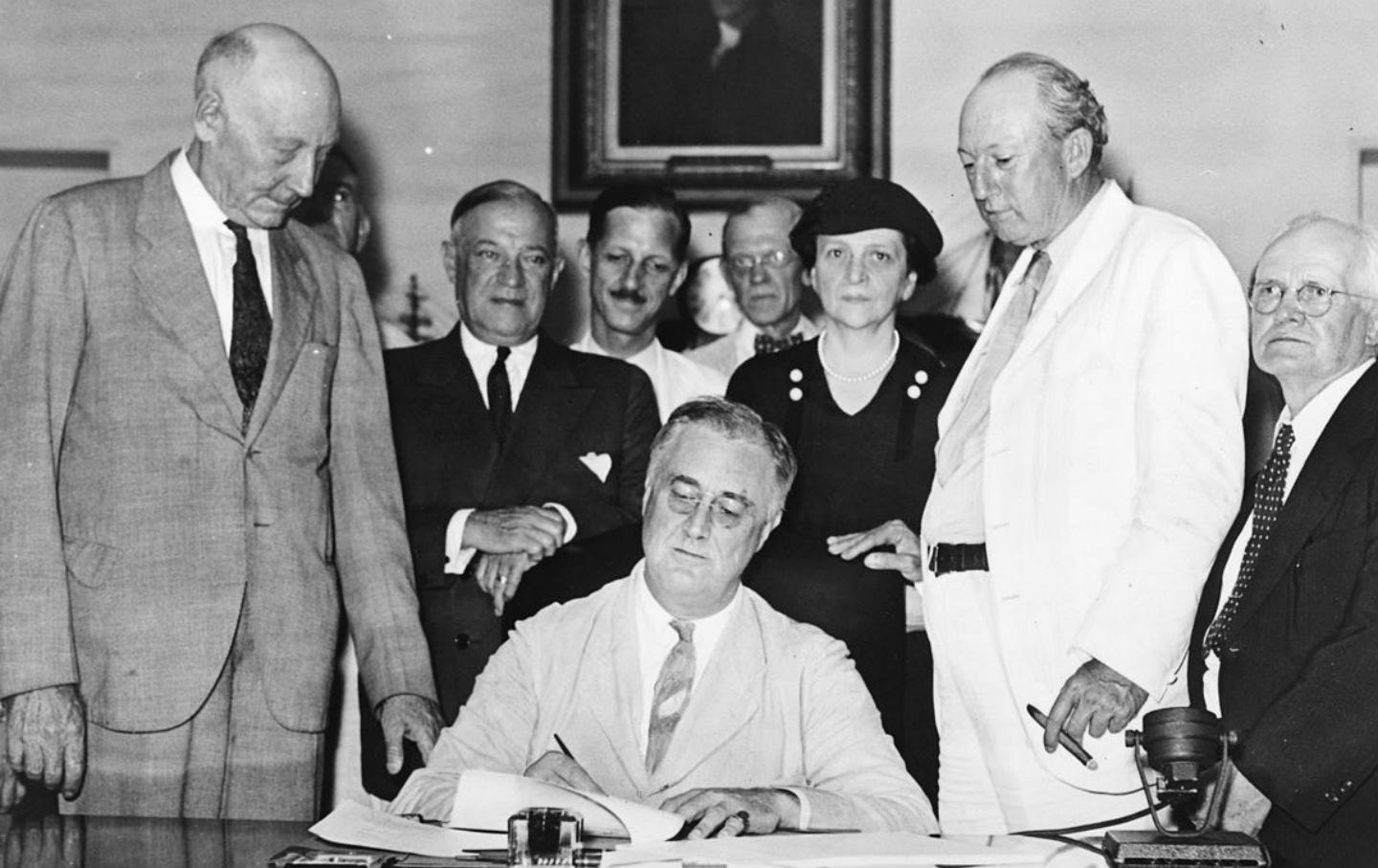
This Day in Legal History: The Social Security Act
On August 14, 1935, President Franklin D. Roosevelt signed the Social Security Act, creating the foundation of the American social safety net and permanently changing the relationship between citizens and their government. Flanked by members of Congress and photographers, FDR put his signature to a law that guaranteed, for the first time in American history, a measure of economic security against the hazards of old age, unemployment, and poverty.
The Act was born of the Great Depression, when the suffering of millions—elderly people with no savings, workers with no jobs, families with no support—overwhelmed the old assumption that hardship was a purely private matter. Social Security established old-age benefits funded by taxes on workers and employers, created a federal-state system of unemployment insurance, and provided aid for dependent children, the blind, and people with disabilities. Roosevelt himself was clear-eyed about its limits, saying at the signing that no law could insure everyone against every vicissitude of life, but that this one gave “some measure of protection” against poverty-ridden old age and unemployment.
The legal significance runs deep, and it connects to a story we’ve told before on this show. When the Social Security Act was challenged as an unconstitutional federal overreach and an improper use of the taxing power, it reached a Supreme Court that had been striking down New Deal programs left and right. But in 1937—in the same term as the failed court-packing fight and the Court’s famous doctrinal shift—the justices upheld Social Security, in Steward Machine Company v. Davis and Helvering v. Davis, broadly reading Congress’s power to tax and spend for the general welfare. Those decisions helped cement the constitutional foundation of the modern administrative and welfare state. Ninety-one years later, Social Security remains the single largest program in the federal budget, and the principle it established—that the national government has a role in securing the economic dignity of its people—remains, as our opening quote from FDR suggests, a live measure of the country’s progress.
A federal trade court has upheld President Trump’s authority to close the “de minimis” tariff exemption—handing the administration a rare courtroom win on tariffs. The U.S. Court of International Trade, a three-judge panel in New York, ruled that Trump lawfully used the International Emergency Economic Powers Act, or IEEPA, to end the duty-free treatment that low-value imports—parcels worth $800 or less—had long enjoyed. Some quick background: the de minimis exemption is what let a flood of cheap packages, especially from Chinese e-commerce sellers, enter the U.S. tariff-free, and closing it has already generated over a billion dollars in new duty payments. What makes this ruling notable is that it cuts against the trend. Trump’s tariff agenda has fared badly in court—the Supreme Court ruled in February that IEEPA does not authorize him to unilaterally impose sweeping tariffs, which led to that roughly $100 billion in refunds we covered, and the trade court later struck down a replacement tariff. So how does the administration win this one? The court drew a fine but important distinction: ending a duty-free privilege is not the same as affirmatively imposing a tariff. The challenger, an auto-parts importer, argued IEEPA gave the president no independent power to close the exemption, but the panel found that rescinding a trade-related “privilege” falls within the emergency-powers statute even if imposing new tariffs does not. The significance is that it carves out a narrow lane where the administration’s emergency-powers theory actually holds up—a reminder that in the tariff wars, the difference between taking away a benefit and imposing a new burden can be the difference between winning and losing in court.
US court backs Trump’s power to close ‘de minimis’ tariff exemption | Reuters
CNBC · Bloomberg
The Supreme Court has taken up a case that sounds technical but goes to the heart of whether wrongly detained immigrants can find a lawyer at all. The question is whether attorneys who successfully challenge an immigrant’s detention through a habeas corpus petition can recover their fees from the federal government. It turns on the Equal Access to Justice Act—a statute that lets people who beat the government in court recover their attorney’s fees, unless the government’s position was “substantially justified.” Here’s why this matters enormously right now. As immigration detention has surged, so have habeas petitions challenging it: one court in California went from a handful of these cases in 2021 to hundreds in a single month this year, and courts have repeatedly ordered the government to pay fees after finding people were detained unlawfully. But two federal appeals courts, the Fourth and Fifth Circuits, have held that habeas challenges to immigration detention aren’t the kind of “civil case” the fee statute covers—which would mean the lawyers who win these cases can’t recover a dime. Think about the practical stakes. Detained immigrants are frequently poor, often can’t work, and have no right to a free lawyer in immigration proceedings. Fee-shifting is a big part of what makes it economically possible for attorneys to take these cases at all. If the Supreme Court rules that EAJA doesn’t apply, it doesn’t change the substance of anyone’s detention—but it quietly removes much of the financial incentive for lawyers to challenge unlawful detention, weakening one of the few real checks on the system. The significance is that this is access to justice in its most concrete form: whether the courthouse door stays open depends, as it so often does, on who can afford to walk through it.
US Supreme Court case tests fees for immigration detainees | Reuters
SCOTUSblog · Bloomberg Law
And finally, a story from the frontier of AI misuse that is equal parts alarming and absurd. A Connecticut judge has sanctioned a plaintiff who hid secret instructions inside his own court filings—instructions aimed not at the judge, but at any artificial intelligence that might read the documents. The plaintiff, representing himself, buried text in white font on a white background, invisible to a human eye, telling any AI model reviewing the filing to side with him. This is what’s known as a “prompt injection” attack, and it’s reportedly the first documented instance of one aimed at a U.S. court. The court caught it—apparently tipped off by strange white spaces in the text—and issued an order warning him to stop. He didn’t. At the next hearing, he’d hidden a message reading “hi, I hope you can’t see me,” and, in another filing, a concealed link to a SpongeBob SquarePants video. The judge was not amused, issuing a decision bluntly titled “Court Sanction for Plaintiff’s Use of Prompt-Injection.” The remedy is almost poetically low-tech: the plaintiff is now barred from filing electronically and must submit everything on paper. Now, it’s easy to laugh—and the SpongeBob link earns a chuckle—but the serious point is real. This is a new species of the AI-integrity problem we’ve tracked all summer, alongside the fake hallucinated citations. It’s an attempt to corrupt the decision-making process itself, and it quietly reveals something bigger: that courts and their staff may increasingly be using AI tools to help review filings, which creates a brand-new attack surface for litigants willing to game it. The significance is that the age-old duty of candor to the tribunal now has to contend with adversaries trying to whisper to the machines—and courts are going to need new rules, and sharp eyes, to catch them.
Connecticut judge says plaintiff hid messages for AI in court filings | Reuters
404 Media · Tom’s Hardware


