


This Day in Legal History: Britain’s Last Executions
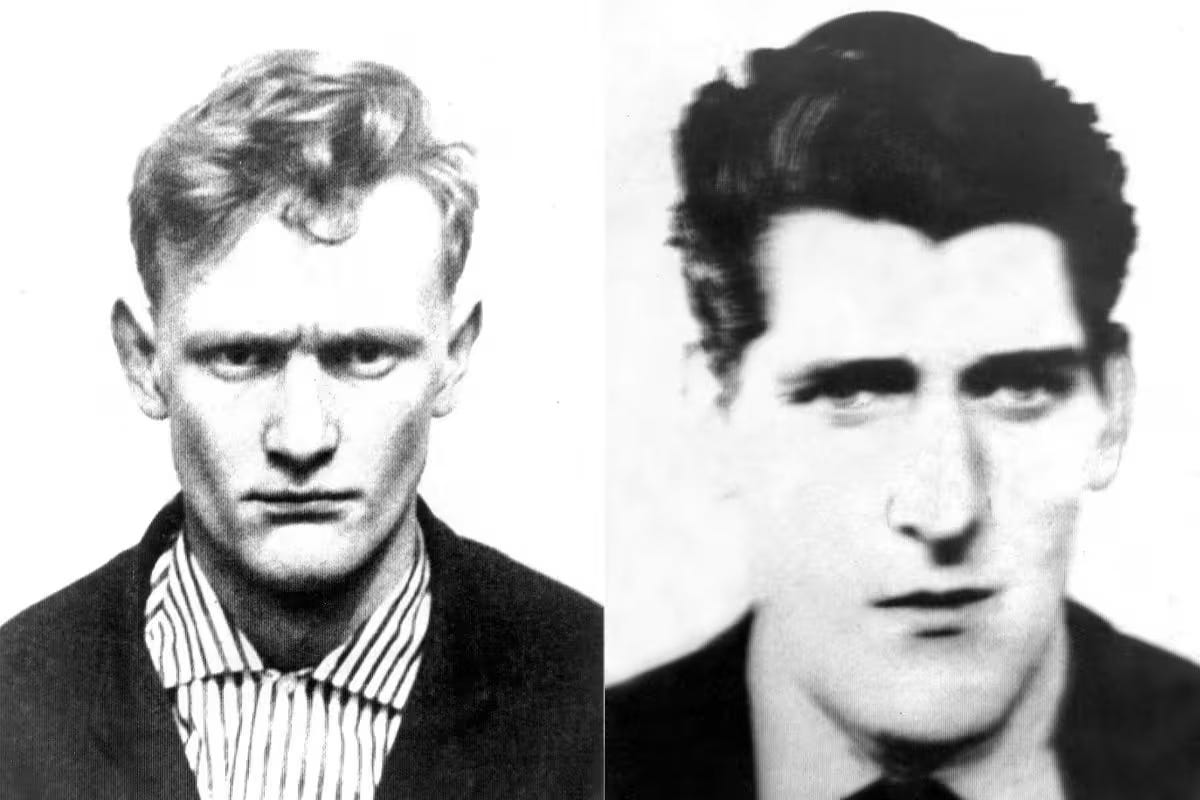
On August 13, 1964, two men—Peter Anthony Allen and Gwynne Owen Evans—were hanged simultaneously in two different English prisons for the murder of a man during a robbery. They were the last people ever executed in the United Kingdom. Evans died at Strangeways Prison in Manchester and Allen at Walton Prison in Liverpool, both at eight in the morning, and with them, centuries of capital punishment in Britain came quietly to an end.
Neither man knew he was making history; the abolition of the death penalty wasn’t yet law. But the machinery of change was already turning. The very next year, in 1965, Parliament passed the Murder Act, which suspended the death penalty for murder for a trial period of five years. In 1969, Parliament made that suspension permanent for England, Scotland, and Wales. The death penalty lingered on the books for a handful of exotic offenses—treason, piracy with violence, certain military crimes—until it was finally abolished completely in 1998, bringing British law into line with the European Convention on Human Rights.
The significance of August 13, 1964 is sharpened by contrast. Britain reached the end of capital punishment through ordinary legislation, and much of Europe followed a similar path, treating abolition as a basic human-rights commitment. The United States took the opposite fork: the Supreme Court briefly halted the death penalty in 1972 in Furman v. Georgia, only to allow it back four years later in Gregg v. Georgia, and capital punishment remains part of American law today, administered by the federal government and a number of states. So this anniversary is a useful mirror—a reminder that two closely related legal systems, working from a shared common-law inheritance, reached opposite conclusions on one of the deepest questions a legal system can face: whether the state should ever have the power to take a life. That’s the question our opening quote, from Bryan Stevenson, puts squarely on the table.
The law firm Motley Rice is in line for a payday of more than $67 million—its fee for winning New Mexico’s sprawling case against Meta. We covered the underlying result: a judge ordered Meta to pay $567 million into a teen mental-health fund, on top of $375 million in civil penalties a jury imposed in March, bringing New Mexico’s potential recovery to more than $942 million. Motley Rice represented the state on contingency, and under its contract it can seek a sliding-scale cut—20% of the first $50 million recovered, scaling down to 5% on amounts over $250 million—which works out to roughly 7% of the total, or about $67 million. Here’s the practice-of-law angle worth understanding. States increasingly hire private plaintiffs’ firms to bring these massive cases because they don’t have the in-house firepower to go toe-to-toe with a company like Meta and its armies of lawyers. The firm fronts the enormous cost and risk of years of litigation in exchange for a percentage if it wins—the same model that produced the giant tobacco settlements of the 1990s, in which Motley Rice was a central player. Supporters say it lets under-resourced states take on deep-pocketed defendants they otherwise couldn’t touch; critics say it hands public law-enforcement power to private firms with a profit motive. The significance is that this is the economic engine behind the whole wave of state social-media litigation we’ve been tracking. The fee comes out of New Mexico’s recovery, and it only gets paid after appeals conclude—and Meta has said it will appeal—so the number, like the verdict, isn’t final. But it’s a rare, concrete look at the money that makes this kind of public-interest litigation actually happen.
Law firm Motley Rice’s fee for Meta case in New Mexico could top $67 million | Reuter
Albuquerque Journal · JD Journal
Two press-freedom organizations—The Intercept and the Freedom of the Press Foundation—have sued in Manhattan federal court to shut down a Trump Media service that sells wealthy subscribers early access to President Trump’s social media posts. The service, called Truth API, launched August 1 and charges up to $100,000 a month for a faster feed of ten high-profile Truth Social accounts, including the president’s own. The legal concern at the heart of the suit is a specific and serious one: Trump’s posts routinely move financial markets—an announcement about tariffs or a company can send stocks lurching—and a paid feed that delivers those posts to deep-pocketed subscribers before the general public gives those subscribers a head start to trade on market-moving information. In other words, it potentially creates a two-tiered market in the president’s words, where those who can pay six figures a month get to act on presidential statements seconds or minutes before everyone else. That’s the kind of information asymmetry securities law generally frowns on. The service drew scrutiny fast—Senators Elizabeth Warren and Adam Schiff had already called for a government investigation days before this suit. It’s also legally novel: the plaintiffs are press-freedom groups, framing public access to a president’s official-ish communications as a matter of public interest, which raises interesting questions about their theory and standing. The significance is that this sits at a genuinely new intersection—of a president who governs partly through market-moving social media posts, the business incentive to monetize that, and a securities and public-information framework that never contemplated selling early access to the president’s feed. However the case comes out, it’s a preview of the strange legal questions created when official speech becomes a paid product.
Trump sued over service that offers paid early access to Truth Social posts | Reuters
Washington Post · NPR
A group of current and former Palestinian students and staff have sued Columbia University, alleging that the school discriminated against its Palestinian community over the past two years. According to the complaint filed in New York, the plaintiffs say Columbia failed to protect Palestinian members from harassment, subjected them to what they call “unfair and biased disciplinary hearings,” and “actively participated in and amplified” what they describe as racially, ethnically, and politically motivated targeting of Palestinians on campus. The legal vehicle here is worth understanding, because it’s the same one being wielded on multiple sides of the campus fights. Civil-rights law—principally Title VI of the Civil Rights Act—bars institutions that receive federal funding from discriminating on the basis of race, color, or national origin. We’ve seen Title VI invoked against universities over allegations of antisemitism, and we’ve seen the Justice Department use it to pressure schools like Harvard. Here, Palestinian and Arab plaintiffs are invoking that same framework to allege discrimination against them. The context matters: Columbia suspended more than 65 students last year over a pro-Palestinian protest that shut down its main library, and it agreed to pay the federal government over $200 million to resolve federal probes and restore funding. Columbia has denied discriminating and says it condemns hate, and it declined to comment on the pending litigation. To be clear, these are allegations in a complaint, not proven facts, and I’m not weighing in on the underlying political conflict. The significance is legal and institutional: universities are now being sued from opposite directions under the very same civil-rights statute, and Columbia in particular finds itself squeezed between federal enforcers, one set of students, and another—each claiming the protection of Title VI. It’s a vivid illustration of how anti-discrimination law becomes the battleground when a campus fractures.
Palestinian students and staff sue Columbia University alleging discrimination | Reuters
US News · Middle East Eye


