



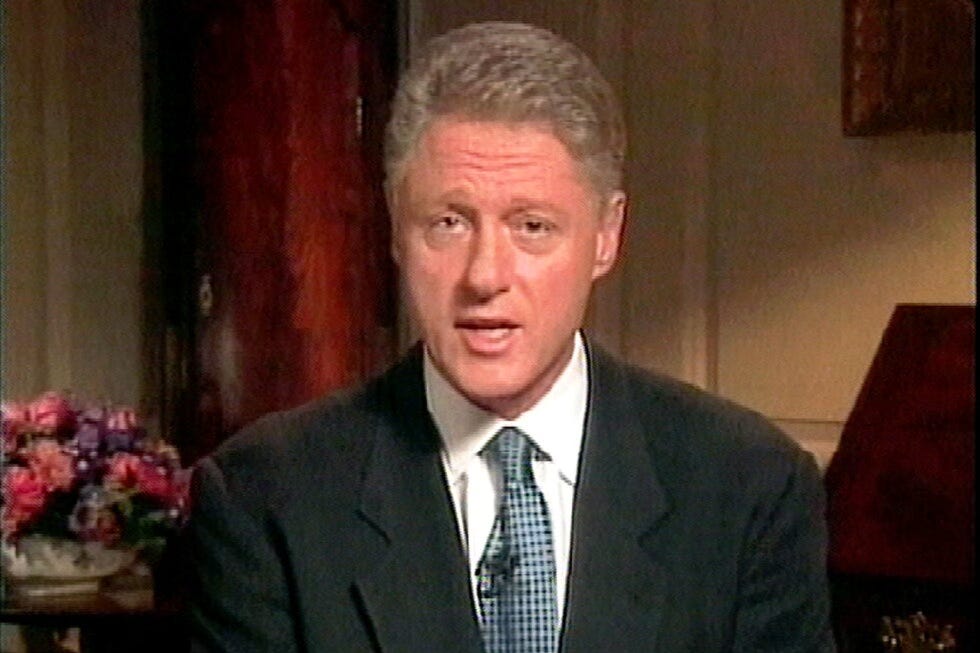
This Day in Legal History: Clinton Testifies Before the Grand Jury
On August 17, 1998, President Bill Clinton became the first sitting president to testify before a grand jury as the subject of its investigation. He gave his testimony via closed-circuit television from the White House to Independent Counsel Kenneth Starr’s grand jury, concerning his relationship with a White House intern—and that same evening, he addressed the nation to admit he had misled the public about it.
The legal machinery that brought a president to that moment is worth understanding. It began, improbably, with a civil lawsuit: Paula Jones’s sexual-harassment suit, which produced the 1997 Supreme Court decision in Clinton v. Jones holding that a sitting president is not immune from civil litigation over unofficial conduct and can be deposed while in office. That deposition, and the questions in it, are what put Clinton’s statements under oath—and when those statements collided with what Starr’s investigation uncovered, the independent counsel built a case around perjury and obstruction of justice. Clinton, carefully, insisted his earlier answers had been “legally accurate,” a phrase that became emblematic of the entire episode.
The significance of August 17, 1998 is layered. It led directly to Clinton’s impeachment by the House on charges of perjury and obstruction—only the second presidential impeachment in American history—and his acquittal by the Senate. But its deeper legal legacies are the ones that still echo: Clinton v. Jones established that the presidency is not a shield against civil accountability for private conduct, a principle you can hear resonating in today’s fights over presidential immunity, and the whole saga became a national seminar on perjury, executive privilege, and the limits of the independent-counsel model, which Congress let expire the following year. It’s a fitting anniversary for a day when the relationship between political power and prosecutorial judgment is, once again, at the center of the news.
Opening statements begin today in Las Vegas in the murder trial of Duane “Keffe D” Davis, nearly thirty years after the 1996 killing of rapper Tupac Shakur. Davis, 63, is charged with murder with a deadly weapon with intent to promote a criminal gang. He has pleaded not guilty and faces life in prison if convicted.
A sixteen-person jury has been selected, and prosecutors are expected to call roughly forty witnesses. The witness list includes Suge Knight, who was driving the car in which Shakur was shot, and Nevada Governor Joe Lombardo, who responded to the shooting as a Las Vegas police sergeant in 1996.
Prosecutors say Davis was the “shot caller” behind a quickly assembled plan to retaliate after Shakur and members of his entourage beat Davis’s nephew at the MGM Grand earlier that evening. The government’s theory places the killing within a larger conflict involving rival street gangs.
The obvious problem for prosecutors is time. Trying a murder case three decades after the crime means dealing with faded memories, unavailable witnesses, and physical evidence that may have been lost or degraded. What eventually revived the case, however, was Davis himself.
Over the years, Davis publicly discussed his involvement in Shakur’s killing in interviews and in a memoir. Those statements now form an important part of the prosecution’s case. They also give the defense an obvious line of attack: statements made years later for publicity, money, or street credibility are not necessarily reliable accounts of what actually happened.
That makes Davis’s own words one of the most important legal issues to watch. Prosecutors do not merely have to show that he repeatedly claimed involvement; they have to persuade jurors that those claims, considered alongside the remaining evidence, prove his guilt beyond a reasonable doubt. The trial is therefore as much about the reliability of decades-old admissions as it is about solving one of the most famous unsolved murders in American popular culture.
Tupac shooting trial begins with opening statements | Reuters
Washington Post · PBS NewsHour
Attorney General Todd Blanche is publicly backing U.S. Attorney Jeanine Pirro after President Trump criticized her office for dropping a vandalism prosecution involving the Lincoln Memorial Reflecting Pool.
Speaking on NBC’s Meet the Press, Blanche said he “absolutely” supports Pirro, the top federal prosecutor in Washington. The comments came after Trump criticized her decision to abandon the prosecution of former Olympian David Hearn and others accused of damaging the Reflecting Pool.
The case grew out of a roughly $15 million renovation project that the administration pushed to complete before July 4. After an algae bloom appeared and portions of the pool’s lining began peeling, Pirro’s office brought vandalism charges. Prosecutors later dropped the case after concluding that the damage resulted from problems with the renovation rather than deliberate sabotage.
Trump was not happy with that conclusion. He publicly called on Pirro to revisit what he described as her “hastily made decision,” and the White House reportedly asked the Justice Department to consider whether additional charges were available.
Blanche is now defending the prosecutor’s decision. He said it was unfair to judge Pirro based on a single case when her office had made its decision based on the evidence available to prosecutors.
The legal principle here is prosecutorial discretion. Prosecutors have substantial authority to decide whether the available evidence justifies bringing or continuing criminal charges, and those decisions are supposed to turn on the law and evidence rather than the political preferences of the president. That principle takes on additional importance because Blanche, who previously served as Trump’s personal lawyer, faced questions during his confirmation about whether he could operate the Justice Department independently.
There is an important qualification. Blanche also said Trump supports Pirro, despite the president’s public criticism of her handling of this case. Still, an attorney general publicly defending a prosecutor’s evidence-based decision against presidential criticism is a meaningful test of how much independence federal prosecutors will have when their charging decisions conflict with the White House.
US Attorney General Blanche publicly backs Pirro after Trump criticism over Reflecting Pool | Reuters · US News
AOL
A federal judge has cleared the way for the Trump administration to end Temporary Protected Status for roughly 1,100 Somalis living in the United States.
U.S. District Judge Allison Burroughs in Boston lifted a pause she had imposed in March on the Department of Homeland Security’s termination of Somalia’s TPS designation. The change largely reflects what has happened at the Supreme Court since Burroughs entered that earlier order.
Temporary Protected Status allows people from designated countries experiencing armed conflict, natural disasters, or other extraordinary conditions to remain and work legally in the United States for a limited period. The protection does not itself provide permanent immigration status, and the executive branch periodically decides whether conditions in a particular country continue to justify the designation.
The administration maintains that conditions in Somalia have improved enough to end TPS. Opponents point to continuing violence in the country, including fighting involving al-Shabaab militants, as evidence that returning people to Somalia remains dangerous.
Four Somali plaintiffs and advocacy organizations also argued that the administration’s decision was motivated by racial discrimination, citing President Trump’s previous comments about Somalis. Burroughs rejected that discrimination claim at this stage, although the broader litigation continues.
The most important legal development, though, happened above the district court. In June, the Supreme Court allowed the administration to terminate similar protections involving people from Haiti and Syria. Burroughs concluded that the Supreme Court’s intervention changed the legal landscape and limited her ability to continue blocking the Somali termination.
That illustrates how a Supreme Court ruling can affect considerably more than the people immediately involved in a particular case. Once the Court signaled that the executive branch has broad authority to terminate TPS designations, lower courts confronting similar challenges had less room to intervene. For the roughly 1,100 Somalis affected here, that means a temporary immigration protection that allowed them to remain legally in the United States can now be withdrawn while the underlying legal fight continues.
US judge clears way for Trump to end Somalis’ deportation protections | Reuters
US News · Fox News


