



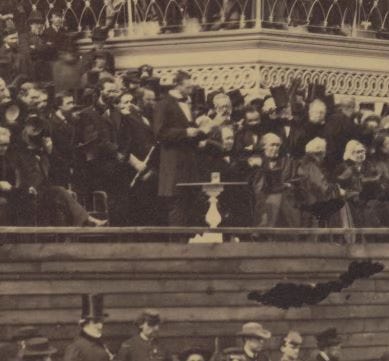
This Day in Legal History: Lincoln’s Second Inaugural
On March 4, 1865, Abraham Lincoln delivered his Second Inaugural Address as he began his second term as President of the United States. The speech came during the final weeks of the Civil War, when Union victory was increasingly likely but the country remained deeply divided. Instead of celebrating the nearing end of the war, Lincoln used the moment to reflect on the deeper causes of the conflict. He identified slavery as the central issue that had brought the nation into war, describing it as both a legal institution and a moral injustice embedded in American law for generations. Lincoln noted that both the North and South had participated in a system that allowed slavery to endure within the nation’s constitutional framework.
In one of the address’s most striking passages, Lincoln suggested that the war itself might be understood as divine judgment for the nation’s long tolerance of slavery. He observed that slavery had existed in the Americas for centuries and reflected on the possibility that the immense suffering of the war was a form of punishment for that history. Lincoln famously stated that if divine providence willed that the war continue “until every drop of blood drawn with the lash shall be paid by another drawn with the sword,” then such judgment might still be just. This reflection framed the war not simply as a political conflict but as a reckoning with a deeply rooted legal and moral wrong.
Lincoln’s remarks also pointed toward the constitutional transformation already underway through the pending Thirteenth Amendment to the United States Constitution. Congress had passed the amendment earlier in 1865, and it awaited ratification by the states. If adopted, it would permanently abolish slavery across the United States and fundamentally alter the constitutional order. Lincoln’s speech emphasized that the war’s conclusion would also mark a legal turning point, ending a constitutional system that had protected slavery. At the same time, he called for reconciliation in rebuilding the nation, urging the country to move forward “with malice toward none.” Only months later, the Civil War ended and the Thirteenth Amendment was ratified in December 1865, permanently outlawing slavery in the United States.
The House Oversight Committee has asked several high-profile figures to testify about their connections to Jeffrey Epstein as part of a broader investigation into how the federal government handled the case. Those requested to appear include departing Goldman Sachs Chief Legal Officer Kathryn Ruemmler, Microsoft co-founder Bill Gates, and Apollo Global Management co-founder Leon Black.
The request to Ruemmler comes shortly after she announced plans to step down from Goldman Sachs and after Justice Department records brought renewed attention to her past communications with Epstein. Emails show that she sought career advice from him while exploring a move from Latham & Watkins to Facebook in 2018 and referred to him in messages as “Uncle Jeffrey.” The correspondence also mentioned gifts she received from him. Reports previously revealed that the two had numerous meetings during the 2010s, years after Epstein had served a prison sentence related to prostitution offenses involving minors.
The committee’s inquiry focuses on whether Epstein and his associate Ghislaine Maxwell used relationships with influential individuals to gain protection or influence while operating their sex-trafficking scheme. Lawmakers are also examining the federal government’s handling of the investigation and the circumstances surrounding Epstein’s death in a Manhattan federal jail in 2019.
Along with Ruemmler, Gates and Black received similar requests for testimony. Gates has indicated he is willing to cooperate and answer questions from the committee. Black, meanwhile, is also facing a proposed class action accusing Apollo and its leadership of misleading investors about their connections to Epstein, allegations the firm has publicly denied.
Other individuals asked to appear include Epstein’s former assistants, political adviser Doug Band, and Gateway co-founder Ted Waitt. The committee has already interviewed several prominent figures, including former President Bill Clinton and former Secretary of State Hillary Clinton, as it continues reviewing the scope of Epstein’s network and the government’s response to his crimes.
Goldman’s Departing CLO, Gates Asked To Testify On Epstein - Law360 UK
The Justice Department quickly reversed course in an ongoing legal fight over executive orders issued by President Donald Trump targeting several prominent law firms. Late Monday, government lawyers told a federal appeals court they planned to drop their appeal after multiple federal judges ruled the orders unconstitutional. But the next day the department asked the court for permission to withdraw that dismissal request and continue defending the orders.
The executive orders targeted firms including Perkins Coie, WilmerHale, Susman Godfrey, and Jenner & Block. The measures sought to restrict the firms’ security clearances, government contracts, and access to federal buildings, citing concerns about their clients and hiring practices. The firms challenged the orders in court, arguing they were unconstitutional retaliation against legal advocates.
Federal judges consistently sided with the firms, with one ruling describing the order against Perkins Coie as an unprecedented attack on the legal system. After those rulings, the Justice Department initially appeared ready to abandon the appeal. Its sudden reversal, however, would allow the administration to continue fighting the cases before the U.S. Court of Appeals for the D.C. Circuit.
The law firms criticized the shift, saying the government offered no explanation for changing its position so quickly. They reiterated their commitment to challenging what they view as an unconstitutional attempt to punish law firms for representing disfavored clients. Civil liberties advocates echoed that criticism, arguing the orders represent a misuse of presidential power.
The litigation highlights a broader dispute over the limits of executive authority and the independence of the legal profession. As the appeals process continues, the courts will ultimately decide whether the executive orders can survive constitutional scrutiny.
BREAKING: DOJ Nixes Plan To Drop Law Firm EO Appeals In About-Face - Law360
In quick reversal, DOJ seeks to continue Trump’s battle with law firms
A trial beginning in Chicago will examine claims that baby formula made by Abbott Laboratories caused premature infants to develop a serious and potentially deadly intestinal condition known as necrotizing enterocolitis (NEC). The case consolidates lawsuits from four families whose premature children were born in Chicago-area hospitals between 2012 and 2019 and later developed the disease. Although the infants survived, the lawsuits say several required surgery and continue to face long-term health complications.
The case is part of a much larger wave of litigation against Abbott and Mead Johnson, the manufacturer of Enfamil. Nearly 1,000 lawsuits have been filed across the country alleging that the companies failed to warn doctors that cow’s milk-based formulas used in hospitals may increase the risk of NEC in premature infants. Many of those cases are consolidated in federal court in Illinois, while others are pending in state courts.
Abbott denies that its formulas cause the disease and maintains that the products are medically necessary when mothers cannot produce enough breast milk. The company and other researchers point to evidence suggesting that the higher risk of NEC is linked to the absence of breast milk rather than exposure to formula itself.
Previous trials involving similar claims have produced mixed results. Some juries have awarded large verdicts to families, including multimillion-dollar judgments against both Abbott and Mead Johnson, though those decisions are currently under appeal. Other cases have resulted in defense wins or retrials, and several potential bellwether cases in federal court have been dismissed.
The Chicago trial, which begins with jury selection, is expected to last several weeks and could influence how the remaining lawsuits move forward. With hundreds of similar claims still pending, the outcome may play an important role in shaping the broader litigation over infant formula and NEC.
Abbott set to face trial over claims premature infant formula caused deadly disease | Reuters
In this week’s column, I look at a new California proposal that attempts to sidestep the federal cap on state and local tax (SALT) deductions by reclassifying vehicle sales taxes as licensing fees. The idea is simple: if the charge is treated as a property-style fee instead of a sales tax, it could fall into a category that allows taxpayers to make greater use of their federal SALT deduction. Supporters frame the proposal as middle-class tax relief and a way to reduce the amount of federal revenue flowing out of California. But while the policy is clever, its practical benefits would be limited and uneven.
The proposal follows a familiar strategy used since the 2017 tax law capped SALT deductions: when one type of tax becomes less deductible, lawmakers try to redesign the tax structure so the revenue flows through a category that remains deductible. California’s approach focuses on vehicle purchases, where sales taxes are currently difficult to deduct for many residents. By redefining those charges as licensing fees, lawmakers hope taxpayers could claim them alongside property taxes under the federal deduction cap.
In practice, though, most lower-income taxpayers wouldn’t benefit at all. Many households take the standard deduction rather than itemizing, especially after recent tax reforms increased its size. For those taxpayers, changing the label on a vehicle tax doesn’t meaningfully change their federal tax bill. Even for many itemizers, the savings would likely be small.
The proposal mainly helps a narrow band of higher-earning taxpayers—people with substantial state and property taxes who are still just below the federal SALT cap. For them, a vehicle purchase could generate a deductible amount that meaningfully lowers their federal tax liability. But that advantage grows with the price of the car and the taxpayer’s marginal tax rate, which means the largest benefits flow to relatively affluent households.
If the goal is truly middle-class relief, a more direct approach would likely work better. For example, a refundable state tax credit tied to vehicle purchases could help working families without depending on federal deduction rules or itemization. Another long-term option would be shifting some of California’s tax burden from individuals to businesses, since certain business-level taxes remain deductible federally.
California’s proposal shows the creativity that the SALT deduction cap has sparked among state policymakers. The real question, however, is whether clever tax reclassification is the right tool—or whether more straightforward policies aimed directly at middle-income taxpayers would produce fairer and more predictable results.
California SALT Deduction Proposal Is More Clever Than Helpful


