



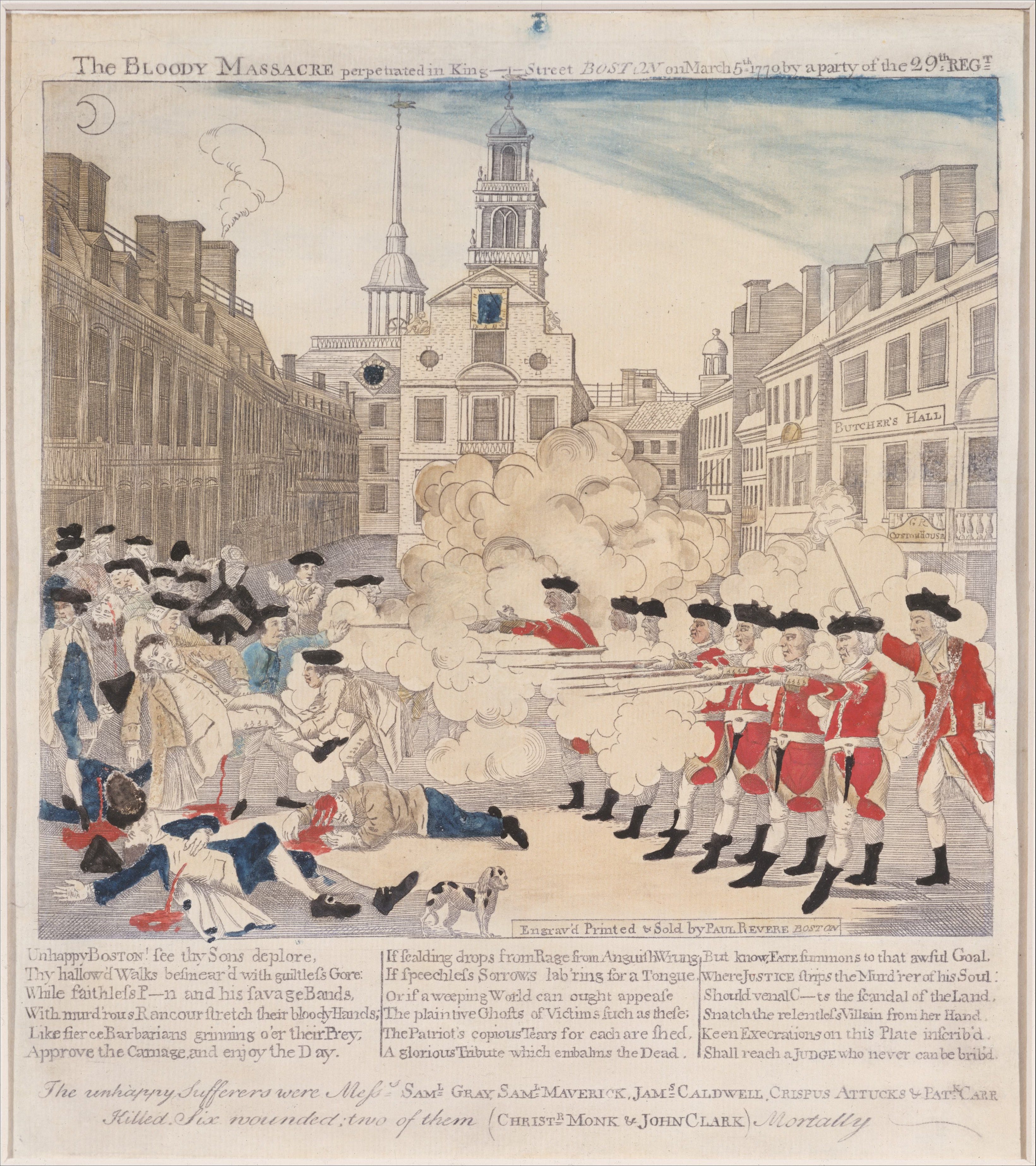
This Day in Legal History: Boston Massacre
On March 5, 1770, a confrontation between British soldiers and American colonists in Boston turned deadly in what became known as the Boston Massacre. Tensions had been rising for months as British troops occupied the city to enforce parliamentary taxes that many colonists believed were unjust. On that evening, a crowd gathered near the Boston Custom House and began taunting a British sentry, shouting insults and throwing snowballs and debris. As the situation escalated, additional soldiers arrived to support the guard, but the crowd continued to press in. In the confusion and fear of the moment, the soldiers fired into the crowd. Five colonists were killed and several others were wounded, including Crispus Attucks, who is often remembered as the first casualty of the American Revolution.
The incident quickly became a flashpoint in colonial politics, with patriot leaders using it as evidence of British tyranny. Yet the legal response that followed was notable for its commitment to due process despite intense public anger. British Captain Thomas Preston and eight soldiers were arrested and charged with murder. Future president John Adams agreed to defend the soldiers, arguing that the rule of law required even deeply unpopular defendants to receive a fair trial. During the proceedings, Adams emphasized the evidence suggesting the soldiers had been surrounded and threatened by a hostile crowd. The jury ultimately acquitted six soldiers and convicted two of the lesser charge of manslaughter.
The trials demonstrated an early American commitment to the principle that legal judgments should be guided by evidence rather than public pressure, even during moments of political upheaval.
The U.S. Supreme Court ruled that New Jersey cannot use sovereign immunity to protect New Jersey Transit from personal injury lawsuits filed by riders injured outside the state. The unanimous opinion, written by Sonia Sotomayor, resolved a conflict between the Pennsylvania Supreme Court and the New York Court of Appeals over whether the transit agency qualifies as an “arm of the state.” The dispute arose from two lawsuits filed by passengers injured in NJ Transit bus crashes that occurred outside New Jersey.
The justices focused heavily on how the agency was structured. During oral argument, several members of the Court questioned why New Jersey created NJ Transit as a corporation with the ability to sue and be sued while also disclaiming responsibility for its debts. Some justices suggested those design choices undermined the state’s argument that the agency should receive sovereign immunity protections.
New Jersey’s lawyers argued that the agency’s independence is largely formal and that the governor maintains significant control over the system. They also warned that allowing such lawsuits could subject the state to litigation in other states’ courts. However, the Court appeared unconvinced by those arguments and emphasized that the plaintiffs were private individuals seeking compensation rather than other states trying to regulate New Jersey.
The ruling ultimately sided with the New York court’s earlier decision and overturned the Pennsylvania ruling, allowing the personal injury lawsuits to proceed.
Supreme Court Rejects NJ Immunity Defense In NY, Pa. Suits
Regulators are increasingly focusing on dynamic or algorithmic pricing, a practice that uses personal data—such as location, browsing history, and purchasing behavior—to set individualized prices for consumers. The approach has raised concerns among privacy and consumer protection regulators because it relies on large amounts of personal data and may affect price transparency. Although grocery pricing has drawn the most attention, the practice is also used in industries like travel, financial services, and online retail.
The Federal Trade Commission has been studying the issue but has not clearly stated whether dynamic pricing violates any specific federal law. In 2024, the agency issued subpoenas to companies that develop pricing algorithms to learn how they collect consumer data, train their systems, and influence the prices consumers see. A preliminary research summary released in 2025 confirmed that these tools rely heavily on consumer data and can adjust prices in real time, but it did not identify specific legal violations.
While the federal approach remains uncertain, state regulators are taking more direct action. The office of Rob Bonta, the California attorney general, launched an investigative sweep in January 2026 to examine how companies use consumer data to personalize prices. Investigators sent letters to retailers, grocery stores, and hotels requesting information about pricing algorithms, data sources, and disclosures to consumers.
Meanwhile, the New York Attorney General’s Office is investigating companies’ compliance with the state’s new Algorithmic Pricing Disclosure Act. The law requires businesses to clearly inform consumers when prices are generated using algorithms that rely on their personal data. Regulators have warned that disclosures hidden behind hyperlinks may not satisfy the law’s requirement that notices be clear and conspicuous.
Other states are considering similar legislation, including proposals targeting surveillance-based pricing or banning dynamic pricing in certain industries. As scrutiny increases, companies that use personalized pricing tools are being urged to review their data practices, pricing disclosures, and compliance with emerging state privacy laws.
Amidst uncertainty from FTC, states zero in on dynamic and algorithmic pricing | Reuters
The U.S. civilian federal workforce decreased by about 12% between September 2024 and January 2026, according to newly released government data. The reductions reflect efforts by Donald Trump’s administration to shrink federal agencies, a policy he promoted as a way to reduce government size and increase efficiency.
Several major departments experienced significant staffing losses. The U.S. Department of the Treasury saw its workforce drop by roughly 24%, while the U.S. Department of Health and Human Services lost about 20% of its employees during the same period. These reductions represent some of the largest declines across federal agencies.
One notable exception was the U.S. Department of Homeland Security, which slightly increased its workforce by less than 1%. The agency’s growth reflects the administration’s continued focus on immigration enforcement and deportation efforts.
Overall, the data indicates that the administration’s push to cut federal staffing has had a broad impact across much of the government, significantly reducing the number of civilian employees in many departments.
US government workforce shrunk by 12% since September 2024 | Reuters


