



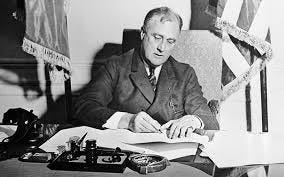
This Day in Legal History: FDR Declares Bank Holiday
On March 6, 1933, just two days after taking office, President Franklin D. Roosevelt declared a nationwide bank holiday in response to the escalating financial panic of the Great Depression. At the time, banks across the country were collapsing as frightened depositors rushed to withdraw their savings. The closures threatened to completely destabilize the American financial system. Roosevelt used emergency executive authority to temporarily shut down the nation’s banks in order to stop the flood of withdrawals. The pause allowed federal officials to inspect financial institutions and determine which were stable enough to reopen.
Although the order began as an executive action, Congress quickly moved to support the president’s efforts. On March 9, lawmakers passed the Emergency Banking Act, which retroactively approved Roosevelt’s bank holiday and expanded federal oversight of banks. The law allowed only financially sound banks to resume operations and provided additional confidence to depositors. In the days that followed, many banks reopened under stricter supervision, and public trust gradually returned to the banking system. Roosevelt reinforced this confidence through his first “fireside chat,” explaining the reforms directly to the American public.
Legal challenges later tested the government’s authority to take such sweeping action during a crisis. Courts ultimately upheld many emergency financial measures adopted during the early New Deal period. These rulings helped establish the principle that the federal government has broader power to respond to national economic emergencies. The bank holiday of March 6, 1933, therefore became an important early example of how executive initiative and congressional support can combine to address a national crisis.
An insurer has filed a lawsuit accusing OpenAI of engaging in the unauthorized practice of law after its AI chatbot allegedly provided faulty legal assistance to a disability benefits recipient. According to the complaint, Nippon Life Insurance Co. of America had settled a long-term disability dispute with Graciela Dela Torre in January 2024. About a year later, she questioned the agreement and asked her attorney about reopening the case due to alleged documentation problems. When her lawyer explained that the settlement was final, Dela Torre consulted ChatGPT, asking whether her attorney had dismissed her concerns.
The insurer claims the chatbot suggested that her attorney had invalidated her feelings and deflected responsibility. After receiving that response, Dela Torre fired her lawyer and attempted to reopen the case on her own. The lawsuit alleges that ChatGPT generated legal arguments asserting that her former counsel had pressured her into signing a blank signature page. She filed a motion based on those arguments, which Nippon says violated the settlement agreement releasing the company from future claims.
According to the complaint, Dela Torre then submitted numerous additional filings drafted with the chatbot’s help, including more than twenty motions and other court documents. The court rejected her attempt to reopen the case and upheld the settlement as valid. Despite that ruling, she allegedly used ChatGPT again to prepare a new lawsuit asserting claims such as fraudulent misrepresentation and interference with disability benefits. Nippon says she has filed dozens of motions that serve no legitimate legal purpose, forcing the company to spend significant time responding. The insurer is now seeking damages and an injunction preventing OpenAI from providing legal assistance to Dela Torre, while OpenAI has dismissed the claims as meritless.
OpenAI Practices Law Without A License, Insurer Alleges - Law360
A coalition of 24 states has filed a lawsuit challenging new global tariffs imposed by President Donald Trump. The case was brought in the U.S. Court of International Trade and seeks to block tariffs introduced on February 20 under Section 122 of the Trade Act of 1974. The states argue the administration rushed to impose the tariffs only hours after the U.S. Supreme Court invalidated an earlier set of trade measures that had been issued under a different statute. According to the complaint, the new tariffs were an attempt to revive similar trade restrictions using a separate legal authority.
The policy first imposed a 10% tariff on imports worldwide and was raised to the statute’s maximum 15% the following day. The administration justified the move by claiming it was necessary to address serious U.S. balance-of-payments deficits. However, the states argue that such deficits do not actually exist and that the government selectively relied on negative data while ignoring overall positive financial inflows. They claim this misuse of the statute mirrors the earlier tariffs that the Supreme Court struck down.
The lawsuit also argues that the tariffs violate the Constitution because the authority to impose taxes and duties belongs to Congress. The Supreme Court recently emphasized this principle when it ruled against the administration’s earlier tariff policy. According to the states, Section 122 was originally enacted to address problems tied to an outdated international currency system that no longer exists today. Because the statutory conditions cannot be met, the coalition argues the president’s tariffs are unlawful. The states are asking the court to invalidate the measures before they remain in effect through the summer.
Two Dozen States Sue Trump to Halt New Global Tariffs - Law360
Twenty-four US states file lawsuit to stop Trump’s latest global tariffs | Reuters
A federal trade judge is meeting privately with government lawyers to determine how the United States will refund billions of dollars in tariffs that courts recently ruled unconstitutional. Judge Richard Eaton of the U.S. Court of International Trade scheduled the closed-door meeting as a settlement conference to discuss a practical process for returning money to importers. The tariffs at issue were a major part of President Donald Trump’s trade policy but were struck down by the U.S. Supreme Court in February for exceeding presidential authority. Because the Court did not provide guidance on how refunds should be handled, lower courts are now working to establish a workable procedure.
The scale of the refunds could be enormous, potentially reaching $175 billion and affecting more than 300,000 importers. Government attorneys have warned that processing the reimbursements will be unusually complex because it may involve manual review of tens of millions of tariff payments. Many of the affected importers are small businesses concerned about the cost and administrative burden of seeking repayment. Judge Eaton has indicated that he wants a system that avoids forcing companies to file individual lawsuits.
The issue arose in a case filed by Atmus Filtration Inc., which claims it paid $11 million in unlawful tariffs. Eaton recently ordered U.S. Customs and Border Protection to begin using its internal processes to refund tariffs not only to Atmus but potentially to all affected importers. The upcoming conference is expected to focus on how the agency can efficiently review roughly 79 million shipments and distribute refunds. Attorneys involved in related cases believe the meeting could lead to a standardized process that allows most businesses to receive reimbursements without extended litigation.
A federal appeals court has ruled that President Donald Trump has the authority to suspend refugee admissions to the United States, reversing most of a lower court decision that had blocked the policy. The ruling came from a three-judge panel of the U.S. Court of Appeals for the Ninth Circuit. The judges concluded that federal law gives the president broad power to restrict the entry of foreign nationals when he believes it serves national interests. As a result, the panel allowed Trump’s halt of the U.S. Refugee Admissions Program to remain in place.
The policy was introduced shortly after Trump took office in 2025 and paused the admission of refugees while the administration reviewed whether the program ensured proper assimilation. Refugees, their family members, and several resettlement organizations filed a class action lawsuit challenging the move. A federal judge in Seattle had previously issued injunctions blocking the suspension and related actions. However, the Ninth Circuit determined that most of those rulings exceeded the district court’s authority.
Writing for the panel, Judge Jay Bybee acknowledged that the decision could have serious real-world consequences for thousands of refugees who had already completed years of vetting and were awaiting resettlement. Despite those concerns, the court emphasized that Congress granted the president sweeping authority over immigration entry decisions. The judges said policy judgments about refugee admissions belong to the executive branch rather than the courts.
The panel did leave some portions of the lower court’s order in place. It upheld injunctions that prevent the government from cutting services to refugees who have already been admitted to the United States and from terminating certain agreements with refugee support organizations. One judge dissented in part, arguing that the district court’s injunctions should have been entirely overturned.
Trump can suspend refugee admissions, US appeals court rules | Reuters


