



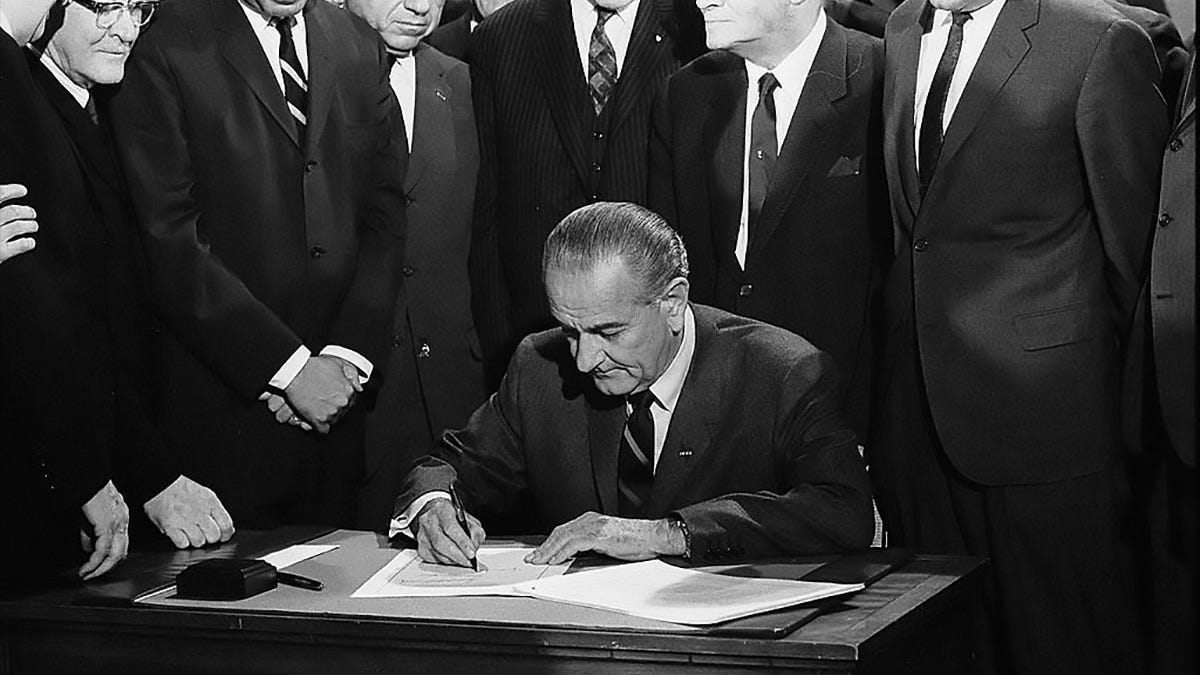
This Day in Legal History: Civil Rights Act of 1968
On April 6, 1968, President Lyndon B. Johnson signed the Civil Rights Act of 1968 into law, marking a major expansion of federal civil rights protections. Commonly known as the Fair Housing Act, the legislation aimed to eliminate discrimination in the sale, rental, and financing of housing. It prohibited unequal treatment based on race, religion, and national origin, later expanding to include sex and other protected characteristics. The law emerged during a period of national unrest, passed just days after the assassination of Martin Luther King Jr.. King had long advocated for fair housing as a central component of racial equality, particularly in Northern cities.
The Act addressed systemic practices such as redlining, steering, and discriminatory lending that had historically segregated communities. It gave the federal government authority to enforce fair housing standards, though early enforcement mechanisms were relatively weak. Over time, amendments strengthened the law, adding protections for people with disabilities and families with children. The statute also allowed individuals to file complaints with the Department of Housing and Urban Development or pursue private lawsuits. Courts have since played a key role in interpreting the scope of the Act, especially in recognizing claims based on disparate impact.
A central legal concept tied to the Fair Housing Act is disparate impact, which refers to policies that appear neutral but disproportionately harm protected groups. Unlike intentional discrimination, disparate impact does not require proof of discriminatory intent, only that a practice has an unequal effect. This theory became firmly established in housing law through later litigation and was upheld by the Supreme Court in cases interpreting the Act. It remains a critical tool for challenging structural inequality in housing markets.
The passage of the Civil Rights Act of 1968 represented both a response to national tragedy and a continuation of the broader civil rights movement’s legislative achievements.
A federal judge refused to reverse his earlier decision blocking subpoenas targeting Federal Reserve Chair Jerome Powell, effectively pausing a criminal investigation and setting up a likely appeal. Chief Judge James Boasberg ruled that prosecutors failed to show any valid basis for suspecting wrongdoing and criticized the lack of evidence supporting fraud allegations. He had previously found that the subpoenas were issued for an improper purpose, suggesting they were meant to pressure Powell to lower interest rates or step down.
The subpoenas, issued by prosecutor Jeanine Pirro, sought information about cost overruns at the Federal Reserve’s headquarters and Powell’s prior congressional testimony. However, the court found no good-faith basis for believing a crime had occurred. Prosecutors argued the judge applied too strict a standard and misread the timeline of the investigation, but the court rejected those claims. Pirro’s office has said it will appeal the ruling, a move supported by Justice Department leadership.
The dispute reflects broader tensions between Powell and allies of President Donald Trump, with Powell arguing the investigation is an attempt to influence Federal Reserve policy. The appeal could delay efforts to confirm Kevin Warsh as a replacement for Powell, as some lawmakers have pledged to block the nomination while the case continues. Powell has said he will remain in his role until the legal challenge is resolved.
US judge upholds block on subpoenas to Fed’s Powell, teeing up likely appeal | Reuters
A federal judge blocked the Trump administration from requiring public universities in 17 states to provide extensive admissions data related to race and sex. Judge F. Dennis Saylor IV issued a preliminary injunction after state attorneys general challenged the policy, arguing it was imposed too quickly and created legal risks for schools. The data request came from the Department of Education, which sought seven years of information to evaluate whether colleges were complying with the Supreme Court’s decision in Students for Fair Admissions v. Harvard that ended affirmative action in higher education.
The states argued that the reporting requirement was confusing and could expose universities to penalties for accidental errors. The court agreed that the rollout was “rushed and chaotic,” noting that officials failed to properly consider concerns raised by universities. At the same time, the judge acknowledged that the Department of Education does have legal authority to collect such data in general. The issue, he emphasized, was how the policy was implemented, not necessarily the underlying power itself.
The ruling also pointed to practical problems, including staffing shortages within the agency after workforce reductions, which made it harder to manage the data collection process. Officials in states like New York and California supported the decision, saying schools should not be forced to produce large amounts of sensitive information under unclear requirements.
Trump administration can’t make colleges provide race-related data, judge rules | Reuters
The Trump administration filed an emergency motion asking an appeals court to allow construction to resume on a planned White House ballroom after a judge ordered the project paused. The administration argued that stopping the work creates serious security risks, claiming the site has been left vulnerable and could endanger the president, staff, and the building itself. The pause was ordered by Judge Richard Leon, who halted construction while a legal challenge moves forward.
The lawsuit was brought by the National Trust for Historic Preservation, which argues that President Donald Trumpexceeded his authority by demolishing the historic East Wing and beginning a $400 million replacement project without congressional approval. In response, the administration claims the lawsuit is legally flawed and that the president has full authority to renovate the White House. It also argues that the plaintiffs lack standing, meaning they do not have a sufficient legal stake to bring the case.
Judge Leon temporarily paused his own order for 14 days to give the administration time to appeal, and the new emergency motion asks the appellate court to lift the construction halt entirely. The administration further contends that the lower court should not have heard the case at all, characterizing the claims as based on subjective concerns rather than legal injury.


