


This Day in Legal History: Freedom Riders
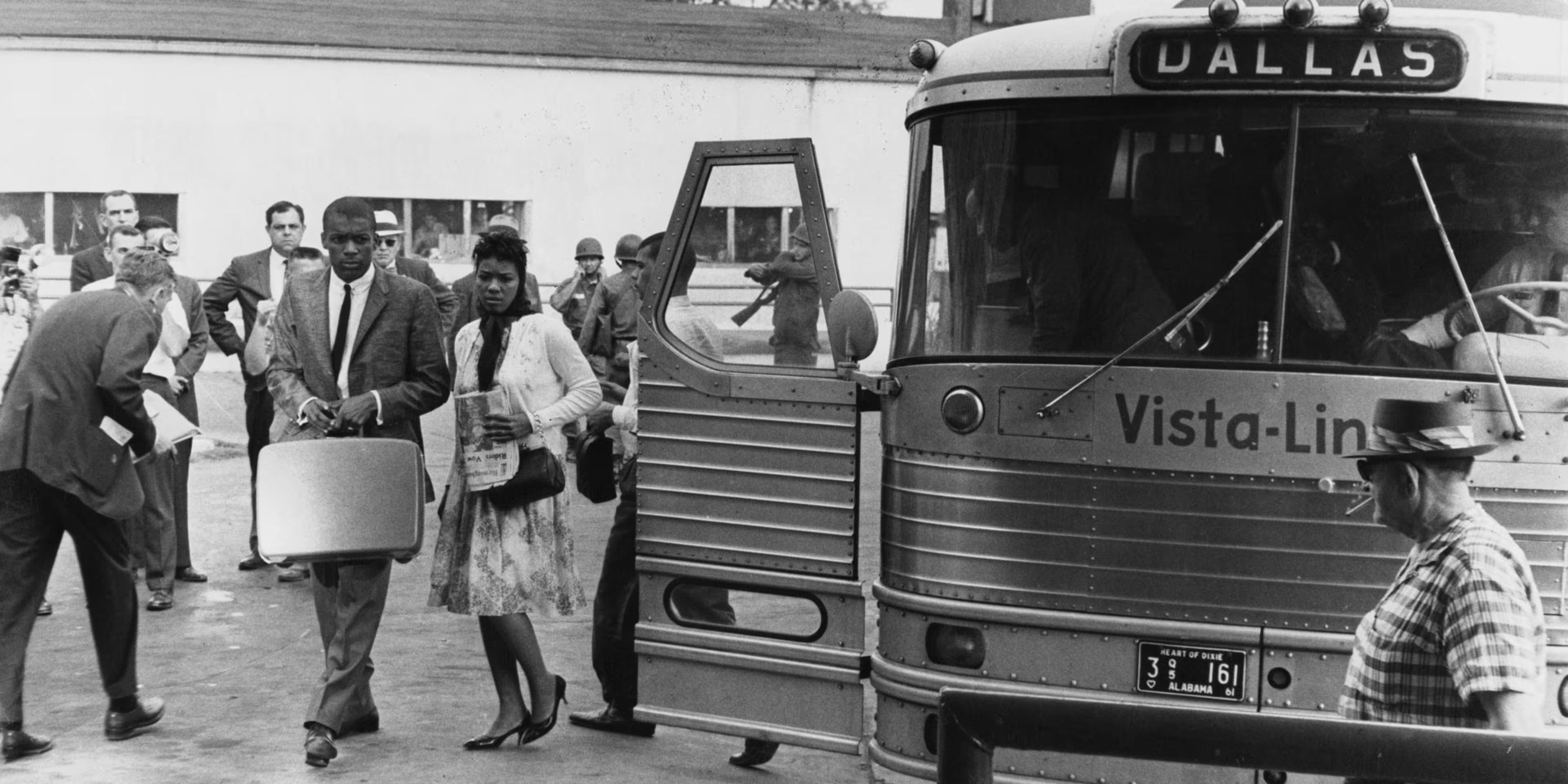
On May 4, 1961, the first Freedom Riders left Washington, D.C., by bus for New Orleans, beginning a direct challenge to segregation in interstate travel. The riders were an interracial group organized by the Congress of Racial Equality, and they set out to test whether Southern states and private carriers would follow federal law. The Supreme Court had already made clear in cases such as Boynton v. Virginia that segregation in facilities connected to interstate bus travel was unconstitutional. But in much of the South, those rulings existed more on paper than in practice. Bus stations, waiting rooms, lunch counters, and restrooms remained divided by race, often with the cooperation or indifference of local officials.
The Freedom Riders deliberately entered that space between legal doctrine and daily reality. By riding together, sitting together, and using facilities marked for white and Black passengers, they forced the country to confront the failure of enforcement. Their journey showed that a constitutional right means little when states, businesses, and police can ignore it without consequence. The riders were met with arrests, intimidation, and mob violence, making the legal stakes impossible for federal officials to avoid. Their campaign placed pressure on the Kennedy administration and the Interstate Commerce Commission to act more forcefully.
Later in 1961, federal regulators issued rules requiring the desegregation of interstate bus and rail facilities and the removal of segregation signs. The Freedom Rides therefore became more than a protest against Jim Crow transportation rules. They became a test of whether federal constitutional law could overcome local resistance. May 4 stands as the date when a small group of riders exposed the difference between winning rights in court and making those rights real in public life.
New Mexico Attorney General Raúl Torrez won a major jury verdict against Meta in March, with jurors ordering the company to pay $375 million over claims that it concealed the harms Instagram and Facebook pose to minors and failed to protect young users from sexual exploitation, bullying, and harmful content. The next stage of the case is a bench trial before Judge Bryan Biedscheid, where the state will seek court-ordered changes to Meta’s platforms and argue that the company’s apps amount to a public nuisance. New Mexico is asking for a wide range of remedies, including safety warnings, stronger detection of child sexual abuse material, limits on teen usage, removal of infinite scroll, hidden like counts, restrictions on AI chatbot interactions with minors, and appointment of a child safety monitor. Meta argues that these requests are sweeping, technically unrealistic, and would effectively require a different version of Instagram to operate in New Mexico. The company also says some requested remedies, such as warning labels about teen mental health harms, would violate the First Amendment by compelling speech.
Legal experts say the injunction phase may be even more significant than the damages award because it could reshape how digital platforms are designed and regulated. They also note that the case raises difficult questions about whether public nuisance law is an appropriate way to address alleged harms from social media platforms. The judge declined to delay the second phase, saying the evidence from the jury trial remains fresh and will help him evaluate the requested relief. The state argues the trial should be more streamlined than the first phase and says Meta cannot claim surprise over the public nuisance theory. Meta maintains that New Mexico is wrongly focusing on one platform while ignoring the many other apps teens use, and says the proposed mandates would interfere with parental rights and free expression.
What To Watch For As Meta Stares Down NM Injunction Trial - Law360 UK
The Department of Defense announced new agreements with several major technology companies to bring their artificial intelligence tools into classified military network environments. The deals involve companies including Nvidia, Google, SpaceX, Reflection, Microsoft, and Amazon Web Services, and are meant to support lawful operational use of AI at high security levels. The Pentagon framed the move as part of a broader effort to make the U.S. military more AI-centered and to help service members make faster and better decisions across different areas of conflict.
The announcement also emphasized that the department does not want to rely on only one AI company or model. Instead, it plans to offer access to a range of AI systems so it can preserve flexibility and avoid becoming dependent on a single vendor. Anthropic was not included in the new agreements, which is significant because the company is currently in litigation after the Pentagon labeled it a supply chain risk to national security. OpenAI had previously reached its own agreement with the Defense Department for use in classified settings and reportedly asked the department to include other AI companies as well.
The Pentagon also said more than 1.3 million personnel have used its official AI platform, GenAI.mil. Amazon Web Services said it has long supported military technology needs and says it will continue helping the department modernize its systems.
Pentagon Reaches AI Deals For Classified Network Use - Law360
A federal appeals court temporarily blocked a 2023 FDA rule that allowed mifepristone, a drug used in medication abortion, to be dispensed by mail rather than in person. The unanimous decision came from a three-judge panel of the Fifth Circuit, which said Louisiana was likely to succeed in its challenge to the Biden-era rule. The ruling is not final, but it immediately narrows access to mifepristone, especially for patients in states that have banned or sharply restricted abortion.
Louisiana argued that the FDA failed to adequately consider safety risks when it removed the in-person dispensing requirement. The Biden administration had defended the rule by pointing to evidence that mifepristone is safe and effective, with serious adverse events occurring in fewer than 1% of patients. Abortion rights advocates warned that restoring in-person dispensing rules would create confusion and make abortion care much harder to obtain. The decision comes amid a broader set of lawsuits over mifepristone, including challenges to the drug’s original approval and later FDA rules expanding access.
Drugmakers Danco Laboratories and GenBioPro have intervened to defend the FDA’s regulation because their businesses depend heavily on mifepristone sales. The case may next go to the full Fifth Circuit or the U.S. Supreme Court. The ruling also intersects with newer fights over telehealth abortion prescriptions and state shield laws protecting providers in states where abortion remains legal.
US court blocks mail-order access to abortion drugs, for now | Reuters


