


This Day in Legal History: Rodney King
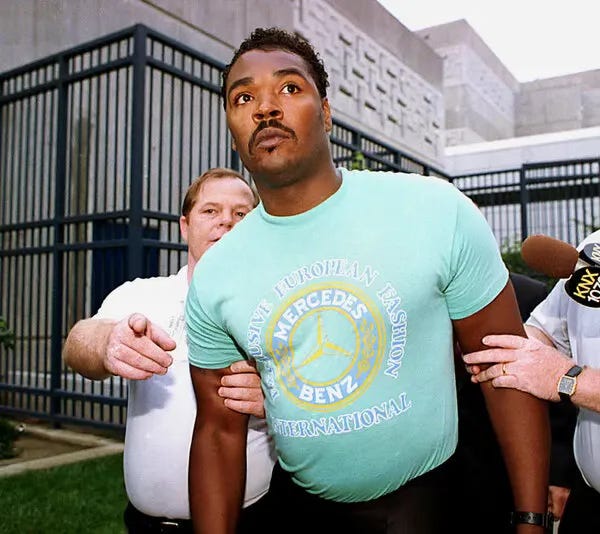
On April 29, 1992, a California jury acquitted four Los Angeles police officers charged in the beating of Rodney King, a Black motorist whose assault had been captured on videotape the year before. The beating took place on March 3, 1991, after a police chase, when officers repeatedly struck King while a bystander recorded the incident from nearby. The footage became one of the most important pieces of video evidence in modern American legal history, not because it settled the matter, but because it showed how even seemingly clear evidence can be interpreted differently in a courtroom.
To much of the public, the video appeared to show obvious police brutality. To the defense, it became something to be slowed down, segmented, and reframed as a series of split-second decisions by officers claiming fear and loss of control. When the jury acquitted the officers, the verdict landed in Los Angeles as a statement about far more than one criminal prosecution. For many residents, especially Black Angelenos, it confirmed the belief that the legal system was unwilling or unable to hold police accountable for violence against Black citizens.
The verdict triggered several days of unrest across Los Angeles, leaving more than 60 people dead, thousands injured, and large portions of the city damaged. The case also forced the country to confront the relationship between race, policing, prosecutorial burden, and jury perception. The state-court acquittals did not end the legal story, because federal prosecutors later brought civil rights charges against the officers.
In 1993, two officers, Laurence Powell and Stacey Koon, were convicted in federal court, while two others were acquitted. King also later received a civil damages award from the City of Los Angeles. April 29 remains a major date in legal history because it revealed the limits of video evidence, the difficulty of prosecuting police officers, and the deep public consequences that can follow when a courtroom verdict collides with what millions of people feel they have already seen.
Purdue Pharma was sentenced in federal court in New Jersey to $5.5 billion in fines and penalties tied to its 2020 guilty plea over misconduct connected to OxyContin sales. The sentencing helps clear the path for Purdue to wind down through bankruptcy and fund a broader $7.4 billion opioid settlement. Before approving the plea deal, Judge Madeline Cox Arleo heard hours of testimony from people who described addiction, death, and family devastation connected to the opioid crisis. More than 200 victims submitted letters, and more than 40 people spoke in court.
Purdue’s chairman, Steve Miller, apologized directly to victims after the judge instructed him to do so. Arleo also apologized from the bench, telling victims that the government had failed them by missing opportunities to stop Purdue’s conduct earlier. Many speakers said financial punishment was not enough and argued that Purdue’s owners, the Sackler family, or company executives should face prison time. The judge said she could not impose jail time because the Justice Department had charged the company, not the individual owners or executives. Although the formal sentence is $5.5 billion, most of that amount will not actually be paid, with the government expected to collect $225 million if Purdue uses its remaining assets to pay creditors.
The settlement includes money for governments and an $865 million fund for individuals, but many victims worry they will be excluded because they cannot produce old prescription records. Purdue says it is on track to exit bankruptcy as a new nonprofit company focused on opioid addiction treatment and overdose-reversal medicines.
Purdue Pharma receives $5.5 billion sentence, paving way for opioid settlement | Reuters
The Justice Department has indicted former FBI Director James Comey over a 2025 Instagram post showing seashells arranged as “86 47,” which prosecutors say amounted to a threat against President Donald Trump. The case was filed in federal court in North Carolina and charges Comey with threatening the president’s life and transmitting a threat across state lines. Comey has said he did not intend violence, explaining that he deleted the post after learning some people interpreted the numbers that way.
Trump and his allies had argued the message was a threat, with “47” referring to Trump as the 47th president and “86” being read by them as a call to remove him violently. Acting Attorney General Todd Blanche defended the indictment as a standard threat case, while critics and Comey’s lawyers say it looks like a politically motivated prosecution. The Secret Service had previously looked into the post and interviewed Comey, but he was not charged at that time. One should also place the indictment in the broader context of Trump’s Justice Department pursuing cases against people and groups seen as political opponents.
Comey already faced a separate criminal case over alleged false testimony to Congress, but that case was dismissed after a judge found a problem with the prosecutor’s appointment, and the government is appealing. Comey’s lawyers are expected to argue that the new case is both retaliatory and protected by the First Amendment. The central legal fight will likely be whether the post was a “true threat” or protected political speech.
Trump’s DOJ indicts former FBI director James Comey over ‘86 47’ post | Reuters
The Trump administration has fired all current members of the National Science Board, according to two former board members who spoke to Reuters. The board, created in 1950, helps oversee the National Science Foundation and advises both the president and Congress on science and engineering policy. It had more than 20 members, who were appointed to six-year terms, and most of them came from academia, with others from national labs, nonprofits, and private industry. Former board members Yolanda Gil and Keivan Stassun said they were told by email that their removals were effective immediately.
According to Gil, all 22 current members were terminated and no explanation was given. Stassun said the move was disappointing but not surprising in light of other Trump administration actions affecting scientific research and independent federal bodies. The National Science Foundation referred questions to the White House. A White House official said the NSF’s work would continue without interruption and suggested that the board’s congressionally created powers may need to be updated. The firings fit into a broader pattern described by political experts as an effort by the administration to reshape independent institutions by replacing existing officials with more loyal leadership.
Trump administration fires entire National Science Board | Reuters


