



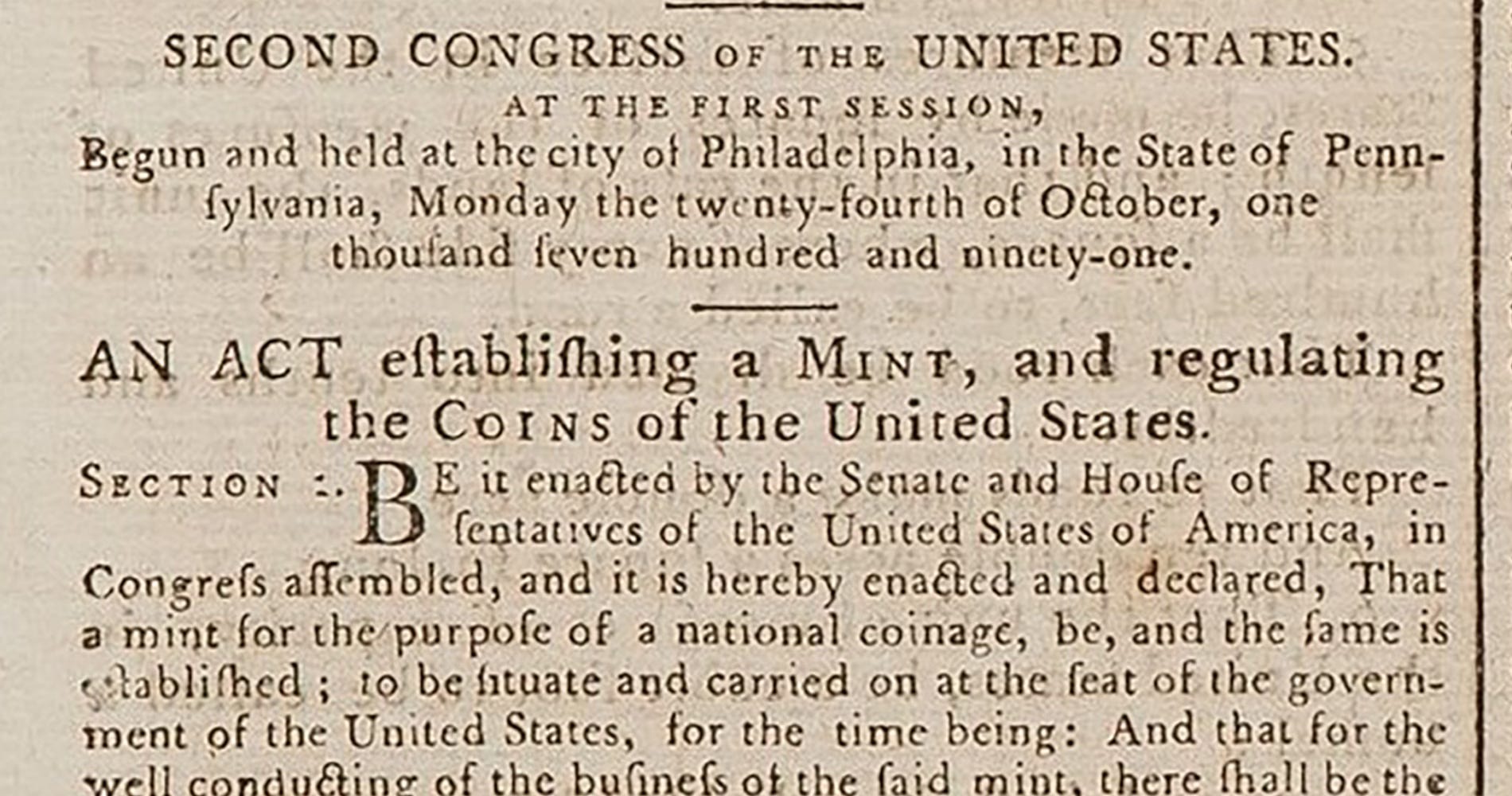
This Day in Legal History: Coinage Act of 1792
On April 2, 1792, the United States took a major step toward economic independence with the passage of the Coinage Act of 1792. This law created the first national mint, later known as the United States Mint, and established a standardized system of coinage for the young nation. Before this act, Americans relied heavily on foreign coins, including Spanish dollars, which made trade inconsistent and difficult to regulate. The law introduced the U.S. dollar as the official unit of currency and set its value based on both gold and silver, adopting a bimetallic standard. It also defined specific denominations, including cents, dimes, and eagles, many of which are still in use today.
A key legal feature of the act was its detailed regulation of coin composition and weight, ensuring uniformity and public trust in the currency. The law imposed strict penalties for debasing coins, including severe criminal consequences, reflecting how seriously the government treated monetary integrity. It also placed the Mint under federal authority, reinforcing the Constitution’s grant of power to Congress to coin money and regulate its value. By standardizing currency, the act helped stabilize commerce and supported the growth of a national economy.
The Coinage Act also carried symbolic importance, as it marked a break from colonial dependence on European financial systems. It demonstrated the federal government’s capacity to create and enforce complex economic regulations. Over time, the framework it established influenced later monetary policies and reforms. The act remains a foundational piece of American financial law, shaping how currency is produced and regulated even today.
The Supreme Court of the United States heard arguments on April 1, 2026, over President Donald Trump’s effort to restrict birthright citizenship, with Trump attending part of the session in person. The case centers on an executive order directing agencies to deny citizenship to children born in the U.S. if their parents are not citizens or permanent residents. Several justices from both ideological wings questioned the administration’s lawyer closely, signaling skepticism about the legal basis of the policy.
The administration argues that the Citizenship Clause of the Fourteenth Amendment to the United States Constitutiondoes not guarantee citizenship to all individuals born on U.S. soil, emphasizing the phrase “subject to the jurisdiction thereof.” Government lawyers claim this language excludes children of undocumented immigrants or temporary visitors. However, multiple justices challenged that interpretation, noting that historical understanding and past precedent support a broader reading.
Chief Justice John Roberts described the administration’s argument as difficult to reconcile with the narrow historical exceptions previously recognized. Justice Sonia Sotomayor pointed to legislative history suggesting lawmakers intended citizenship to apply broadly to those born in the country. Justice Elena Kagan also questioned whether the administration relied on weak or selective historical sources. Conservative justices, including Brett Kavanaugh and Amy Coney Barrett, raised practical concerns about how the policy would be enforced, especially regarding determining parental intent to remain in the U.S.
The challengers argue that the Court already settled the issue in United States v. Wong Kim Ark, which affirmed birthright citizenship for children born on U.S. soil to foreign parents. Some justices suggested that Trump’s position may conflict with that precedent. The case could have wide-reaching consequences, potentially affecting hundreds of thousands of births each year and requiring families to prove citizenship status.
The legal dispute reflects broader tensions over immigration policy and constitutional interpretation, particularly how historical meaning should be applied to modern circumstances. The Court is expected to issue a decision by late June, which could significantly reshape the understanding of citizenship in the United States.
A federal judge has allowed a lawsuit by the American Bar Association to move forward against the administration of Donald Trump. The case claims the administration created an unlawful policy to target law firms based on their past legal work, diversity efforts, and political affiliations. U.S. District Judge Amir Ali found that the ABA plausibly alleged a coordinated effort to intimidate lawyers and firms whose views the government opposed.
According to the ruling, the ABA provided enough detail to suggest the policy may have discouraged firms from taking cases against the administration. The organization argues this created a “chilling effect,” causing some lawyers to avoid certain clients or legal challenges out of fear of retaliation. The lawsuit seeks a declaration that the policy is illegal and an order preventing its enforcement.
The dispute stems from executive orders issued by Trump that targeted specific law firms by restricting their access to federal resources, revoking security clearances, and threatening government contracts tied to their clients. Several courts previously blocked those orders, finding they likely violated constitutional protections such as free speech and due process. The administration has appealed those earlier rulings.
Government lawyers argued the ABA should not be allowed to sue because it was not directly targeted and therefore lacks standing. They also denied that any broader policy to intimidate firms exists and described the claims as speculative. However, the ABA pointed to statements suggesting additional firms could be targeted and argued the effects are ongoing.
Judge Ali’s decision does not resolve the case but allows it to proceed, meaning the courts will continue to examine whether the administration’s actions unlawfully interfered with the legal profession.
Trump administration must face ABA lawsuit over law firm orders, judge rules | Reuters
Luigi Mangione appeared in federal court seeking to delay his upcoming trial related to the killing of a health insurance executive. Mangione is facing federal stalking charges connected to the 2024 shooting death of UnitedHealthcare CEO Brian Thompson and has pleaded not guilty. His lawyers argue the trial should be postponed because he is also preparing for a separate New York state murder trial scheduled to begin earlier in the summer. They say handling two major cases at once would make it difficult for him to prepare an adequate defense.
Prosecutors oppose delaying the federal trial, though they are open to adjusting parts of the pretrial process, such as juror questionnaires, to ensure fairness. Jury selection in the federal case is currently set for September, with opening statements planned for October. Mangione has been in custody since his arrest shortly after the shooting.
A significant development in the case is that the federal murder charge was dismissed earlier, removing the possibility of the death penalty. The judge found that charge conflicted legally with the remaining stalking charges. Even so, Mangione could still face life in prison if convicted federally, along with a lengthy sentence in the state case.
The case has drawn public attention, with some condemning the killing while others have expressed sympathy for Mangione due to broader frustrations with the U.S. healthcare system.
Luigi Mangione due in court in bid to delay federal trial over CEO killing | Reuters


