



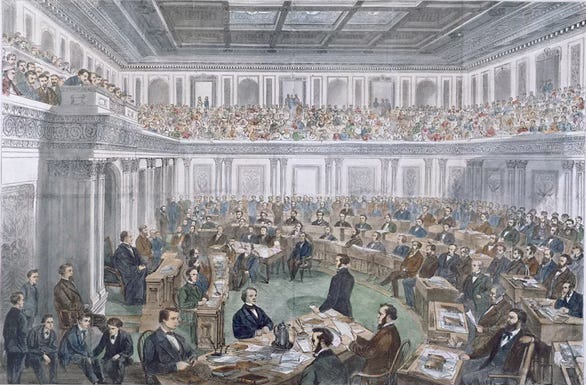
This Day in Legal History: Andrew Johnson Impeachment Trial Ends
On May 26, 1868, the United States Senate ended the impeachment trial of President Andrew Johnson, bringing one of the most dramatic constitutional confrontations in American history to a close. Johnson had been impeached by the House of Representatives earlier that year after clashing repeatedly with Congress over Reconstruction. At the center of the dispute was the future of the defeated South and the legal status of formerly enslaved people after the Civil War. Johnson favored a more lenient approach toward former Confederate states, while the Republican-controlled Congress sought stronger protections for freedmen and stricter conditions for reentry. The immediate trigger for impeachment was Johnson’s attempt to remove Secretary of War Edwin Stanton, which Congress argued violated the Tenure of Office Act. The Senate had already voted on one article of impeachment on May 16, and Johnson survived by a single vote. Ten days later, on May 26, the Senate voted on two more articles, with the result again falling one vote short of the two-thirds majority required for conviction. The final vote of 35 to 19 meant Johnson would remain in office.
After that result, the Senate adjourned as a court of impeachment and the trial came to an end. The acquittal did not make Johnson politically strong, but it preserved the principle that removing a president required more than intense political disagreement. The trial also tested the separation of powers during a period when Congress and the presidency were fighting over who would control Reconstruction. In later years, the Tenure of Office Act was repealed, and its constitutionality remained deeply suspect. Johnson’s impeachment became a lasting example of how legal rules, political conflict, and constitutional design can collide in moments of national crisis.
The House Transportation and Infrastructure Committee has advanced a major five-year transportation funding bill that would send about $580 billion toward roads, bridges, transit, rail projects, and highway safety programs. The measure, called the BUILD America 250 Act, passed the committee by a 62-2 vote after a lengthy markup and now heads to the full House. The bill is meant to replace the current surface transportation law, which was part of the 2021 infrastructure package and is set to expire at the end of September. Supporters from both parties framed the proposal as a way to keep infrastructure funding moving while giving states flexibility and speeding up project delivery.
One of the most closely watched additions is a rail safety package inspired by the 2023 Norfolk Southern derailment in East Palestine, Ohio. That section would require at least two crew members on many trains, add inspection requirements, regulate defect detectors, and place limits on certain hazardous-material trains. Rail labor groups and the White House have backed stronger rules, while the major railroads argue the proposal is driven more by politics and labor demands than by the causes of the East Palestine crash.
The bill would also create a first federal regulatory structure for autonomous commercial vehicles, including automated trucks, buses, and other larger vehicles. Industry supporters say that framework would help the United States compete globally in autonomous transportation, while transit labor leaders say the bill includes important human-oversight protections to keep workers involved and improve safety. Another contested provision would impose a new annual federal registration fee on electric vehicle owners, starting at $130 and later rising to $150, to help support the Highway Trust Fund.
Backers say EV drivers should contribute to road funding because they do not pay federal gas taxes. Electric vehicle advocates, however, call the fee punitive and argue it would discourage EV adoption without meaningfully solving the trust fund’s long-term funding gap.
What’s In The House Surface Transportation Funding Bill? - Law360
The Justice Department has asked a federal court to lift an injunction blocking work on President Donald Trump’s ballroom project, arguing that a recent shooting outside the White House shows why stronger security is needed. In a short filing Sunday, DOJ said the incident highlights the need for high-level security upgrades at the White House, including the ballroom, and again sought dismissal of the lawsuit challenging the project. The case was brought by the National Trust for Historic Preservation, which has opposed the project and previously refused to withdraw its suit after an alleged foiled attack connected to the White House Correspondents’ Association dinner in April. DOJ had already cited that earlier incident in asking the court to end the case. According to the Secret Service, the person who fired at a White House checkpoint on Saturday was shot by officers and later died at a hospital. The filing ties the shooting to the government’s broader argument that the project is important for national security.
US Justice Department seeks to lift injunction on ballroom project after shooting | Reuters
My column for Bloomberg this week argues that Tennessee’s recent decision in SAP America, Inc. v. Gerregano shows how poorly traditional state tax categories fit modern software. The court treated SAP’s software licenses as nontaxable intangible property, while allowing Tennessee to tax cloud hosting and cloud-based services delivered electronically into the state. That split made sense because SAP’s products were cleanly separated into licenses, hosting, and cloud services. But the column argues that most modern software is not so tidy. Even products that seem local often rely on remote tools for logins, updates, syncing, storage, analytics, customer support, or payment processing. As AI becomes built into ordinary software, the line between software and cloud-based service will become even harder to draw.
The column focuses on the “true-object” test, which asks what the customer is really buying when a transaction has multiple elements. That test works when the taxable and nontaxable pieces are visible and separately priced, but it becomes much harder to apply when remote processing is hidden inside a product the customer experiences simply as software. The piece argues that states should adopt a software-specific safe harbor rather than treating every remote feature as taxable cloud access. Under that approach, software would be presumed to remain software when remote functions are limited to things like authentication, updates, syncing, security, or modest product enhancements. A state could rebut that presumption if the customer is really buying hosted processing, managed infrastructure, AI model access, inference, or other platform-level functionality. The point is not to abandon the true-object test, but to give it a clearer threshold for hybrid software. Without that guardrail, AI could give states an easy but flawed path to reclassify almost any software product with a remote model feature as taxable cloud access.


