



This Day in Legal History: The Sedition Act of 1798
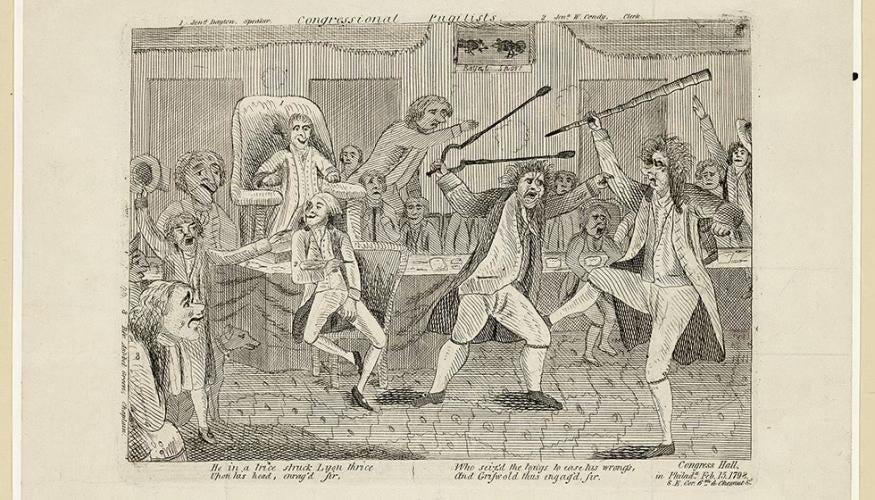
On July 14, 1798, Congress passed the Sedition Act, the most notorious of the four laws known collectively as the Alien and Sedition Acts. The Sedition Act made it a federal crime to write, print, utter, or publish “any false, scandalous and malicious writing” against the government of the United States, the Congress, or the President—with the intent to defame them or bring them into disrepute. In plain terms, it criminalized criticism of the government.
The context was a Federalist administration, under President John Adams, gripped by fear of France and of domestic dissent, and eager to silence the opposition press aligned with Thomas Jefferson’s Republicans. And that’s exactly how it was used. Federal prosecutors went after Republican newspaper editors and even a sitting congressman, securing convictions for the crime of harsh political speech. Notably, the Act was written to expire in 1801—conveniently, the moment Adams’s term would end—so that it could be wielded against his critics but would not outlive his own hold on power.
The reaction was fierce and consequential. Jefferson and James Madison drafted the Kentucky and Virginia Resolutions arguing the Act was unconstitutional, and the ensuing backlash helped sweep Jefferson into the presidency in 1800; once in office, he pardoned those convicted under it. The Sedition Act was never tested at the Supreme Court, but history rendered its verdict. More than a century and a half later, in New York Times v. Sullivan, the Court looked back and declared that the Act’s assault on free expression had been repudiated “in the court of history,” using it as a touchstone for modern First Amendment law. The lesson of July 14, 1798 endures: laws that punish criticism of the government are almost always tools of the powerful against their critics—and a free press is most necessary precisely when the state would prefer it silent.
Federal prosecutors have issued subpoenas seeking to compel four New York Times journalists to testify before a Manhattan grand jury, part of a leak investigation into the paper’s reporting on security concerns surrounding President Trump’s flight on the new Qatari-donated Air Force One. Federal agents delivered some of the subpoenas to the reporters’ homes. Here’s the legal terrain. There is no absolute federal reporter’s privilege—the Supreme Court held decades ago that the First Amendment doesn’t categorically shield journalists from grand jury subpoenas—but the Justice Department has long operated under internal guidelines that made going after reporters a last resort. Those guardrails matter here, because in 2025 Attorney General Pam Bondi rescinded the Biden-era policy that had sharply limited subpoenas against journalists, restoring broader authority to pursue them. The Times says it will fight, and can ask a court to quash the subpoenas as overbroad, issued in bad faith, or violating the First Amendment. The significance is the pressure this puts on newsgathering: when the government can subpoena reporters to unmask their sources, sources stop talking, and the kind of national-security reporting at issue here gets harder to do. Press-freedom groups warn this administration has reached for subpoenas and search warrants against journalists—at the Times, the Post, and the Wall Street Journal—more freely than its predecessors.
Explainer: Can prosecutors compel New York Times journalists to testify in leak probe? | Reuters
A federal judge has voided President Trump’s roughly $1.78 billion settlement with the IRS, delivering a scathing rebuke and referring his lawyers for possible discipline. The backstory is unusual. Trump sued his own administration in January over the leak of his tax returns, and by late May had reached a deal with the IRS to create an “anti-weaponization” fund and to “forever bar” the government from any action related to his past tax returns—protection extending to his family and businesses. U.S. District Judge Kathleen Williams found the whole thing was a setup. The core legal defect is the absence of what courts call adverseness. Federal courts can only decide genuine “cases or controversies”—real disputes between opposing parties. Here, Judge Williams wrote, “there was never adverseness between the Parties; there was never a case or controversy; and there was never a question as to who would prevail,” because Trump was effectively suing himself, with his own Justice Department on the other side agreeing to lose. She found the case was brought for an improper purpose: to get a court’s stamp of legitimacy on a settlement with no basis in law or fact. She sanctioned Trump’s attorneys and referred one, Alejandro Brito, to the Florida bar, and suggested Acting Attorney General Todd Blanche should face discipline too. The significance is a court refusing to be used as a rubber stamp—insisting that its legitimacy can’t be borrowed to bless a collusive deal dressed up as litigation.
US judge voids Trump’s settlement with IRS | Reuters
A federal appeals court has revived more than 500 private lawsuits against Kenvue, the maker of Tylenol, alleging that acetaminophen use during pregnancy caused autism and ADHD in children—and here it’s worth being clear about the science before the law. There is no firm scientific evidence that Tylenol causes autism or ADHD. The most rigorous recent research, including a large Swedish sibling-comparison study of millions of children, found no causal link once you control for genetic and environmental factors shared within families; mainstream medical bodies continue to regard acetaminophen as one of the safer pain and fever options in pregnancy, and untreated high fevers carry their own real risks. So this ruling is not a finding that Tylenol is dangerous. What the Second Circuit actually decided was narrower and procedural: that the trial judge had wrongly excluded the plaintiffs’ expert witnesses. Under the rules governing expert testimony, judges act as “gatekeepers,” admitting expert opinion only if it rests on reliable methodology. The district court had tossed the plaintiffs’ experts as unreliable; the appeals court, per Judge Guido Calabresi, said their methods reflected approaches other scientists use and amounted to “acceptable interpretations of scientific evidence where scientists may, and in fact do, disagree.” Crucially, the court stressed it was not deciding whether Tylenol actually causes these conditions. The significance is about who weighs contested science—the ruling lets juries, not just judges, hear the dispute, which is a real win for the plaintiffs procedurally even though the underlying causation case remains, on the current evidence, weak.
US appeals court revives private lawsuits linking Tylenol to autism, ADHD | Reuters
And finally, in my column for Bloomberg Tax this week, I take on a counterintuitive idea: that big corporate taxpayers may come to miss the boring, predictable world of administrative tax law now that the Supreme Court has overruled Chevron deference. My argument, in short, is that a weaker IRS and Treasury is not the unalloyed win a lot of multinationals assume it is.
Here’s the setup. For forty years, under Chevron, courts deferred to a federal agency’s reasonable interpretation of an ambiguous statute. With Chevron gone, courts no longer have to defer to Treasury’s reading of the tax code just because the statute is vague and the agency has expertise. A lot of corporate taxpayers cheered that—less agency power sounds like more freedom. But my point is that killing Chevron did nothing to remove the underlying ambiguity in the tax code; it just moved the job of resolving that ambiguity to a different desk. And there are only two other desks it can land on, and I don’t love either one for a company that wants predictability.
The first desk belongs to the courts. If Treasury can’t issue as many binding, prospective rules, then more of these questions get resolved through litigation—case by case, on particular records, often years after the transactions are done. Courts are built to handle controversies, not to administer a global corporate tax system. The Coca-Cola transfer-pricing fight is the stress test I point to: a company may win a great refund that way, but you can’t organize a multinational’s affairs around the hope that every ambiguous question turns into a bespoke judicial adventure. The second desk belongs to Congress, which is the more democratically satisfying answer—Congress writes the code and is politically accountable. But in practice Congress moves slowly and episodically, usually only when tax changes ride along on some bigger budget deal. By the time Congress fixes an international tax problem, the business model that created it has been reorganized twice and pivoted to something involving AI.
So the core of my argument is that corporate taxpayers need to distinguish between a useful litigation win and a stable legal environment—those two things don’t always travel together. A bad but clear rule can be modeled and planned around; an ambiguous rule, as I put it, isn’t really a rule, it’s a threat in the shape of a Treasury notice. My prescription is that Congress should make clearer, more deliberate delegations where technical administration is unavoidable—transfer pricing, international tax, anti-abuse rules—and that Treasury should do a post-Chevron audit of its own regulations to flag where the code is asking too much of administration and too little of legislation. Because the real choice here isn’t between IRS power and taxpayer freedom. It’s between prospective administration and retroactive improvisation—and multinationals may get their wish, see the IRS diminished, and then find themselves stuck with rules everyone knows are broken but no one can fix.
Big Corporate Taxpayers Need More Clarity in a Post-Chevron World | Bloomberg Tax


