


This Day in Legal History: The Housing Act of 1949
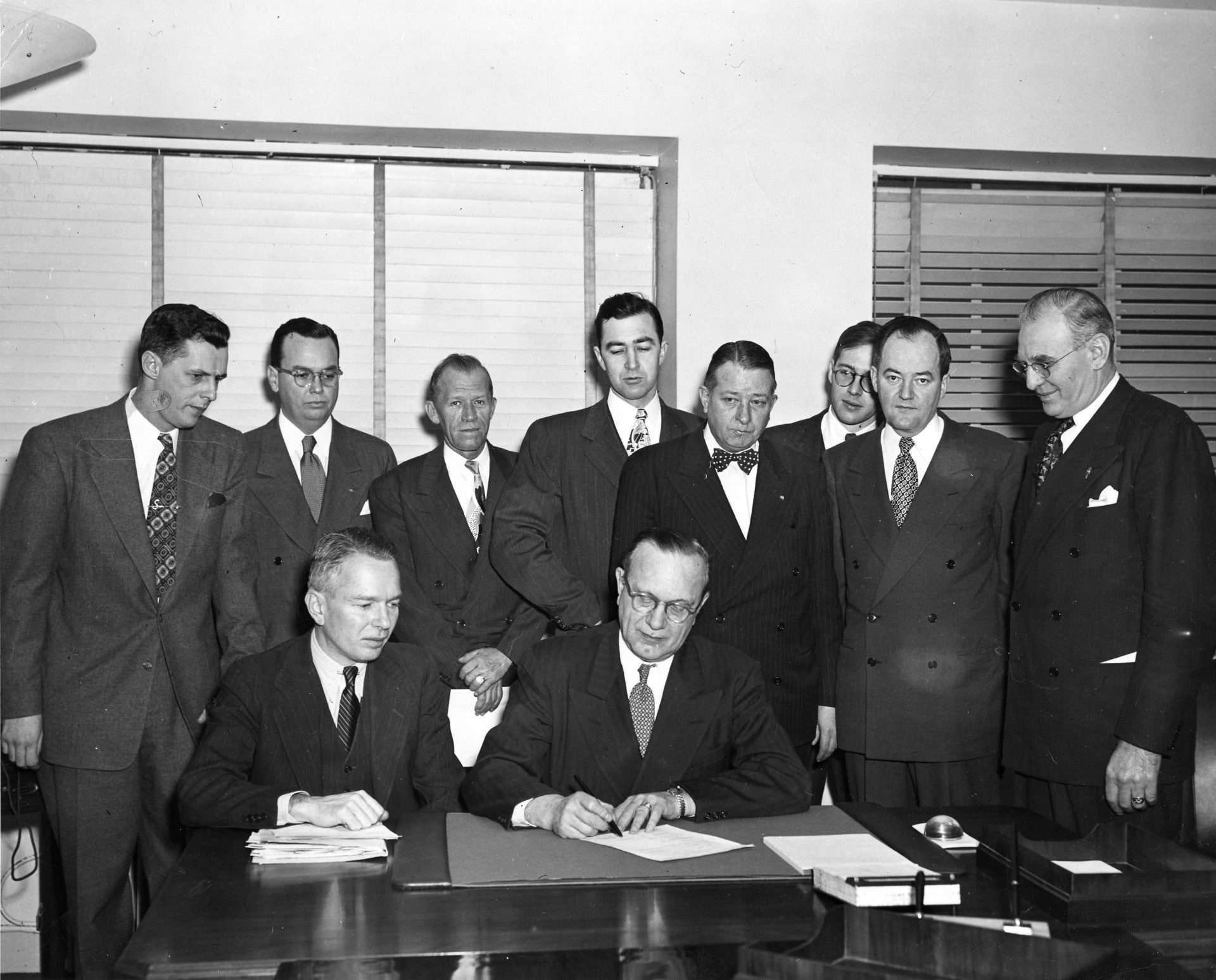
On July 15, 1949, President Harry Truman signed the Housing Act of 1949, a centerpiece of his “Fair Deal” and one of the most ambitious housing laws in American history. Its stated goal was breathtaking in scope: “a decent home and a suitable living environment for every American family.” To get there, the Act poured federal money into public housing construction, expanded federal mortgage insurance, and created the urban renewal program to clear and redevelop so-called “slum” neighborhoods.
The Act’s legacy is genuinely double-edged, and it’s worth telling honestly. On one hand, it expanded homeownership for millions and built hundreds of thousands of units of public housing. On the other, its implementation became one of the great engines of racial segregation in the twentieth century. Urban renewal too often meant bulldozing established Black neighborhoods—critics bitterly renamed it “Negro removal”—and the public housing built in their place was frequently segregated by design and concentrated in already-poor areas. Meanwhile the federal mortgage machinery it fed continued the practice of redlining, steering the benefits of homeownership toward white families and away from Black ones.
That mixed legacy is why the Housing Act belongs in a legal-history conversation about civil rights. The same federal government that would, within a few years, order schools desegregated in Brown v. Board of Education was, through its housing policy, actively entrenching residential segregation—and residential segregation is what makes school segregation so durable, because in America where you live largely determines where you go to school. The story of July 15, 1949 is a reminder that the law’s effects depend enormously on how it’s carried out: a statute promising a decent home for every family became, in practice, a tool that shaped the segregated geography we’re still litigating over today.
Todd Blanche faced a high-stakes Senate Judiciary Committee hearing today in his bid to become attorney general on a permanent basis. Blanche has been acting attorney general since President Trump fired Pam Bondi in April, and before joining the Justice Department he served as Trump’s personal criminal defense lawyer—a background that sits at the center of the concerns about him. The confirmation process exists because the Constitution’s Appointments Clause requires the Senate to advise and consent on the nation’s top law-enforcement officer, and the attorney general is supposed to serve the United States, not the president personally. That tension drove the questioning: senators pressed Blanche on the Department’s $1.8 billion “anti-weaponization” fund, its handling of the Jeffrey Epstein files, and its prosecutions of figures perceived as Trump’s political enemies, including former FBI Director James Comey and New York Attorney General Letitia James. The significance is about the independence of the Justice Department. An attorney general who was recently the president’s private defense attorney raises the question of whether federal prosecutorial power will be wielded neutrally or as an instrument of the president’s interests. With a pair of undecided Republicans—Senators Cornyn and Tillis—holding real leverage, the hearing was Blanche’s chance to reassure a narrowly divided Senate, and most observers still expect him to be confirmed by a slim margin.
Blanche to face Senate grilling in bid to be Trump’s attorney general | Reuters
Two U.S.-based advocacy groups have sued the Trump administration, arguing that its sanctions targeting the International Criminal Court violate the First Amendment. The groups—Democracy for the Arab World Now and the Taxpayer Alliance Against Genocide—are challenging the February 2025 executive order under which the administration has sanctioned ICC judges, prosecutors, and Palestinian human rights organizations, and which officials pledged this week to expand. The free-speech theory is the key. The plaintiffs say the sanctions regime is so broad that they have stopped doing constitutionally protected things—filing submissions with the ICC and coordinating advocacy with sanctioned people, like the U.N. special rapporteur for Palestine—out of fear that doing so could expose them to fines or even prison. In First Amendment law, that’s a classic “chilling effect”: when a law is vague or sweeping enough that people self-censor protected speech to avoid the risk of penalty, the law itself can be unconstitutional even before anyone is actually punished. There’s notable precedent here: a similar Trump order in 2020 was blocked by a judge who found it likely violated the First Amendment, before the Biden administration rescinded it in 2021. The significance is a direct clash between the executive’s broad power over foreign affairs and sanctions on one side, and Americans’ right to speak, associate, and petition on the other. Three ICC judges have separately sued over the same sanctions, so this order is now being attacked on multiple fronts.
Trump’s ICC order violates free speech, advocacy groups say in lawsuit | Reuters
A federal appeals court has ended more than sixty years of federal oversight of the Concordia Parish School Board in Louisiana, lifting one of the desegregation orders that dates back to the Civil Rights era. The Fifth Circuit’s decision hands a win to the Trump administration, which has pushed to wind down these long-running cases—a striking reversal for a Justice Department that spent decades on the other side, fighting to enforce them. Here’s the legal framework. After Brown v. Board of Education, hundreds of Southern school districts were placed under federal court supervision and ordered to dismantle segregation. A district can be released from that oversight when a court finds it has achieved “unitary status”—meaning it has eliminated the vestiges of segregation, to the extent practicable, in areas like student assignment, faculty hiring, facilities, and discipline. The dispute in cases like this one is whether that’s really been accomplished. Louisiana officials argue the orders are relics of a bygone era and no longer needed. Civil rights advocates and some parents counter that the vestiges persist—in racial disparities in student discipline, access to advanced academic programs, and teacher hiring—and that lifting oversight removes a crucial tool for addressing them. The significance is part of a broader push to close out Civil Rights-era decrees, and it raises a hard question: whether these districts have genuinely outgrown the need for supervision, or whether ending it prematurely risks letting old patterns quietly reassert themselves.


