


This Day in Legal History: America’s First Patent
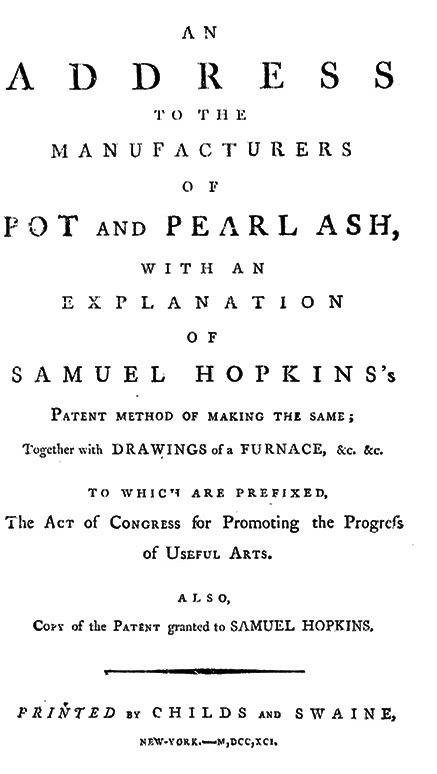
On July 31, 1790, the United States issued its first patent under the newly enacted Patent Act of 1790. The patent was granted to Samuel Hopkins of Vermont for an improved method of producing potash and pearl ash, chemicals widely used in fertilizer, soapmaking, and glass production. President George Washington, Secretary of State Thomas Jefferson, and Attorney General Edmund Randolph personally signed the patent—a reminder that, in the nation’s earliest years, the federal government itself directly evaluated patent applications.
The Patent Act of 1790 was one of Congress’s first major efforts to implement the Constitution. Article I, Section 8 authorizes Congress to “promote the progress of science and useful arts” by granting inventors exclusive rights to their discoveries for limited periods. Rather than viewing patents as natural rights, the Framers saw them as legal incentives designed to encourage innovation while ultimately benefiting the public.
The original patent system was remarkably small. A board consisting of Jefferson, Randolph, and Secretary of War Henry Knox decided whether an invention was “sufficiently useful and important” to merit protection. As the country industrialized, that system quickly became overwhelmed, leading Congress to create a more formal Patent Office in 1836 with professional examiners and standardized procedures.
The first patent issued on this day marked the beginning of what has become one of the world’s most influential intellectual property systems. Today, the U.S. Patent and Trademark Office grants hundreds of thousands of patents each year, and patent law continues to shape industries ranging from pharmaceuticals and biotechnology to software and artificial intelligence.
President Donald Trump is pressing Senate Republicans to confirm acting Attorney General Todd Blanche, whose nomination has stalled because of a dispute over a proposed $1.8 billion “anti-weaponization” fund. Republican Senators John Cornyn and Thom Tillis have withheld their support while demanding written assurances that the Justice Department will not establish the program. The fund emerged from a proposed settlement of Trump’s $10 billion lawsuit accusing the Internal Revenue Service of improperly handling his tax records. Critics contend that the program could use taxpayer money to compensate Trump supporters who claim they were unfairly targeted by federal authorities, including people investigated or prosecuted in connection with the January 6 Capitol attack. Trump defended the proposal by arguing that victims of government misconduct deserve compensation and maintained that he would not personally benefit from it. Cornyn and Tillis have also objected to a separate provision that could shield Trump and certain associates from future IRS audits. Blanche reportedly met with the senators as the Justice Department attempted to resolve the disagreement. Even without confirmation, Blanche may be able to remain acting attorney general while his nomination is pending, provided that Trump does not formally withdraw it and the Senate does not reject it.
Trump defends ‘anti-weaponization’ fund as Blanche nomination stalls | Reuters
New York Attorney General Letitia James has sued prediction-market operator Kalshi, alleging that the company is offering illegal gambling without a state license. Kalshi allows customers to trade contracts tied to the outcomes of sporting events, elections, television programs, and other future events. New York argues that these transactions function as wagers because customers risk money on outcomes they cannot control. State officials also object to Kalshi allowing customers between the ages of 18 and 20 to participate, while New York generally requires mobile sports bettors to be at least 21. The lawsuit seeks to stop the allegedly unlawful activity, recover Kalshi’s gains, impose civil penalties worth three times those gains, and obtain restitution for customers. James previously brought similar cases against prediction-market platforms operated by Coinbase and Gemini. Kalshi argues that its contracts are federally regulated derivatives under the exclusive authority of the Commodity Futures Trading Commission, rather than gambling products governed by individual states. The CFTC has supported that position and filed an emergency request seeking to prevent New York from enforcing its gambling laws against the company. Courts in several other states have already restricted Kalshi’s operations, while a federal judge in New York recently declined to protect the company from state enforcement. The litigation could determine whether prediction markets must comply with state gambling laws, federal commodities regulation, or both.
New York Says Kalshi’s Prediction Markets Are Illegal Gambling
Former federal health official Anthony Fauci could face a contempt-of-Congress referral after refusing to answer more than 100 questions during a Senate investigation into the government’s response to COVID-19. Senator Rand Paul, the Republican chair of the Senate Homeland Security and Governmental Affairs Committee, said the panel would consider referring Fauci for prosecution. Federal law makes it a crime for a person summoned by Congress to deliberately refuse to provide relevant testimony or requested documents. Congress cannot prosecute the offense itself, however, so a committee must approve a referral, followed by the full Senate or House, before the Justice Department decides whether to pursue charges. Reuters reported that a Senate referral would likely require 60 votes, meaning some Democratic support would be necessary. Prosecutors would then need to persuade a grand jury that Fauci intentionally refused to answer questions that fell within the committee’s legitimate investigation. Fauci would likely argue that the Fifth Amendment allowed him to remain silent because his testimony could expose him to criminal liability. President Joe Biden previously pardoned Fauci for possible federal offenses committed between 2014 and January 2025, but that pardon does not cover conduct occurring after Biden left office. The pardon creates an unsettled legal issue because courts have not clearly decided whether a witness may invoke the Fifth Amendment regarding conduct already covered by a presidential pardon. Even if Congress approves a referral, the Justice Department and a Washington grand jury would still have separate opportunities to decline the case.
Could Fauci face criminal charges for refusing Senate COVID questions? | Reuters


