


This Day in Legal History: America’s First Representative Assembly
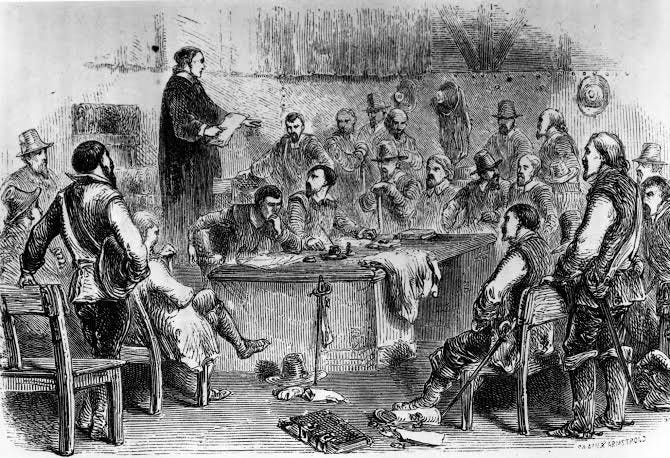
On July 30, 1619, in a wooden church at Jamestown, twenty-two elected representatives took their seats alongside the governor and his council, and the first representative legislative assembly in what would become the United States came to order. This was the Virginia General Assembly—soon known through its elected chamber as the House of Burgesses—and it marks the beginning of self-government by elected representatives in America.
The mechanics were modest and the setting brutal: two burgesses were elected from each of the colony’s eleven settlements, and they met in sweltering heat so severe that one burgess died during the six-day session. But the principle was revolutionary. Under instructions from the Virginia Company, Governor George Yeardley had called forth a body in which colonists—not just a distant crown or company—would have a hand in making the laws that governed them. It became the oldest continuous law-making body in the New World, and it planted an idea that would grow over the next century and a half into a full-blown theory of government by consent.
The significance of July 30, 1619 is that so much of American constitutional order traces back to this cramped, miserable first session. The House of Burgesses trained generations of colonial leaders in the practice of legislative self-government; it was the venue where figures like Patrick Henry and Thomas Jefferson cut their political teeth; and its example fed directly into the revolutionary conviction that legitimate power flows from the consent of the governed and is exercised through elected representatives. It’s a fitting anniversary for a day when one of our stories turns on that very principle—the Senate’s constitutional duty to advise and consent on who leads the Justice Department.
President Trump and the Justice Department have asked the Supreme Court to throw out the $83 million defamation verdict that writer E. Jean Carroll won against him, arguing that he can’t be sued for statements he made while he was president. Some quick context: a Manhattan jury awarded Carroll roughly $83 million in early 2024 over defamatory comments Trump made in 2019 denying her sexual-assault allegation. This is now Trump’s second trip to the Supreme Court in the Carroll saga—recall that back in June the justices declined to hear his appeal of a separate $5 million verdict, which we covered here. The new appeal leans heavily on the Court’s 2024 presidential-immunity decision, which gave presidents broad immunity for official acts. Trump’s lawyers argue that because he made the disputed statements in 2019 while in office, that immunity should shield him, and they accuse the appeals court of “procedural contortions” to avoid the question. The significance is about how far the 2024 immunity ruling stretches. That decision arose in the context of criminal prosecution for official acts; here it’s being deployed to wipe out a civil defamation judgment for things a sitting president said to reporters. Whether “official act” immunity reaches a president’s public denials about a private, decades-old personal matter is a genuinely consequential question—and the fact that the Justice Department has joined Trump’s personal civil appeal is itself a notable signal about how the government is deploying its weight.
Trump asks Supreme Court to throw out E. Jean Carroll’s $83 million verdict | Reuters
Todd Blanche’s bid to become attorney general has hit a serious snag: the Senate Judiciary Committee scrapped a planned vote after Republican Senator John Cornyn said he is “not prepared to vote yes.” We’ve tracked Blanche’s nomination through his confirmation hearing, and the math has always been tight—with the recent death of Senator Lindsey Graham, committee Republicans have just one vote to spare, so Cornyn alone could sink it. What’s notable is the substance of his objection, because it ties together several threads we’ve followed all month. Cornyn’s concerns center on the administration’s roughly $1.8 billion “anti-weaponization fund” and the settlement of Trump’s lawsuit against the IRS—the very deal a federal judge voided weeks ago as a collusive arrangement, and which would have handed Trump and his associates protections from tax audits unavailable to ordinary taxpayers. In other words, the sticking point isn’t Blanche’s résumé; it’s the integrity of the tax system and whether the Justice Department has been used to engineer special treatment. The committee said the vote is postponed while it works “to secure sufficient support.” The significance is a real-time illustration of advice and consent functioning as a check—not a rubber stamp. A president’s nominee for the nation’s top law-enforcement job is stalled because a member of his own party wants answers about a tax settlement that courts have already called unlawful. It’s the Senate’s constitutional role doing exactly what it’s designed to do: forcing accountability before handing over power.
Trump’s attorney general nominee hits snag as senator withholds support | Reuters
And finally, a story close to home for anyone in this profession: the debut of the new national bar exam has gone badly wrong. This week marked the first-ever administration of the NextGen Uniform Bar Examination—a major overhaul of how aspiring lawyers are licensed—across ten jurisdictions. And in Washington State, it collapsed. Officials canceled the entire first day of testing after network bandwidth and Wi-Fi problems left hundreds of examinees unable to even access the exam; somewhere between 645 and 700 standard-time test-takers were affected. Missouri saw delayed start times, and a Maryland site had a shorter delay. The National Conference of Bar Examiners, which runs the exam, insists the NextGen platform itself performed as intended and pinned the failures on local network and site infrastructure rather than the software. That’s cold comfort to the test-takers. Think about what’s actually at stake for them: months of full-time study, bar-prep costs, and in many cases a job offer contingent on passing—all thrown into limbo. Washington is offering a make-up exam on September 1, or the option to transfer to the February 2027 sitting or get a refund, and there are already calls for a class action and even for “diploma privilege”—admitting these graduates without an exam. The significance is both practical and symbolic. Practically, hundreds of careers are on hold through no fault of the examinees. Symbolically, the gateway to the legal profession—the gatekeeping ritual that’s supposed to certify competence—failed a basic test of its own on its most important day, and it’s going to intensify the already-heated debate over whether the bar exam, in any form, is the right way to license lawyers.
Tech problems, cancellation mar new US bar exam for some test-takers | Reuters


