


This Day in Legal History: The Indian Citizenship Act of 1924
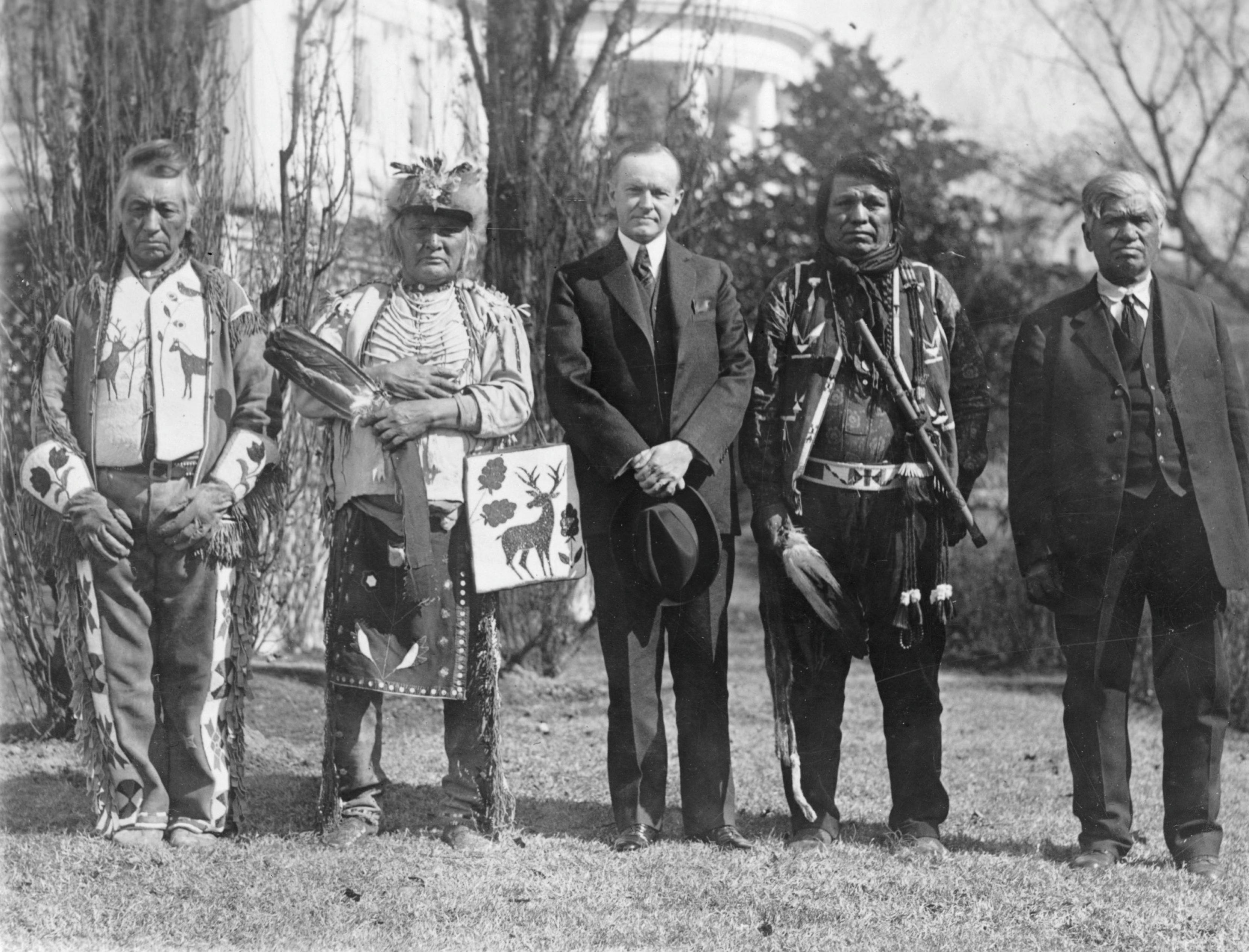
On this day in 1924, President Calvin Coolidge signed the Indian Citizenship Act, also called the Snyder Act, declaring that all Native Americans born within the territorial limits of the United States were U.S. citizens. It is one of those laws that sounds, in retrospect, like it cannot possibly have been necessary — and yet it was. For most of the country’s first 150 years, the federal government treated Native people as members of separate sovereign nations whose status under American law was, at best, ambiguous. Earlier vehicles for citizenship — the Fourteenth Amendment, the Dawes Act, military service in World War I — had reached only some Native people, and a string of Supreme Court decisions had taken the position that being born inside the United States to a member of a tribe did not, on its own, make a person a citizen.
The Snyder Act fixed that with a single sentence.
What it did not fix was voting: many states continued to bar Native citizens from the ballot for decades afterward, on a variety of pretexts that were eventually struck down one by one. The Act also did not affect tribal citizenship — Native people are dual citizens of their tribe and the United States, which is part of why federal Indian law continues to occupy a separate doctrinal universe. June 2 is a quietly important date on the calendar of American citizenship, and a reminder that the seemingly obvious questions of who counts as an American have, for long stretches of our history, not been obvious at all.
Florida Attorney General James Uthmeier announced Monday that his office has filed a civil lawsuit against OpenAI and its CEO Sam Altman, arguing that the company is misleading parents about the safety of ChatGPT and pointing to incidents in which young users were allegedly nudged toward violence by the chatbot. The complaint follows a criminal investigation Uthmeier’s office opened in April, after a deadly mass shooting at Florida State University in 2025 that the AG says ChatGPT helped facilitate. Florida is asking for civil penalties and an order forcing OpenAI to redesign the product, including adding meaningful parental controls.
The legal angle here is essentially a state consumer-protection theory: a state attorney general claiming that the company’s marketing of a product as safe-for-kids is deceptive, and that the company is therefore on the hook under the state’s unfair-trade laws. Whether that survives a motion to dismiss is going to depend a lot on whether the court treats ChatGPT as a “product” in the traditional sense — software has, for decades, gotten more leeway than physical products under product-liability law, and Section 230 of the federal Communications Decency Act has historically immunized platforms for what users post.
The new wrinkle is that generative AI doesn’t fit neatly into either bucket — ChatGPT produces its own output rather than hosting somebody else’s — and several courts are now beginning to grapple with that distinction. Expect this case to be one of the early test cases for how AI companies get sued in the U.S.
Florida AG Sues OpenAI, Says ChatGPT Spurs Violence | Law360
The Supreme Court on Monday declined to hear an appeal from asbestos victims who had challenged a corporate bankruptcy tactic known as the “Texas Two-Step” — leaving in place a Fourth Circuit ruling that lets companies use the maneuver to corral mass-tort claims into bankruptcy court.
The Two-Step works like this: a healthy company splits itself into two using a Texas state-law provision that allows divisional mergers, dumps its asbestos or talc or opioid liabilities into the newly created spinoff, and then puts only the spinoff into Chapter 11. The result is that injury claimants get herded into a bankruptcy proceeding where their leverage is sharply limited, even though the parent company that actually caused the harm is still solvent and operating.
The case the Supreme Court turned away involved Bestwall, a spinoff of Georgia-Pacific that has been in Chapter 11 since 2017. The Third Circuit threw out a similar Johnson & Johnson talc-unit bankruptcy in 2023 on the ground that the spinoff wasn’t actually in financial distress, but the Fourth Circuit went the other way in this case, and the Supreme Court’s denial of review leaves that split standing for now. The bigger picture: a powerful settlement-shaping tool stays on the menu for corporate defendants facing waves of mass-tort litigation, and the next big talc, opioid, or asbestos defendant looking to manage a docket of claims now knows the Two-Step is at least available in the Fourth Circuit.
Justices Won’t Hear Challenge To ‘Texas Two-Step’ Ch. 11 | Law360
A group of IKEA customers filed a proposed class action against the Swedish retailer Monday in U.S. federal court, arguing that they overpaid for furniture during the period when President Trump’s import tariffs were in effect — tariffs that the Supreme Court has since struck down — and that they are entitled to a share of the refunds the company will now collect from the federal government. It is one of the first big consumer-side cases to follow the Supreme Court’s tariff ruling, and the legal theory is novel: importers paid the tariffs, then passed those costs through to consumers in the form of higher sticker prices, and now that the government is sending refunds back to importers, the customers who effectively bore the cost are asking for a piece of that money.
Some major shippers like FedEx and UPS have already publicly committed to passing tariff refunds back to their customers; IKEA, the suit alleges, has not. Whether the claim survives depends largely on whether the court is willing to treat the relationship between retailer and customer as something like a constructive trust or unjust enrichment, rather than an arm’s-length sale at a final price. If even one of these cases succeeds, expect copycat suits against every other large importer that quietly built tariff costs into retail prices over the last several years.
IKEA customers sue for share of Trump tariff refunds | Reuters


