



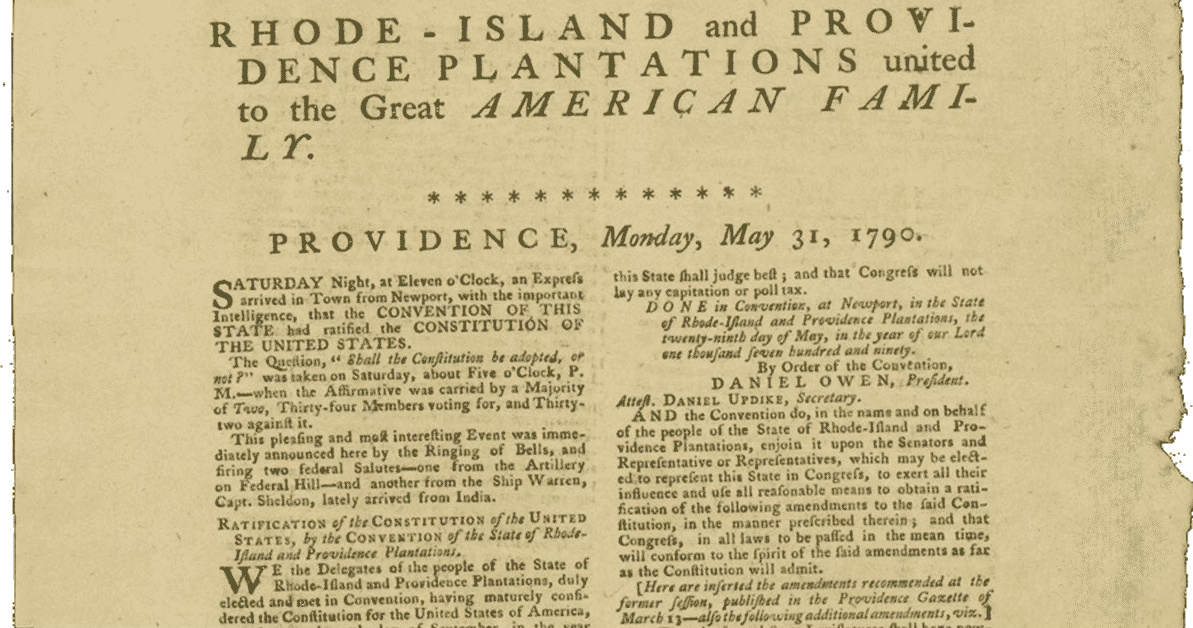
This Day in Legal History: Rhode Island Ratifies the Constitution, 1790
On this day in 1790, Rhode Island became the thirteenth and final original state to ratify the United States Constitution, doing so by a margin of 34 to 32 at a convention in Newport. Rhode Island’s hesitation had been considerable: the state refused to send delegates to the Philadelphia Convention in 1787, and twice rejected ratification in popular referenda — a curiously democratic method for refusing to join a constitutional union founded in part on the premise that pure direct democracy is dangerous. The state’s small-farmer and debtor classes, the same constituencies that had backed the paper-money policies that horrified Madison, were deeply suspicious of a strong federal government that would constrain state-issued currency, ban impairment of debt contracts (Article I, Section 10), and override state-level debtor protections.
Ratification finally came under the gun: Congress, frustrated by the foot-dragging, was openly threatening to treat Rhode Island as a foreign nation for tariff purposes, which would have devastated the Providence merchants. The convention’s narrow margin reflected a hostile deal more than a meeting of constitutional minds.
Importantly, Rhode Island’s ratification was conditioned on a lengthy list of proposed amendments — many of them mirroring the Bill of Rights that James Madison had already shepherded through Congress in September 1789 and that would be ratified in December 1791. With Rhode Island in, the original Union was at last complete, and the practical question of whether the new federal government could function with one stubborn holdout fell away. The episode is a useful reminder that the constitutional founding was not so much a singular moment as a slow, contested, occasionally coerced bargain — one that ended in Newport on a humid Saturday in May.
The U.S. Supreme Court on Thursday handed down a narrow 5-4 ruling in Pitchford v. Cain, reviving a Mississippi death row inmate’s challenge to the prosecutor’s race-based use of peremptory strikes at his 2006 capital trial. Justice Kavanaugh, writing for a majority that included Chief Justice Roberts plus Justices Sotomayor, Kagan, and Jackson, held that the Mississippi Supreme Court unreasonably applied Batson v. Kentucky’s three-step framework for challenges to peremptory strikes.
The Court found the trial judge accepted the prosecutor’s race-neutral explanations without giving defense counsel a meaningful opportunity to argue that those reasons were pretextual, and the state appellate court compounded the error by treating that omission as a waiver. The prosecutor, Doug Evans, used four of his twelve strikes to remove four of the five Black prospective jurors, leaving a jury of eleven white jurors and one Black juror in a Mississippi county that was then roughly 40 percent Black.
The Court leaned heavily on its 2019 Flowers v. Mississippi decision, which involved the same prosecutor and the same trial judge and had already found Evans’s pattern of striking Black jurors discriminatory. Federal habeas relief was appropriate because the Antiterrorism and Effective Death Penalty Act’s deferential “no fair-minded jurist could agree” standard cannot rescue a state-court ruling that simply skips Batson’s third step. Justice Gorsuch dissented, joined by Justices Alito, Thomas, and Barrett, arguing the record showed counsel chose silence rather than being denied an opportunity. The case now returns to the Fifth Circuit for further proceedings.
Justices Revive Mississippi Death Row Inmate’s Batson Claim | Law360
Caesars Entertainment agreed Thursday to be acquired by Tilman Fertitta’s privately-held Fertitta Entertainment in an all-cash deal valued at roughly $17.6 billion, including the assumption of approximately $11.9 billion of Caesars’ outstanding debt. Shareholders will receive $31 per share, a 49 percent premium over Caesars’ unaffected share price as of February 25, and the company will be delisted from Nasdaq upon closing. The agreement includes a go-shop period running through approximately July 11 — a Delaware deal-protection mechanism that lets the target board solicit competing bids without triggering a termination fee, and that helps insulate the sale process from a Revlon-flavored fiduciary-duty challenge by signaling the board actively tested the market after signing.
Latham & Watkins and Skadden are representing Caesars (the latter on antitrust), White & Case is advising Fertitta, and Freshfields is counseling the Carano family, which holds a roughly 5 percent stake and will roll part of its equity into the combined entity. The combined company would control more than 60 casino resorts and over 200 retail sports betting locations under the William Hill brand. Antitrust review will be the inflection point given the overlap on the Las Vegas Strip — where Caesars operates eight properties — and across digital betting. Funding will come from Fertitta equity and committed debt financing arranged by a syndicate of ten banks.
4 Firms Steer Fertitta’s $17.6B Caesars Entertainment Buy | Law360
The Department of Health and Human Services on Thursday finalized a long-awaited overhaul of the federal Independent Dispute Resolution process under the No Surprises Act of 2021, the statute that pulls most out-of-network billing fights out of the patient’s hands and into a baseball-style arbitration between provider and payer. The headline change slashes the per-party administrative fee from $115 to $15 per case, undoing a sharp 2023 hike that providers had successfully challenged in the Eastern District of Texas as having been adopted without notice-and-comment rulemaking under the Administrative Procedure Act.
The rule also expands batching, so economically similar items and services can be bundled into a single arbitration, which the agency says will cut transaction costs and ease the chronic IDR backlog. HHS is also rolling out a centralized federal dispute portal and a payer registry intended to fix the persistent problem of providers being unable to identify which entity is actually on the hook in any given case. Reactions from physician and radiology groups have been mixed, with broad support for the fee cut but lingering concern that the qualifying payment amount methodology — the benchmark arbitrators must consider — still tilts the field toward insurers. APA Section 706 challenges to portions of the earlier IDR framework remain pending in the Fifth Circuit.
US HHS finalizes rule to streamline dispute resolution under No Surprises Act | Reuters
ABC’s New York affiliate WABC-TV filed an objection with the FCC on Thursday, calling Chairman Brendan Carr’s April order requiring early license renewals for all eight ABC-owned stations an “unconstitutional” act of viewpoint-based retaliation barred by the First Amendment. WABC submitted its renewal under protest, arguing the agency has not demanded simultaneous early renewals from a commonly owned station group in more than fifty years and that the Media Bureau’s stated rationale — possible violations of the Communications Act of 1934 and the FCC’s nondiscrimination rules — is pretext for punishing disfavored editorial speech.
The doctrinal hook is the Bantam Books line of cases through last term’s NRA v. Vullo, which holds that government officials cannot use the implicit threat of regulatory sanction to coerce private intermediaries into suppressing protected expression. The order followed a separate FCC inquiry into whether “The View” has been violating the agency’s equal-time rule for political candidates, and came against the backdrop of repeated White House demands that Disney fire Jimmy Kimmel. Democratic Commissioner Anna Gomez has openly urged Disney not to “flinch.”
On the same day, the FCC issued a broader notice warning all broadcasters that licenses could be reviewed early if stations are deemed to be failing their statutory public-interest obligation — a posture that drops the question of broadcast licensing back into Red Lion-era First Amendment territory.
FCC Targeting ABC Licenses To Punish Speech, Station Says | Law360


