



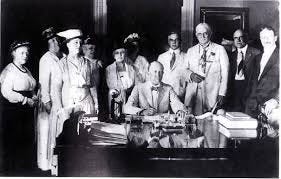
This Day in Legal History: Congress Passes the Nineteenth Amendment
On this day in 1919, the U.S. Senate voted 56 to 25 to approve the Nineteenth Amendment, sending to the states a one-sentence constitutional rule that “the right of citizens of the United States to vote shall not be denied or abridged by the United States or by any State on account of sex.” The House had already passed it two weeks earlier, by a comfortable margin, and the question now moved to the states, where ratification would take fourteen months of careful organizing and a now-legendary single vote by a Tennessee legislator named Harry Burn — cast on his mother’s instruction — to clinch the 36-state threshold in August 1920. The Nineteenth Amendment did not by itself enfranchise all American women: Black women in the South, women of color across the country, and Native women living on tribal land would face decades more of state-level disenfranchisement that did not begin to ease until the Voting Rights Act of 1965 and would not be fully addressed even after that. But June 4, 1919 was the day that women’s suffrage stopped being a state-by-state campaign and became, at the federal level, a constitutional commitment. The structural lesson is one worth holding onto: in the United States, voting rights live not just in the Constitution but in the day-to-day administration of elections by the states — which is why the fight over them is never quite over.
Senators John Kennedy of Louisiana and Ron Wyden of Oregon — a Republican and a Democrat who do not often appear in the same headline — jointly introduced the Open Courts Act on Tuesday, a bill that would do something the federal judiciary has talked about for two decades and never quite accomplished: replace PACER, the public court records system, with a modern interface, eliminate the per-page fees, and harden the cybersecurity around the federal judiciary’s electronic filing system. PACER stands for Public Access to Court Electronic Records, and right now it charges users ten cents a page to read federal court filings, which adds up alarmingly quickly when you’re trying to follow a case of any size. The bill would also require the Administrative Office of the U.S. Courts to build a new system funded outside the regular appropriations cycle, which the sponsors argue would save taxpayers about $60 million a year in operating costs and avoid the budget-fight ritual that has stalled past reforms. The cybersecurity piece is not incidental: the federal courts have suffered two significant intrusions in recent years, one reportedly tied to Russian actors in 2025 and a similar one in 2020, and Wyden has been pushing for an independent security review since last year. The legal stakes here are unusual because PACER is a public-access tool that has historically been priced like a paywalled subscription product, which is a kind of legal-transparency contradiction the U.S. has tolerated longer than almost any peer democracy. Kennedy’s framing — “Americans should not have to sell plasma or wrestle with clunky government websites just to read public court records” — is the kind of soundbite the bill needs to actually move. Whether it actually moves is another question; previous versions of this bill have died quietly. Watch the Judiciary Committee in the next month.
Bipartisan Bill Would Modernize Court Records Systems | Law360
The Department of Justice has opened an investigation into former U.S. Representative George Santos for possible insider trading on Kalshi, the federally-regulated prediction-market exchange, after Kalshi itself reportedly flagged a pattern of suspicious wagers to prosecutors. The story, broken by Reuters on Wednesday, is one of the first big public test cases for how insider trading principles map onto event-based contracts — which are not stocks, are not commodities in the traditional sense, and have spent the better part of the last two years in regulatory limbo while Kalshi and the CFTC fought in federal court over whether the platform could list its contracts at all. The legal challenge is real: insider trading liability under Section 10(b) of the Securities Exchange Act and Rule 10b-5 historically requires a “security,” and Kalshi contracts are not securities — they sit under the CFTC’s authority as “event contracts.” That leaves DOJ working with commodities-fraud theories, wire-fraud statutes, and potentially Santos’s own conditions of release from his prior unrelated criminal sentencing, all of which apply differently and less neatly than they would in an old-fashioned stock-trading case. If you are wondering how an ex-Congressman ends up with material nonpublic information worth betting on Kalshi, you are asking the right question, and it is also the question prosecutors will have to answer if they want any of this to stick. Expect this to become a defining test case for how event-contract markets get policed.
DOJ investigating ex-US lawmaker Santos for insider trading on Kalshi, source says | Reuters
In my column for Bloomberg this week, I write about a pattern emerging across California, Minnesota, Oregon, Illinois, Washington, Maine, and other states: lawmakers are reaching for the politically powerful phrase “wealth tax” to describe what are, on inspection, just new top brackets or surtaxes on high-income earners. I argue that the slippage is not just sloppy branding, it is a strategic mistake. A wealth tax and an income surtax are not the same thing — wealth is a stock and income is a flow, and a higher rate on income realized this year will never reach the accumulated balance-sheet fortunes that the wealth-tax conversation was actually designed to capture. The “buy, borrow, die” critique that motivates much of the wealth-tax movement is precisely about taxpayers who never realize income because they never need to: they hold appreciating assets, borrow against them for liquidity, and defer or escape income-tax recognition entirely. Adding a few points to the top marginal income-tax rate, I write, is just a slightly higher toll at the same toll booth — it does not reach the wealth that bypassed the toll entirely. The political-capital point is what worries me most. Wealth taxes pick a specific kind of fight — about asset valuation, billionaire flight, capital mobility, constitutional limits, and the like — and to spend that capital fighting that fight on behalf of what is in fact a different and more familiar policy is a strange trade. I think a more honest framing would serve both sides better: if states want a real wealth tax, they need to design one — with valuation rules, third-party reporting, anti-avoidance, residency standards, and liquidity protections — and if they want a high-income surtax, they should call it that and defend it on its own merits. The middle ground gets you the burden of a tax hike without the benefits of either. Half measures that cost full price in political capital, I conclude, are not helping anyone.


