


This Day in Legal History: Jackie Robinson Signs with Dodgers
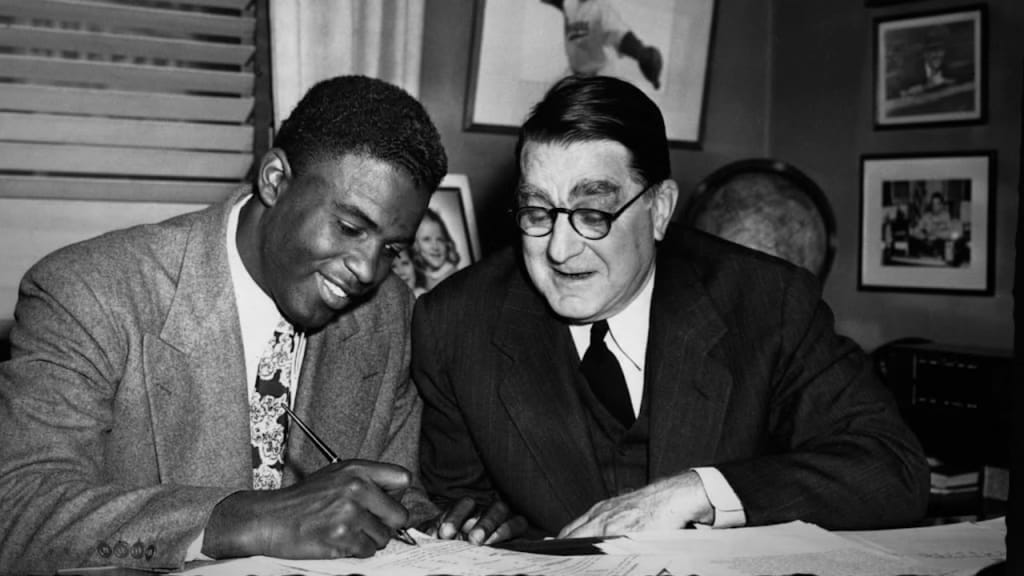
On April 10, 1947, Jackie Robinson signed his contract with the Brooklyn Dodgers, marking a pivotal moment in both sports and legal history. At the time, racial segregation was deeply entrenched in American society, including in professional athletics, where informal but rigid “color lines” excluded Black players. Robinson’s signing, orchestrated by Dodgers executive Branch Rickey, directly challenged this exclusionary system. Although no court decision mandated integration in baseball, the move carried significant legal implications by undermining accepted norms of segregation.
Robinson’s entry into Major League Baseball occurred just years before landmark civil rights rulings, including Brown v. Board of Education, which declared racial segregation in public schools unconstitutional. His success on the field helped shift public opinion, demonstrating that integration was both possible and beneficial. This cultural shift played an indirect but meaningful role in supporting broader legal challenges to segregation. At the same time, Robinson faced hostility, threats, and discriminatory treatment, highlighting the gap between evolving social practices and existing legal protections.
The federal legal framework addressing discrimination was still underdeveloped in 1947, with major statutes like the Civil Rights Act of 1964 nearly two decades away. Robinson’s breakthrough contributed to the growing momentum for such legislation by exposing the injustice and inefficiency of segregated systems. His experience also illustrated the limits of private action in achieving equality without formal legal enforcement mechanisms. Over time, his role became part of a larger narrative demonstrating how social change can precede and influence legal reform.
Robinson’s signing stands as an example of how non-judicial actions can shape the development of law by altering public attitudes and expectations. It underscores the interplay between private institutions and constitutional principles, particularly in the realm of equal protection. The event remains a key reference point in discussions about the relationship between cultural progress and legal change in the United States.
A California federal judge has ordered another evidentiary hearing in the ongoing dispute between Epic Games and Google over proposed changes to an antitrust injunction governing Android app distribution. U.S. District Judge James Donato expressed frustration that each revised proposal introduces new elements, warning the parties that the court will not continue reviewing endless iterations. The latest proposal follows Epic’s earlier trial victory, where a jury found Google had monopolized the Android app marketplace.
Although the companies claim their revised plan better aligns with the original injunction, the judge raised concerns about potential anticompetitive effects. In particular, he questioned Google’s idea of a “registered app store” program, suggesting it might create barriers for rival app stores. He also flagged possible issues with fees that could undermine competition. As a result, the court will require more detailed explanations before deciding whether to approve the changes.
The dispute stems from litigation filed in 2020 challenging restrictions that limited alternative app stores and required developers to use Google’s billing system. After Epic’s win, the court imposed an injunction requiring Google to open its platform to competitors. While the revised proposal keeps some pro-competition measures—such as allowing alternative billing and preventing exclusionary deals—it has drawn mixed reactions.
Supporters argue the new terms still promote competition, but critics, including Microsoft and advocacy groups, say the changes weaken the original order. They highlight concerns about new fees and provisions that could make it harder for competitors to enter the market. Some also argue that shifting key terms into private agreements reduces judicial oversight. Judge Donato indicated this upcoming hearing will likely be the final step before a decision, emphasizing the need to resolve the matter without further revisions.
‘Not Going To Keep Doing This,’ Judge Warns Epic, Google - Law360
The U.S. Department of Justice has launched an investigation into whether the National Football League is engaging in anticompetitive practices that could harm consumers. While the exact scope of the probe is unclear, it appears to focus on how the league distributes broadcasting rights for its games. Concerns have grown among regulators, lawmakers, and broadcasters about the increasing shift of sports content from free television to paid streaming platforms.
Critics argue that this trend makes it harder and more expensive for fans to watch games, with some estimates suggesting it could cost over $1,500 annually to access all NFL broadcasts across multiple services. The NFL has defended itself by noting that most of its games are still available on free broadcast television, particularly in local markets. Meanwhile, the Federal Communications Commission has also begun reviewing the broader migration of live sports to subscription-based platforms.
The issue has drawn political attention, including a request from Senator Mike Lee for federal agencies to examine whether the NFL’s longstanding antitrust exemption should still apply. That exemption, established by a 1961 law, allows leagues to bundle and sell broadcasting rights collectively.
US Justice Department opens probe into NFL over anticompetitive practices, source says | Reuters
A federal judge in Washington, D.C. ruled that the U.S. Department of Defense failed to comply with a prior court order protecting journalists’ access and reporting rights at the Pentagon. U.S. District Judge Paul L. Friedman found that the department’s revised media policy effectively recreated the same unconstitutional restrictions it had already been ordered to remove. The dispute arose after The New York Times and reporter Julian Barnes challenged rules limiting journalists’ ability to seek information from government sources.
Although the Pentagon changed the wording of its policy, the judge said the new language still prohibited routine journalistic practices, such as requesting non-public information. He rejected the government’s argument that the revisions fixed the issue, calling them a clear attempt to sidestep the court’s ruling. The opinion also criticized a provision that presumed journalists acted improperly if they offered anonymity to sources, noting that this is a standard practice in reporting.
The judge further found that the Pentagon undermined the order by restricting reporters’ physical access, including closing a designated workspace and requiring constant escorts inside the building. He dismissed the government’s security justification, stating that existing screening procedures were never removed and that the new limitations appeared designed to weaken press access.
Ultimately, the court ordered the government to restore prior conditions and comply fully with its ruling. Judge Friedman emphasized that the policy violated First Amendment protections by chilling press freedom and limiting the flow of information to the public. He warned that suppressing political speech and controlling media access are hallmarks of authoritarian systems, underscoring the constitutional importance of an independent press.
‘Mark Of Autocracy’: Court Says Pentagon Defied Press Order - Law360
US judge says Pentagon violated court order to restore press access | Reuters
A U.S. trade court is considering whether President Donald Trump’s 10% global tariff on imports is lawful. The tariffs, introduced in February, are being challenged by a coalition of 24 states and small businesses, who argue that the policy exceeds presidential authority and improperly bypasses Congress. The case is being heard by a three-judge panel at the U.S. Court of International Trade.
The Trump administration defends the tariffs as a valid response to ongoing trade deficits, relying on Section 122 of the Trade Act of 1974. This provision allows temporary tariffs during serious balance-of-payments issues. However, the challengers argue that the law was intended for short-term economic emergencies, not persistent trade imbalances, and that the administration is stretching its meaning.
The dispute comes shortly after the U.S. Supreme Court struck down many of Trump’s earlier tariffs imposed under a different statute, ruling he had overstepped his authority. Plaintiffs claim the new tariffs are an attempt to work around that decision using a different legal justification.
US trade court weighs legality of Trump 10% global tariff | Reuters


