


This Day in Legal History: Prayer in … Local Government Meetings?
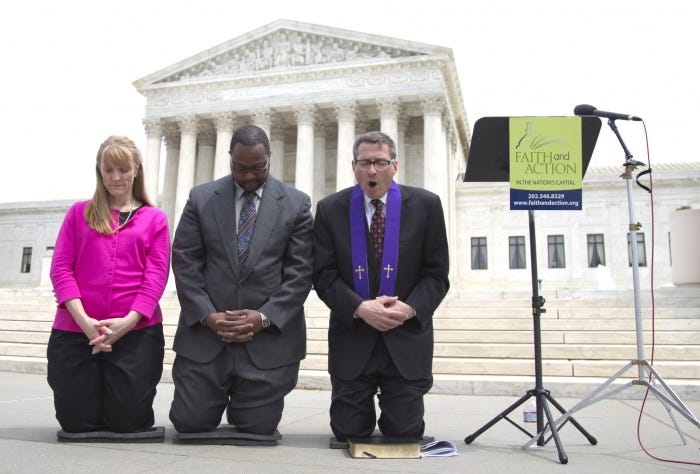
On this day in legal history, May 5, 2014, the Supreme Court decided Town of Greece v. Galloway, a major Establishment Clause case about prayer at local government meetings. The town of Greece, New York, opened its monthly board meetings with prayers delivered by invited clergy. For years, nearly all of those clergy were Christian, and many of the prayers used explicitly Christian language. Two residents sued, arguing that the practice aligned the town government with Christianity and made non-Christian attendees feel like outsiders in their own local government.
In a 5–4 decision, the Supreme Court upheld the town’s practice. Justice Anthony Kennedy wrote for the Court, emphasizing the long historical tradition of legislative prayer in the United States, including Congress’s own use of chaplains dating back to the Founding era. The majority reasoned that the Establishment Clause does not require legislative prayers to be stripped of sectarian references. Instead, the key question was whether the practice coerced participation, denigrated other faiths, or proselytized in a way that crossed a constitutional line.
The dissent, led by Justice Elena Kagan, saw the case differently. She argued that town board meetings are not like sessions of Congress: ordinary citizens attend them to seek zoning changes, permits, and other direct government action. In that setting, she warned, repeated explicitly Christian prayers could pressure residents to participate or mark them as outsiders before officials who held power over their daily lives. The case matters because it illustrates how much Establishment Clause doctrine turns on competing ideas of history, coercion, equality, and civic belonging. Town of Greece did not end the debate over prayer in public life; it sharpened the question of when tradition becomes exclusion.
The Supreme Court temporarily restored a federal rule allowing mifepristone, the abortion pill, to be prescribed through telemedicine and delivered by mail. Justice Samuel Alito issued an administrative stay that pauses a 5th Circuit order reinstating an older requirement that patients receive the drug only after an in-person clinician visit.
The stay is temporary and mainly gives the justices time to consider emergency requests from mifepristone manufacturers Danco Laboratories and GenBioPro. Louisiana, which brought the challenge, must respond by Thursday, and the stay is set to expire May 11 unless the Court extends it or acts more formally.
The case is another front in the post-Dobbs fight over abortion access. The Supreme Court rejected an earlier challenge to mifepristone restrictions in 2024 on standing grounds, but Louisiana’s new case argues that the Biden-era FDA rule expanding mail and telehealth access unlawfully interferes with the state’s near-total abortion ban. Abortion-rights groups frame the challenge as political and contrary to medical evidence, while anti-abortion advocates argue that relaxed access rules remove important safety safeguards.
US Supreme Court lets abortion pill mail delivery restart for now | Reuters
New Mexico is asking a state judge to declare Meta’s Facebook, Instagram, and WhatsApp platforms a public nuisance and order $3.7 billion in abatement funding, along with major design changes aimed at protecting minors. The case follows a March jury verdict finding that Meta misrepresented the safety of its platforms for young users and awarding $375 million in damages, a verdict Meta says it will appeal.
This phase of the case is being tried to Judge Bryan Biedscheid, who must decide whether Meta’s platforms amount to a public nuisance under New Mexico law. If he agrees, he could order broad remedies, including age verification, changes to recommendation algorithms for minors, and limits on features such as autoplay and infinite scroll.
Meta argues that New Mexico is trying to stretch public nuisance law beyond its traditional bounds. Its lawyer said the state is not alleging interference with a public right like clean air or open roads, but instead seeking sweeping regulation based on individual harms—something Meta says should be handled by legislators, not a single judge. The judge himself signaled concern that some requested remedies might be overreach, noting that he is not a regulator or legislature.
New Mexico counters that Meta knowingly designed addictive platforms and failed to protect children from mental health harms and sexual exploitation. The case is significant because it could test whether public nuisance law can be used not just to seek damages from social media companies, but to force platform-level design changes.
New Mexico seeks $3.7 billion, changes to Meta platforms in youth harm trial | Reuters
Massachusetts’ highest court sounded skeptical of Kalshi’s argument that only federal commodities regulators can oversee its sports-event contracts. Kalshi says it is a federally regulated prediction market, registered with the CFTC, and that its contracts are swaps governed exclusively by federal law under Dodd-Frank.
Massachusetts argues that, whatever Kalshi calls the product, users are effectively betting on sports without a state gaming license. Several justices pressed Kalshi on how its contracts differ from ordinary sports bets, with one justice noting that if someone wants to gamble on a game, Kalshi offers a way to do it.
The case is part of a broader national fight over prediction markets, sports betting, and federal preemption. Kalshi recently won a favorable ruling from the 3rd Circuit in a dispute with New Jersey regulators, and the CFTC has supported Kalshi’s position in Massachusetts. But the Massachusetts justices appeared concerned that accepting Kalshi’s theory would sharply limit states’ traditional authority over gambling unless Congress clearly said it intended that result.
If the state wins, Massachusetts could become the second state after Nevada to have a court-ordered ban on Kalshi sports-event contracts. The larger issue is whether prediction markets can avoid state gambling law by framing sports wagers as federally regulated financial contracts.
Massachusetts top court appears open to state ban on Kalshi sports betting | Reuters
My column for Bloomberg this week argues that if the United States wants to become the world’s crypto capital, France’s experience with crypto kidnappings and alleged tax-data leaks should be treated as a warning. I’m not arguing against crypto tax reporting; in fact, better reporting can make tax compliance more realistic for taxpayers and enforcement more administrable for the IRS. But I argue that crypto reporting creates a different kind of privacy risk because identity-linked ownership data can become a physical safety risk, not just a financial-fraud risk.
The core point is that crypto is unusually portable, irreversible, and vulnerable to coercion. If criminals learn that someone owns valuable crypto, the path from threat to transfer can be frighteningly short. That makes tax and compliance databases more dangerous than ordinary financial records if access is poorly controlled or if insiders, contractors, vendors, or hackers can expose taxpayer information.
So in the piece I argue Congress should not build crypto reporting rules first and think about privacy later. If lawmakers want more reporting from exchanges, platforms, vendors, and taxpayers, they also need a crypto-specific privacy architecture: data minimization, role-based access controls, automated access logs, audits, breach notifications, and real penalties for misuse. My takeaway is that pro-crypto policy cannot just mean lower taxes, lighter regulation, and friendlier rhetoric. If the government wants crypto brought into the mainstream financial system, it also has to build rules that protect taxpayers from having compliance data turned into a criminal target list.


