



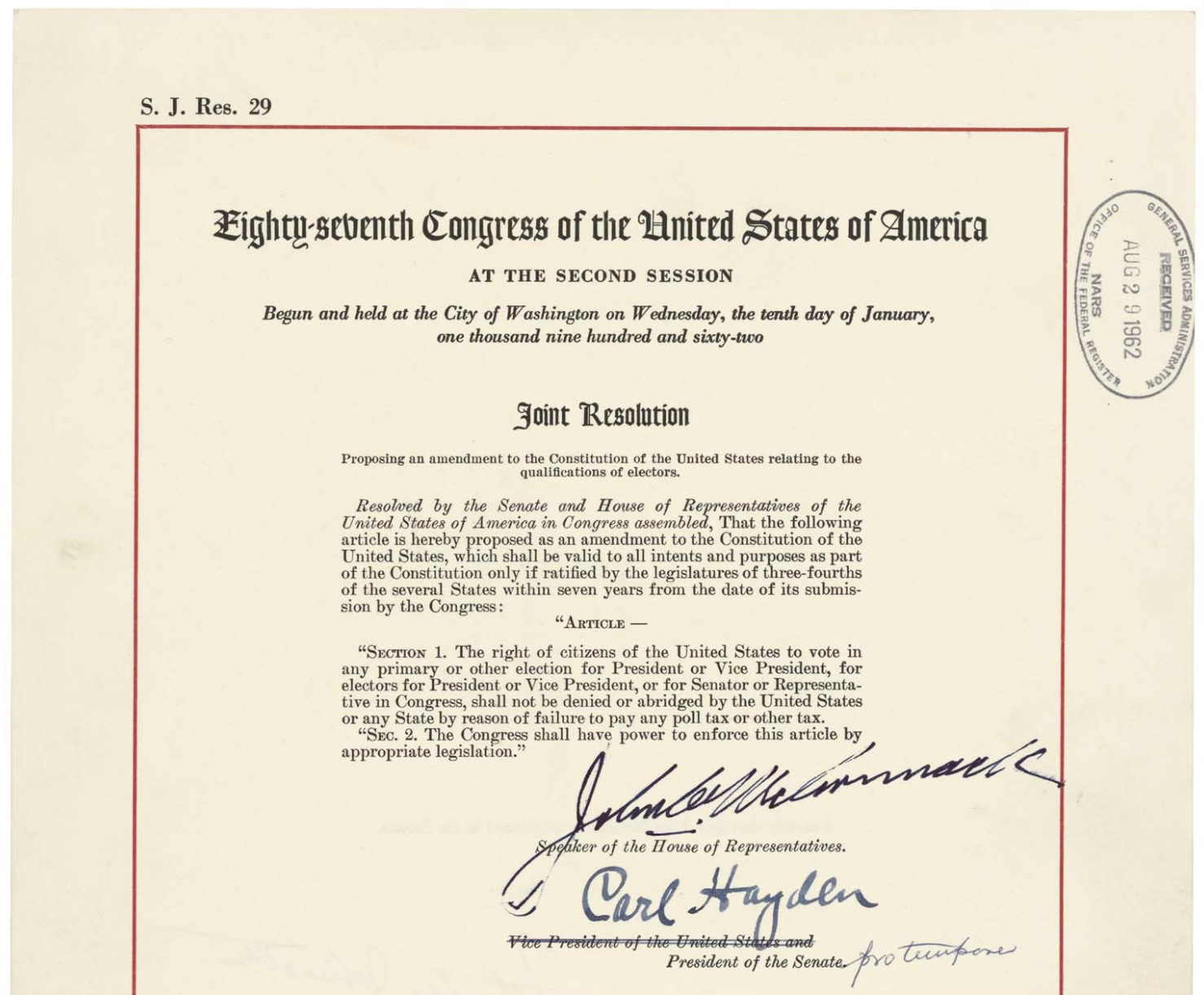
This Day in Legal History: Poll Tax
On March 19, 1962, Congress approved a constitutional amendment to abolish the poll tax in federal elections, a practice that had long been used to suppress voter participation. The poll tax required citizens to pay a fee before casting a ballot, which disproportionately affected low-income individuals, especially African Americans in the South. By removing this financial barrier, Congress took a clear step toward expanding access to the democratic process. The amendment was later ratified as the Twenty-Fourth Amendment, cementing the principle that voting should not depend on one’s ability to pay. This change reflected the growing influence of the civil rights movement, which pushed lawmakers to confront systemic inequality in voting laws. It also signaled a broader shift toward recognizing voting as a fundamental right rather than a conditional privilege.
The legal reasoning behind abolishing the poll tax focused on fairness and equal protection, emphasizing that economic status should not determine political participation. Courts and lawmakers increasingly viewed such barriers as incompatible with democratic ideals. This moment in legal history continues to shape debates about what constitutes an undue burden on voters.
Today, discussions around the SAVE Act, which proposes strict voter identification requirements, have raised similar questions about access and eligibility. Supporters argue that identification rules protect election integrity, despite there being no evidence of widespread voter fraud. Critics warn that they may disproportionately affect certain groups, including those with limited access to documentation. The comparison to the poll tax debate lies in how both policies raise concerns about whether procedural requirements might exclude eligible voters. While the mechanisms differ—one being a direct financial cost and the other an administrative requirement—the underlying legal tension remains similar. Lawmakers and courts must again weigh the balance between safeguarding elections and ensuring that access to voting remains broad and equitable.
The Third Circuit heard arguments in a high-stakes appeal involving a $1.6 billion False Claims Act (FCA) verdict against Johnson & Johnson and broader challenges to the law’s constitutionality. The FCA is a federal law that allows the government to pursue individuals or companies that defraud federal programs. It also lets private whistleblowers file lawsuits on the government’s behalf and share in any financial recovery.
Judges appeared reluctant to dismantle the FCA’s whistleblower, or qui tam, mechanism, though they engaged seriously with arguments questioning its validity. Much of the discussion focused on whether private individuals wield too much power by bringing fraud claims on behalf of the government. An attorney for business groups argued that this structure improperly grants executive authority to non-government actors, while judges pushed back by pointing to the long historical use of such actions.
A central issue in the case was “materiality,” meaning whether the alleged misconduct actually influenced the government’s decision to pay claims. J&J argued there was no proof that its actions affected payment decisions, but the judges suggested that such determinations are typically left to juries. They also questioned whether J&J had properly preserved certain legal arguments for appeal. The Department of Justice disputed J&J’s interpretation of its position, emphasizing that the evidence could still support liability under the FCA.
The panel also examined the role of evidence and jury instructions, particularly how jurors were told to evaluate whether improper marketing led to false claims. J&J criticized the “substantial factor” standard used at trial, arguing it was unclear and insufficient. In response, the whistleblowers’ counsel maintained that J&J was seeking a stricter standard than the law requires. Judges appeared to wrestle with whether the instructions properly guided the jury without overcomplicating the burden of proof.
Overall, the arguments revealed judicial skepticism toward sweeping constitutional attacks on the FCA, alongside concern about how the specific trial was conducted. The case highlights ongoing legal debates over the balance between encouraging whistleblowers and ensuring fair limits on liability.
Key Details As 3rd Circ. Ponders FCA’s Fate, $1.6B J&J Fine - Law360
Music company BMG has sued AI firm Anthropic, alleging it used copyrighted song lyrics from artists like Bruno Mars, the Rolling Stones, and Ariana Grande to train its Claude chatbot without permission. The lawsuit claims this involved copying hundreds of protected works, possibly sourced from unauthorized platforms, and seeks significant damages under U.S. copyright law.
The case is part of a broader wave of lawsuits against AI companies over training data practices, including a similar ongoing suit by other music publishers and a prior $1.5 billion settlement Anthropic reached with authors. While BMG argues this use is unlawful infringement, AI companies like Anthropic maintain that training models on such material qualifies as fair use because it transforms the content.
BMG sues Anthropic for using Bruno Mars, Rolling Stones lyrics in AI training | Reuters
A Second Circuit judge sharply questioned OpenAI’s position in a copyright dispute with Raw Story, expressing frustration that the company’s lawyer could not explain whether its AI system copied articles or removed copyright management information (CMI). The judge suggested that this lack of clarity weakened OpenAI’s argument, especially at an early stage without full discovery.
OpenAI argued the case should be dismissed because the plaintiffs failed to show concrete harm or properly allege infringement, emphasizing that removing CMI alone does not violate a protected property right. The company also claimed the complaint relied too heavily on speculation rather than specific facts about how its systems operate. However, the judges appeared skeptical, noting that factual questions about copying and CMI removal might need further development.
Raw Story countered that copying articles without CMI is itself a recognized legal injury and fits within longstanding copyright protections. The publishers also argued that OpenAI knowingly removed identifying information in a way that could enable infringement, which is prohibited under the DMCA. The panel ultimately took the case under advisement, leaving unresolved key questions about how copyright law applies to AI systems.
2nd Circ. Judge Unimpressed By OpenAI’s IP Suit Stance - Law360
An immigration judge has ended the asylum claims of five-year-old Liam Conejo Ramos and his family after their detention during a large immigration operation in Minnesota. Liam and his father were taken into custody in January and held for about 10 days in a Texas facility before being released. Public attention grew after a widely shared image showed the child standing outside his home while federal agents were nearby.
The ruling was issued by U.S. Immigration Judge John Burns, and the family’s attorney has said they will appeal the decision, a process that could take a long time. Community members, including Liam’s school district, expressed sadness and concern over the outcome while acknowledging that the legal process is ongoing.
The case is tied to “Operation Metro Surge,” a large-scale enforcement effort that brought thousands of immigration agents to Minnesota. The operation led to widespread detentions and significant backlash, especially after two U.S. citizens were fatally shot during related protests or observations. The federal government later ended the operation, but local communities continue to deal with its emotional and economic effects.
Advocates and officials have emphasized the broader human impact of the raid, particularly on children and families whose lives were disrupted. Liam’s case has become a focal point in discussions about immigration enforcement and its consequences.
Judge ends asylum claim of Minnesotan boy detained by ICE, report says | Reuters


