



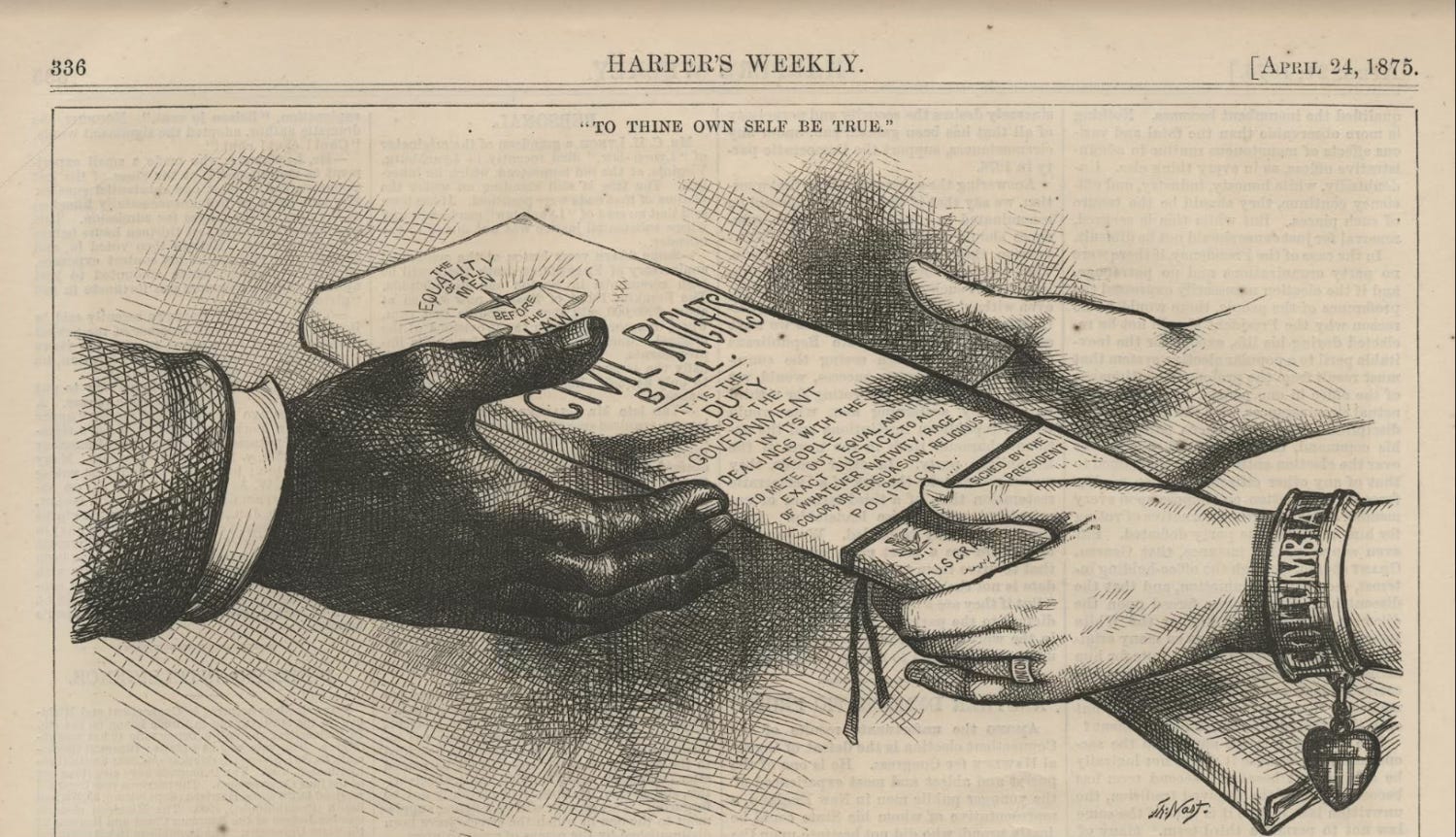
This Day in Legal History: Civil Rights Act of 1866
On April 9, 1866, the United States Congress took a decisive step in shaping post-Civil War legal order by overriding President Andrew Johnson’s veto of the Civil Rights Act of 1866. This marked the first time in American history that a major piece of civil rights legislation became law over a presidential veto. The Act established that all persons born in the United States were citizens, directly challenging the legacy of Dred Scott v. Sandford, which had denied citizenship to African Americans. By affirming equal protection under the law, Congress sought to secure basic civil rights for newly freed individuals in the aftermath of the Civil War. The override demonstrated a powerful assertion of legislative authority during the Reconstruction era.
The law also reflected growing tensions between Congress and the executive branch over how to rebuild the nation. Johnson had argued that the Act overstepped federal authority, but Congress rejected that view, signaling a shift toward stronger federal protection of individual rights. This moment helped redefine the balance of power within the federal government. It also underscored the role of Congress in enforcing civil rights when the executive resisted such measures. The Civil Rights Act of 1866 would later serve as a foundation for the Fourteenth Amendment to the United States Constitution, which constitutionalized its key principles.
In practical terms, the Act granted citizens the right to make contracts, sue in court, and own property regardless of race. Although enforcement remained uneven, the statute represented a critical legal milestone in the transition from slavery to citizenship. It also set an enduring precedent for future civil rights legislation. The events of April 9, 1866, illustrate how constitutional mechanisms like veto overrides can shape the trajectory of American law.
A former DLA Piper associate, Anisha Mehta, testified in federal court that she was unexpectedly fired shortly after announcing her pregnancy, despite receiving positive feedback on her work. She told the jury she handled significant responsibilities, including managing trademark portfolios for major corporate clients, and believed her performance was strong. Mehta said her supervisor initially reacted supportively to her pregnancy but soon raised vague performance concerns that she had not previously encountered. She described feeling shocked and distressed when she was terminated during a call with her supervisor and an HR representative in August 2022.
Mehta claims the firm violated federal and New York City laws by discriminating against her based on pregnancy, while DLA Piper maintains she was dismissed for poor performance. She testified that she attempted to challenge the termination and requested to go through a formal evaluation process, but was denied. After her firing, she continued working briefly until her system access was cut off when she declined a severance agreement.
Following her termination, Mehta applied to hundreds of jobs while pregnant but struggled to find employment. She eventually secured a position at eBay in 2024, earning significantly less than her prior salary. During cross-examination, the defense highlighted several alleged mistakes, including minor errors in client communications and administrative oversights, to support its claim of poor performance. Mehta acknowledged some errors but characterized them as minor and not indicative of overall poor work.
At the center of the case is whether Mehta’s termination was motivated by unlawful pregnancy discrimination or legitimate performance concerns. The legal issue involves employment protections under anti-discrimination laws, which prohibit adverse actions based on pregnancy while still allowing employers to terminate at-will employees for lawful reasons.
Pregnant DLA Piper Atty Recounts Firing: ‘This Feels Wrong’ - Law360
A federal judge in Rhode Island ruled that a coalition of states can proceed with their lawsuit challenging a major restructuring of the U.S. Department of Health and Human Services led by Robert F. Kennedy Jr.. U.S. District Judge Melissa DuBose denied the federal government’s motion to dismiss, finding that the states presented plausible claims under both the Constitution and the Administrative Procedure Act. She also criticized the government for repeating jurisdictional arguments that had already been rejected earlier in the case and by the appellate court.
The lawsuit, brought by 19 states and Washington, D.C., challenges a sweeping overhaul that aimed to significantly reduce the agency’s workforce and restructure key programs. The states argue that the changes disrupted essential public health services, including disease detection, tobacco control efforts, and lead poisoning prevention. They also claim the restructuring caused missed regulatory deadlines, canceled health initiatives, and confusion around federal grants.
Judge DuBose had previously issued a preliminary injunction blocking layoffs, noting that the states demonstrated real and ongoing harm. In this latest ruling, she emphasized that courts have the authority to review and stop government actions that may violate constitutional principles, including separation of powers. The states allege the overhaul exceeded executive authority and violated both statutory requirements and constitutional limits on government power.
The federal government argued that the states lacked standing, that the court lacked jurisdiction, and that the agency’s actions were lawful internal management decisions. However, the judge rejected these arguments, stating they had already been considered and did not undermine the plausibility of the claims. As a result, the case will move forward, allowing the states to continue challenging the legality of the HHS restructuring.
HHS Must Face States’ Suit Over RFK’s ‘Dramatic Overhaul’ - Law360
John Deere has agreed to a $99 million settlement to resolve a class action lawsuit brought by farmers who accused the company of restricting competition in the repair market for its equipment. The farmers alleged that John Deere limited access to necessary diagnostic tools and software, effectively forcing customers to rely on authorized dealers for repairs at higher costs. The company denied wrongdoing but said the agreement resolves the dispute and allows it to move forward.
The settlement includes both monetary compensation and significant changes to repair access. Farmers who paid for repairs through authorized dealers since 2018 will be eligible for compensation, with total payouts expected to exceed $100 million with interest. Experts estimated that the alleged overcharges ranged much higher, making the recovery a relatively strong percentage compared to typical antitrust settlements.
In addition to financial relief, John Deere agreed to provide independent repair shops and equipment owners with access to diagnostic tools and software over a 10-year period. This change is intended to allow farmers to repair their own equipment or use third-party providers, addressing concerns about restricted competition. Plaintiffs described this as a major shift that breaks down the company’s control over the repair market.
The lawsuit, filed in 2022, claimed that John Deere monopolized the aftermarket for repairs by designing equipment that required proprietary tools. A federal judge previously allowed the case to proceed, finding sufficient evidence of potential market power. While this settlement resolves the private lawsuit, similar claims brought by the Federal Trade Commission remain ongoing.
John Deere Inks $99M Deal In Farmers’ Right-To-Repair Suit - Law360


