



This Day in Legal History: The White House Tapes Revealed
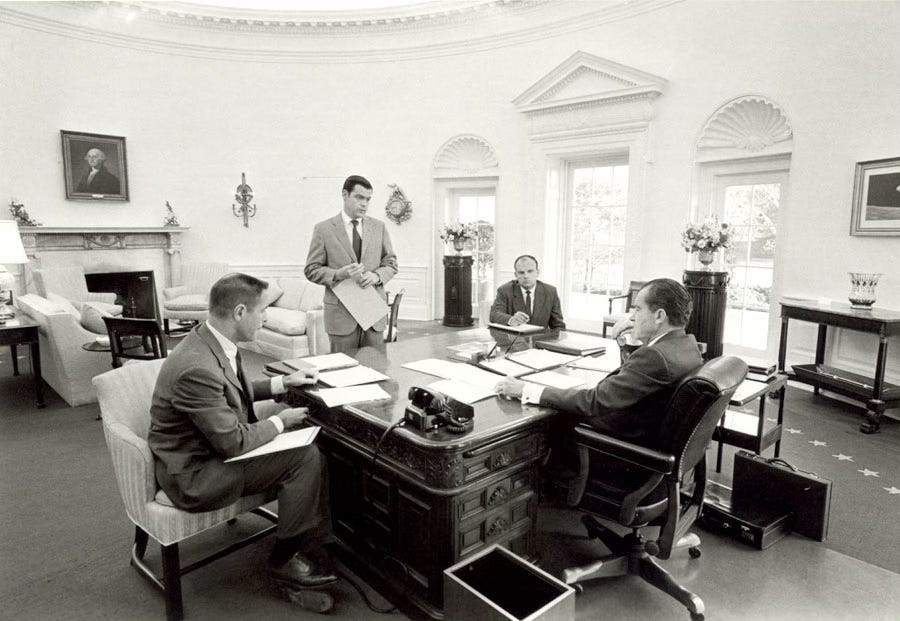
On July 16, 1973, before the Senate Watergate Committee and a live national television audience, a former White House aide named Alexander Butterfield answered a question that changed American history. Asked whether there was any kind of recording system in the White House, Butterfield confirmed that President Nixon had installed a secret, voice-activated taping system that recorded his conversations and phone calls in the Oval Office and elsewhere. In a single answer, the entire Watergate investigation pivoted.
Until that moment, the inquiry into the Watergate break-in and cover-up had largely been a contest of competing testimony—Nixon’s word against that of his former counsel John Dean. The existence of the tapes meant there was now an objective record of what the President had actually said and known. Prosecutors and Congress immediately sought them; Nixon refused to hand them over, asserting executive privilege—the claim that a president’s confidential communications are shielded from disclosure. That standoff produced one of the most important separation-of-powers decisions in American law.
In United States v. Nixon, decided a year later in July 1974, a unanimous Supreme Court rejected the President’s claim of absolute privilege. The Court recognized that executive privilege exists and has real constitutional footing, but held that it is not unqualified—that it must yield to the demonstrated, specific need for evidence in a criminal proceeding. No person, the decision made clear, not even the president, is above the ordinary processes of the law. Nixon turned over the tapes, one of which captured him plotting to obstruct the investigation, and he resigned days later. The significance of July 16, 1973 is that a single truthful answer under oath set in motion the enforcement of a foundational principle: that presidential power operates within the law, and that the courts, not the president, decide the limits of privilege.
Todd Blanche’s bid to become attorney general is hanging in the balance after a tense confirmation hearing before the Senate Judiciary Committee. Blanche, who has been acting attorney general since President Trump fired Pam Bondi in April and who previously served as Trump’s personal criminal defense lawyer, spent hours fielding pointed questions—including a telling moment when he said he “is” the president’s lawyer before catching himself and correcting it to “was.” The awkwardness captures the central concern: whether a former personal attorney to the president can run the Justice Department as a neutral servant of the law rather than of the man who appointed him. Senators pressed him on the now-defunct anti-weaponization fund, the handling of the Epstein files, and Trump’s pardons for January 6 defendants. The math is what makes this precarious. The recent death of Senator Lindsey Graham left committee Republicans with just one vote to spare, and Senator John Cornyn—a lame duck—has said he isn’t sold, meaning Blanche’s advancement may rest largely in Cornyn’s hands. The significance is about the independence of federal law enforcement: confirming a president’s former defense lawyer as attorney general tests whether the Justice Department’s prosecutorial power will be insulated from the president’s personal interests, and the narrow margin means a single Republican could decide the outcome.
Blanche to face Senate grilling in bid to be Trump’s attorney general | Reuters
The Senate has confirmed a second Florida state appeals judge who ruled in President Trump’s favor in his defamation suit against the Pulitzer Prize Board, giving him a lifetime seat on the federal bench. The vote was 51-46 along party lines to place Chief Judge Jeffrey Kuntz on the U.S. District Court for the Southern District of Florida. Here’s the connection that drew scrutiny. Kuntz sat on the Florida appeals court panel that ruled for Trump on a personal-jurisdiction question, allowing his defamation case against the Pulitzer Board to move forward—and Kuntz wrote that panel ruling. He is now the second judge from that same panel to be nominated by Trump and confirmed to a lifetime federal judgeship. At his hearing, Kuntz defended his decision not to recuse from the Trump matter. The significance is about judicial independence and the appearance of a quid pro quo. There is nothing unusual about elevating state appellate judges to the federal bench, and a favorable ruling doesn’t by itself prove anything improper. But when a president rewards judges who ruled for him personally with lifetime appointments, it raises an uncomfortable question about incentives—whether judges hoping for advancement might feel subtle pressure to favor the person doing the appointing—and that perception, critics argue, can corrode public confidence in an impartial judiciary even where each individual ruling was defensible on the merits.
2nd Florida judge who ruled for Trump in Pulitzer case confirmed to federal bench | Reuters
And finally, the Federal Trade Commission and the Ohio State Bar Association have thrown their support behind an Ohio Supreme Court proposal to loosen the American Bar Association’s long-standing grip on who gets to become a lawyer. The proposal would let graduates of non-ABA-accredited law schools sit for the Ohio bar exam and would move toward a state-run accreditation process. Here’s the structure worth understanding. In most states, you generally can’t take the bar exam unless you graduated from a law school the ABA has accredited—which effectively makes the ABA the national gatekeeper of legal education. The FTC’s objection is framed in competition terms: it argues the ABA’s accreditation standards “go beyond what is reasonably necessary” to ensure lawyers are prepared, and that restricting the supply of lawyers this way may boost incumbent lawyers’ pay while raising costs and reducing access for ordinary people who need legal help. Ohio isn’t alone—Florida and Texas have already amended their rules so the ABA no longer has the final say, and Tennessee is weighing a similar move. The significance is a real shift in how the profession polices its own entry. Supporters see it as breaking up a monopoly to expand access to legal careers and legal services; critics worry that weakening a uniform national standard could erode the quality and consistency of legal training. Either way, the ABA’s decades-long role as the sole gatekeeper is eroding, state by state.
State bar, FTC back Ohio proposal to limit ABA role in lawyer admissions | Reuters


