


This Day in Legal History: NAACP v. Alabama
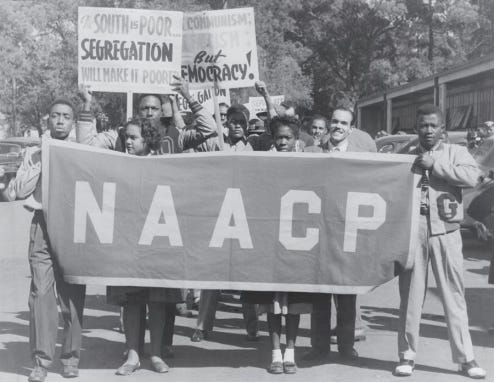
On March 17, 1958, the Supreme Court of the United States issued a landmark decision in NAACP v. Alabama, a case that reshaped constitutional protections for civil rights organizations. The dispute arose when the state of Alabama sought to compel the NAACP to disclose its membership lists as part of a legal proceeding. At the time, the NAACP was deeply involved in challenging segregation laws across the South, making its members vulnerable to retaliation and harassment. Alabama argued that it had the authority to demand these records under its corporate registration laws. The NAACP refused, asserting that disclosure would violate its members’ constitutional rights.
The case eventually reached the Supreme Court, where the central question became whether forced disclosure infringed on the freedom of association. Writing for a unanimous Court, Justice John Marshall Harlan II emphasized that privacy in group membership was essential to preserving lawful association. The Court held that Alabama’s demand posed a substantial restraint on the ability of individuals to organize and advocate collectively. It recognized that exposure of members’ identities could lead to economic reprisal, loss of employment, and even physical danger.
Importantly, the Court grounded its reasoning in the Due Process Clause of the Fourteenth Amendment, incorporating First Amendment protections against state action. This marked a significant step in expanding constitutional safeguards for civil liberties at the state level. The ruling made clear that states could not use indirect means to suppress lawful advocacy groups. It also strengthened the legal foundation for future civil rights litigation during a critical period in American history.
The decision in NAACP v. Alabama remains a cornerstone of First Amendment jurisprudence. It continues to influence cases involving anonymity, privacy, and the right to organize without undue government interference.
A federal judge in Massachusetts has blocked the federal government’s revised childhood vaccine schedule and paused related policy actions, finding the changes likely unlawful. The court concluded that the Department of Health and Human Services departed from longstanding, science-based procedures when issuing the new recommendations. Central to the ruling was the government’s apparent sidestepping of the Advisory Committee on Immunization Practices (ACIP), a key expert body that has historically guided vaccine policy.
The judge rejected the argument that the health secretary has near-total discretion over vaccine decisions, emphasizing that such authority is still constrained by statutory and procedural requirements. He underscored that courts can review agency actions, particularly when they appear to ignore scientific standards or established processes. The opinion was especially critical of the administration’s position that its vaccine guidance was not subject to judicial review, noting that the recommendations carry real legal and practical consequences.
The revised schedule itself had scaled back universal recommendations for several vaccines, instead limiting them to certain groups or requiring consultation with a doctor. The court found that these changes could significantly affect liability protections for healthcare providers and insurance coverage obligations.
The ruling also raised concerns about potential violations of the Federal Advisory Committee Act after the abrupt dismissal and replacement of ACIP members, many of whom reportedly lacked relevant expertise. While the court did not cancel upcoming committee meetings, it halted the appointments of new members and froze future decisions tied to the disputed process.
The decision represents a significant check on the administration’s approach to public health policymaking, reinforcing that agencies must follow established legal frameworks and rely on qualified expertise. An appeal is expected, and related litigation is already pending in other courts.
HHS’ Childhood Vaccine Policy Changes Put On Ice - Law360
US judge upends Kennedy’s overhaul of childhood vaccine policies | Reuters
A federal judge in Washington, D.C., is set to hear arguments over whether to halt construction of a $400 million ballroom project at the White House. The dispute centers on a lawsuit brought by preservationists, who argue that the project—built on the site of the demolished East Wing—was launched without proper legal authorization. They are seeking a preliminary injunction to stop construction while the case proceeds.
The National Trust for Historic Preservation claims that neither the president nor the National Park Service has the authority to approve such a major structural change without explicit approval from Congress. The group argues that past practice shows Congress typically authorizes significant developments on federal land in Washington.
The Trump administration, however, maintains that the project is lawful and does not require specific congressional approval. Government lawyers argue that the ballroom will improve infrastructure, enhance security, and help preserve the main White House building by shifting large events elsewhere. They also contend that the plaintiffs have not met the high legal standard required for an injunction.
A federal judge previously denied an earlier request to stop construction, finding the initial legal arguments insufficient. The new hearing will consider revised claims focused more directly on presidential authority and statutory limits.
At this stage, the case turns on whether the plaintiffs can show both a likelihood of success on the merits and that immediate harm justifies blocking the project before a final decision is reached.
US judge to weigh new bid to halt Trump’s $400 million ballroom project | Reuters
You may have heard about the SAVE America Act, and given the attention it’s received, it’s helpful to clearly lay out what the bill actually does.
The SAVE America Act would make significant changes to federal voter registration and election procedures, primarily by requiring proof of U.S. citizenship. The bill amends the National Voter Registration Act to require applicants to present documentary evidence—such as a passport, birth certificate, or certain government-issued identification—before registering to vote in federal elections. It also requires that this proof generally be provided in person, even when registering by mail, though states may create alternative processes for applicants who cannot readily produce documentation.
The legislation directs states to verify citizenship status during voter registration and to establish systems for identifying and removing non-citizens from voter rolls. It encourages the use of federal and state databases, including systems maintained by the Department of Homeland Security and the Social Security Administration, to confirm eligibility. Federal agencies are required to respond quickly to state requests for citizenship verification and to share relevant data across agencies.
The bill further mandates that voters present a qualifying photo ID when casting a ballot in federal elections. For in-person voting, the ID must be shown at the polling place, while absentee voters must submit copies of identification with their ballots. Acceptable IDs must generally include both a photograph and an indication of U.S. citizenship, though supplemental documentation may be used in some cases.
The bill would effectively bring all the convenience and ease of a trip to the DMV to the ballot box.
In addition, the legislation expands enforcement mechanisms. It creates potential criminal liability for election officials who knowingly register individuals without proof of citizenship and allows private lawsuits against officials who fail to enforce the requirements. It also requires states to take ongoing steps to ensure that only eligible citizens remain registered, including removing individuals identified as non-citizens.
The bill includes provisions addressing discrepancies in documentation and requires election officials to document the basis for registering individuals who lack standard proof. It also preserves the use of provisional ballots, allowing individuals to vote while their eligibility is later verified. Overall, the measure shifts the federal framework toward stricter documentation, verification, and enforcement standards tied to voter eligibility in federal elections.
What is in Trump’s bill that requires proof of citizenship to vote? | Reuters
Text - H.R.7296 - 119th Congress (2025-2026): SAVE America Act
This week, my Bloomberg Tax column examines California’s recent crackdown on luxury vehicles registered in Montana to avoid sales tax. The enforcement actions reveal a deeper flaw in California’s system: it relies heavily on formal delivery paperwork rather than the actual use of the vehicle. Buyers have been able to exploit this by creating the appearance of out-of-state delivery through inexpensive documentation, even when the cars never leave California. Prosecutors allege that some schemes were remarkably simple, involving little more than fabricated shipping records.
The current rule allows residents to avoid sales tax if a vehicle is delivered and kept out of state for 12 months, a policy originally designed for legitimate interstate purchases. However, it has unintentionally created a market for services that help buyers simulate compliance. Entity formation companies, transporters, and storage providers all play a role in generating paperwork that masks in-state use. This has made tax avoidance both accessible and predictable.
California has responded with audits, criminal prosecutions, and surveillance tools like license plate readers, but these efforts address symptoms rather than the underlying design problem. A system built on easily manipulated documentation invites abuse. Instead, the column argues that California should adopt a “primary-use” rule, taxing vehicles based on where they are actually driven and stored.
Other states already apply similar approaches to aircraft, using objective data like flight logs to determine tax liability. A comparable framework for cars could rely on existing data sources such as toll records, insurance information, and registration patterns. This would allow enforcement to focus on real-world usage rather than paper compliance.
Clear thresholds and penalties could further deter avoidance by making enforcement more predictable. While some buyers might still structure legitimate out-of-state ownership, the system would no longer reward purely formalistic schemes. The broader point is that tax policy should reflect economic reality, not paperwork.
California’s Car Sales Tax Crackdown Calls for Primary-Use Rule


