



This Day in Legal History: Congress Repeals the Gold Clause
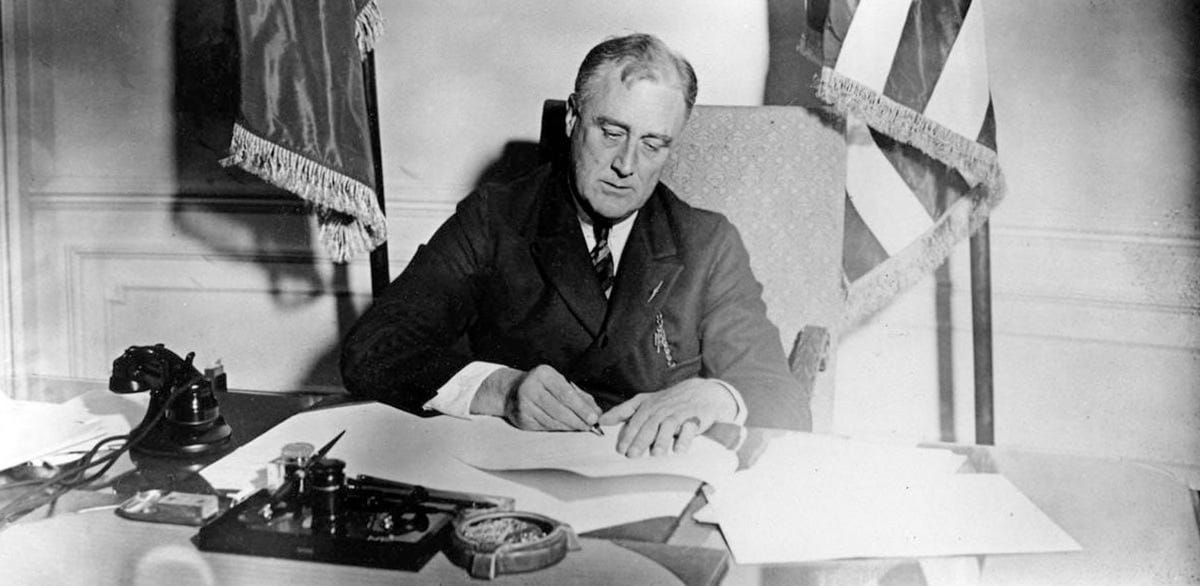
On this day in 1933, Congress passed the Joint Resolution that voided the gold clauses written into nearly every long-term contract and bond obligation in the United States, both public and private. The resolution declared that any provision purporting to require payment “in gold or a particular kind of coin or currency” was “against public policy,” and that obligations could be discharged dollar for dollar in whatever legal tender currency was in force at the time of payment. It was a remarkable act of legislative power: a one-paragraph statute that rewrote the payment terms of millions of existing contracts overnight, in the middle of the Great Depression, to make Franklin Roosevelt’s recent abandonment of the gold standard actually stick. The Supreme Court took up the inevitable challenge two years later in the Gold Clause Cases — Norman v. Baltimore & Ohio, Nortz v. United States, and Perry v. United States — and in February 1935 it upheld the resolution as applied to private contracts by a 5-4 vote, while telling the United States, in Perry, that it had violated its own contractual word in repudiating gold-payment promises on government bonds, but that the bondholder had suffered no compensable injury. The doctrinal residue of that compromise is still with us: Congress can use its monetary powers to alter private contract terms retroactively when monetary policy requires it, the rule that has quietly underwritten every major monetary intervention since, from Bretton Woods to the post-2008 emergency lending programs. June 5 is not a day most lawyers mark on the calendar, but the resolution Congress passed on this date is one of the cleanest examples in American law of a legislature using its enumerated powers to dissolve a contract term that had been considered, until that moment, untouchable.
The Supreme Court on Thursday handed Hikma Pharmaceuticals — and the entire generic drug industry — a 9-0 win in a case that had been hanging over the so-called “skinny label” pathway for years. Justice Ketanji Brown Jackson, writing for a unanimous Court in Hikma Pharmaceuticals USA Inc. v. Amarin Pharma, Inc., held that Amarin, the maker of the brand-name fish-oil drug Vascepa, had not plausibly alleged that Hikma actively induced infringement of Amarin’s patents covering a still-patented cardiovascular use of the drug. The skinny label is a feature of Hatch-Waxman generic-drug law that lets a generic manufacturer copy only the unpatented uses of a brand drug by literally carving the patented uses out of its FDA-approved label, which is supposed to let cheaper generics reach the market for the unpatented indications even while patents on other indications are still in force. Brand companies have been trying for years to sue around that carve-out under the active inducement statute, 35 U.S.C. § 271(b), by pointing to generic press releases, marketing language, or website descriptions and arguing that doctors could read those statements as encouragement to prescribe the generic for the still-patented use. The Federal Circuit had bought a version of that argument and revived Amarin’s case. The Supreme Court rejected that approach, and the test that Justice Jackson articulated is meaningful: the question is not how doctors might interpret what a generic manufacturer said, but whether the manufacturer itself actively encouraged the infringing use. Neutral statements that could be read as instructions to infringe do not count. The practical effect is to shore up the skinny label pathway and make it harder for brand companies to weaponize induced infringement against generic competition. The decision was originally framed as a pharmaceutical-industry case, but its inducement standard will reach across patent law generally and into every industry where § 271(b) gets litigated.
It’s unanimous: SCOTUS agrees with Hikma in ‘skinny label’ case vs. Amarin | Fierce Pharma
Also unanimous on Thursday: the Supreme Court in Sripetch v. SEC held that the Securities and Exchange Commission can obtain disgorgement of a wrongdoer’s ill-gotten gains without having to prove that any individual investor lost money. Justice Neil Gorsuch wrote the opinion for a 9-0 Court, which is itself a small surprise given the Court’s recent pattern of skepticism toward broad SEC remedial powers. The case came out of a penny-stock pump-and-dump scheme that Ongkaruck Sripetch ran across some 20 small companies — buy shares quietly, promote them aggressively, sell into the bubble — and the SEC won an order requiring him to disgorge roughly $3 million. Sripetch’s argument on appeal was that disgorgement is supposed to be tied to investor harm, that the SEC had not shown specific pecuniary losses traceable to him, and that the order was therefore not the kind of equitable relief the Court approved in its 2020 Liu v. SEC decision. The Court disagreed, on traditional equity principles: disgorgement, the Court explained, is measured by the defendant’s unjust gain, not the plaintiff’s quantified loss, and equity has always been willing to strip a wrongdoer of profit even when the victim cannot mathematically prove harm. The practical importance for the SEC is enormous — the agency reports collecting roughly $1.4 billion in disgorgement in fiscal 2025 alone, and a contrary ruling would have forced the SEC into an evidentiary burden that pump-and-dump and insider-trading cases are notoriously bad at supplying. The opinion is also a reminder that the Court’s recent administrative-state skepticism is not all in one direction: when the question is grounded in old equity doctrine, the same justices who narrowed SEC adjudication in Jarkesy are willing to leave the agency’s remedial toolkit intact.
US Supreme Court Backs SEC in Fight Over ‘Disgorgement’ Power | US News
The third and most constitutionally significant of Thursday’s rulings was FCC v. AT&T, in which the Supreme Court upheld 8-1 the Federal Communications Commission’s longstanding practice of imposing forfeiture penalties on regulated carriers through its own in-house process, without first giving the carrier a jury trial. Chief Justice John Roberts wrote the majority, with Justice Clarence Thomas the lone dissenter. The case grew out of the FCC’s headline-making fines against AT&T, Verizon, T-Mobile, and Sprint for selling access to real-time customer location data to third parties without consent — fines that ran nearly $200 million across the four carriers, with AT&T’s portion at $57 million and Verizon’s at $46.9 million. The carriers challenged the fines on Seventh Amendment grounds, arguing that the Court’s 2024 decision in SEC v. Jarkesy — which struck down the SEC’s in-house adjudication of securities-fraud penalties as a violation of the jury-trial right — should reach FCC forfeitures too. The Court said no, on a structural distinction that matters: an FCC forfeiture order is not self-executing. The FCC cannot collect on its own. If a carrier refuses to pay, the matter is referred to the Justice Department, which then has to file a civil action in federal district court — a proceeding in which the carrier is entitled to a full jury trial and the government has to prove the violation de novo, with no deference to the FCC’s findings. That collection-stage jury trial, Roberts wrote, is enough to satisfy the Seventh Amendment, even though the agency itself first issues the penalty. Justice Thomas’s dissent argued the in-house process is no less coercive than the SEC adjudication the Court rejected in Jarkesy and would have extended Jarkesy here. The practical takeaway: agency in-house penalty proceedings survive after Jarkesy if there is a real, downstream jury-trial backstop. Expect every regulator with a similar two-step enforcement structure to point to this opinion the next time someone tries to push Jarkesy further.
Court rules against cell service providers over right to jury trial in FCC proceedings | SCOTUSblog


