



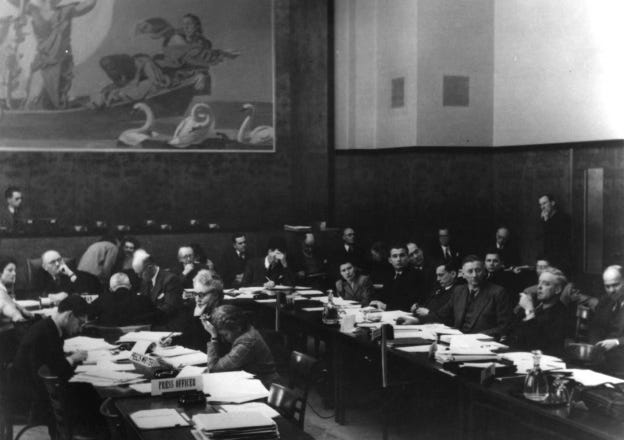
This Day in Legal History: WHO Established
On April 7, 1948, the World Health Organization (WHO) was officially established when its constitution entered into force, marking a pivotal moment in the development of international law. The creation of the WHO reflected a growing recognition among nations that public health challenges transcend borders and require coordinated legal and institutional responses. Its constitution set out a broad definition of health as a fundamental human right, helping to shape future legal frameworks and policy discussions worldwide. By joining the organization, member states accepted binding obligations, particularly in the areas of disease surveillance, reporting, and cooperation. These obligations were designed to promote transparency and rapid response to emerging health threats, which had historically spread unchecked due to limited coordination.
The WHO’s legal framework also empowered the organization to issue regulations and recommendations, including what would later become the International Health Regulations, a key tool in managing global health emergencies. This marked an important shift toward formalized international governance in public health, moving beyond informal cooperation to structured legal commitments. The constitution further established the World Health Assembly, giving member states a forum to negotiate and adopt health-related policies with legal and political significance. Over time, the WHO has played a central role in shaping international responses to pandemics, vaccination efforts, and health equity initiatives. Its authority, while not absolute, carries significant influence in both legal and diplomatic contexts.
A group of YouTube creators has filed a proposed class action lawsuit against Amazon, alleging that the company improperly used their copyrighted videos to train its AI video-generation tool, Nova Reel. The plaintiffs claim Amazon bypassed YouTube’s technological safeguards to access and download large amounts of video content without permission. According to the complaint, Amazon used automated scraping tools and techniques like rotating IP addresses to avoid detection while extracting videos at scale. The creators argue that this conduct violated both YouTube’s terms of service and federal copyright law.
The lawsuit specifically alleges violations of the Digital Millennium Copyright Act, focusing on Amazon’s alleged circumvention of technological protection measures designed to safeguard content. Plaintiffs claim their videos were then used for Amazon’s commercial benefit in developing its AI system, without compensation or consent. They also argue that once content is used to train AI models, it cannot be effectively removed, causing lasting harm to creators. The complaint challenges Amazon’s characterization of its training data as “publicly available,” arguing that availability does not equal lawful use.
The creators seek to represent a nationwide class of individuals whose content may have been similarly used. They are asking for damages, injunctive relief, and a declaration that Amazon’s actions were willful. The case highlights broader tensions between content creators and AI developers over data sourcing practices. Similar lawsuits have been filed against other AI companies, reflecting a growing wave of litigation in this area.
YouTube Creators Say Amazon Scrapes Videos To Train AI - Law360
The Supreme Court of the United States has sent a long-running lawsuit over alleged FBI surveillance of Muslims in Southern California back to a lower court for reconsideration. The case, brought by several individuals including Sheikh Yassir Fazaga, claims the FBI unlawfully monitored their community using an informant after 9/11. The justices did not rule on the merits but instead instructed the lower courts to revisit the case in light of new factual developments and the government’s motion to dismiss.
At the center of the dispute is the state secrets privilege, a legal doctrine that allows the government to block litigation if it risks exposing national security information. The FBI has argued that continuing the case could reveal sensitive intelligence methods and weaken this protection. Previously, the United States Court of Appeals for the Ninth Circuit allowed parts of the lawsuit to move forward, reasoning that courts should not dismiss claims too early without fully examining whether secret evidence is truly necessary. The appellate court suggested possible ways to proceed while protecting classified information, such as limited judicial review of sensitive materials.
The Supreme Court’s earlier 2022 decision confirmed that the state secrets privilege applies but left open how it should be used in this case. The Ninth Circuit later revived some claims, while still dismissing others against individual agents. The government challenged that ruling, arguing it forces courts to rely on protected information in ways that undermine the privilege. Plaintiffs, however, maintain their case can proceed using non-classified evidence and that the subject matter itself is not a state secret.
The remand keeps the case alive but unresolved, requiring the lower courts to reassess whether it can proceed without endangering national security. The outcome could shape how courts handle similar conflicts between civil rights claims and government secrecy.
Justices Remand State Secrets Dispute In FBI Spying Case - Law360
In my column for Bloomberg this week, I examine how a major IRS modernization effort fell short—not simply because of execution issues, but because of chronic underfunding. A recent report by the Treasury Inspector General for Tax Administration shows that funds from the Inflation Reduction Act that were intended for modernization were largely redirected to cover basic operations. Instead of transforming systems and rebuilding long-term capacity, the IRS used much of the money to sustain staffing and maintain existing IT infrastructure. In my view, this outcome was predictable given the agency’s longstanding resource constraints.
I explain how budget cuts and workforce reductions undermined the modernization initiative from the start. Even with new funding, the IRS still had to meet its core obligation of processing hundreds of millions of tax returns each year. Faced with those pressures, it prioritized immediate operational needs over long-term upgrades, including spending significant sums on routine IT maintenance. I also point out that contractor spending surged, reflecting a growing reliance on outside support rather than investment in internal expertise.
The report highlights inefficiencies as well, including canceled or reworked contracts that consumed large amounts of funding without delivering meaningful results. At the same time, labor costs remained elevated due to the complexities of downsizing, creating a situation where the IRS was both shrinking its workforce and paying contractors to compensate for lost capacity. I argue that this pattern is better understood as institutional outsourcing rather than modernization.
Ultimately, I contend that real modernization cannot occur without stable baseline funding for core operations. Without that foundation, any new investment will continue to be diverted toward keeping the agency running. My conclusion is that Congress attempted to modernize the IRS without first ensuring its institutional stability, making the outcome not just disappointing, but largely inevitable.


