



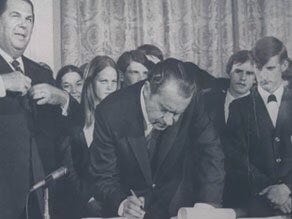
This Day in Legal History: Title IX
On June 23, 1972, President Richard Nixon signed the Education Amendments of 1972, a sweeping federal education law that included what became one of the most consequential civil rights provisions in American history: Title IX. Title IX stated that no person in the United States, on the basis of sex, could be excluded from participation in, denied the benefits of, or subjected to discrimination under any education program or activity receiving federal financial assistance. The language was brief, but its legal effect was enormous because it tied sex-equality obligations to the federal funding received by schools, colleges, and universities. That structure gave the federal government a powerful enforcement tool: institutions that accepted federal education money also had to comply with anti-discrimination rules.
Although Title IX is often remembered for transforming women’s and girls’ athletics, the law was never limited to sports. It also affected admissions, scholarships, hiring, classroom access, pregnancy discrimination, and later legal debates over sexual harassment and institutional responsibility. Before Title IX, many educational institutions openly limited opportunities for women, including through quotas, unequal athletic resources, and restricted access to professional programs. The statute helped turn those practices into legal liabilities rather than accepted traditions. In later decades, courts and federal agencies would shape Title IX’s meaning through regulations, enforcement actions, and major cases interpreting what counts as sex discrimination in education. Its influence reached far beyond individual lawsuits because schools had to rethink policies, reporting systems, athletic budgets, and equal-access obligations.
Title IX also became a model for how civil rights law can operate through spending power, using federal money as the hook for national anti-discrimination standards. Its passage showed that a single sentence in a larger statute could become a foundation for generations of legal, political, and cultural change. On June 23, 1972, the federal government did more than amend education law; it created a durable legal framework for challenging sex discrimination wherever public money supported educational opportunity.
A federal judge in California dismissed the Trump administration’s lawsuit challenging Los Angeles’s limits on cooperation with federal immigration enforcement. The administration had argued that the city’s ordinance was unconstitutional because it restricted the use of city resources to support federal immigration operations and limited the collection of citizenship-status information. U.S. District Judge Fernando Olguin rejected that argument, finding that Los Angeles was regulating the conduct of its own employees and agencies rather than trying to control the federal government. The dismissal was not necessarily the end of the case, because the judge allowed the administration to file an amended complaint. Los Angeles City Attorney Hydee Feldstein Soto praised the ruling, saying it confirmed that local governments can decide how to use their own personnel and resources. The lawsuit was filed after immigration-related protests in Los Angeles and after Trump sent troops to the city in response to unrest over deportation operations. The case is part of a broader Trump administration effort to challenge local “sanctuary” policies in Democratic-led jurisdictions. Similar administration lawsuits against Boston and Chicago have also been dismissed by federal judges. The White House did not immediately comment on the ruling. The decision leaves Los Angeles’s ordinance intact for now while giving the federal government another chance to revise its legal claims.
US court dismisses Trump administration lawsuit over Los Angeles immigration policy | Reuters
A federal judge in Washington, D.C., blocked the Trump administration from using a revised immigration database to help states check voter rolls. The database, known as SAVE, is used by the Department of Homeland Security to verify citizenship and immigration status, but the administration had changed it to make bulk searches easier for state and local officials reviewing voter eligibility. U.S. District Judge Sparkle Sooknanan sided with voting-rights and privacy groups that argued the changes made the system less reliable and could wrongly remove eligible voters from registration lists. The challengers said the database can be outdated, especially when naturalized citizens are still incorrectly listed as noncitizens. The judge also found that the revamped system raised serious privacy concerns because it gave users access to sensitive information, including Social Security numbers. DHS criticized the ruling and framed the case as part of its effort to prevent noncitizen voting. The ruling comes as the Trump administration has tried to expand the federal government’s role in election administration before the November 2026 midterm elections. Courts have already blocked several related efforts, including parts of executive orders involving proof-of-citizenship requirements and mail-ballot restrictions. The administration has also faced setbacks in lawsuits seeking full voter-roll data from states. For now, the decision limits how the federal government can use immigration records in voter-roll checks.
Judge blocks Trump’s use of revamped immigration database for voter checks | Reuters
In my Bloomberg column this week, I wrote about OpenAI’s request that Treasury update an outdated R&D tax credit rule for computer-related research expenses. My argument is that OpenAI’s position should not be dismissed as just another technology company asking for a more generous tax benefit. The problem is that the existing rule was designed for an older world of identifiable physical computers, not modern cloud computing, data centers, GPUs, and reserved compute capacity. Section 41 allows a research credit for certain amounts paid to another person for computer use in qualified research, but Treasury regulations narrow that benefit by requiring that the computer be owned and operated by someone else, located off the taxpayer’s premises, and not be a computer for which the taxpayer is the “primary user.” That “primary user” test made more sense when a taxpayer could point to a discrete machine, but it becomes unstable when a company is buying access to capacity inside a provider-owned cloud or data center.
I argue that reserved or exclusive use of computing capacity should not automatically be treated as ownership or abuse, because modern AI research may require dedicated capacity for security, speed, and performance reasons. The real question should be whether the taxpayer is buying a third-party service or has effectively acquired, operated, or taken control of the infrastructure. Treasury can still protect against abuse without treating ordinary commercial cloud arrangements as disguised ownership. I suggest that a practical safe harbor could presume service treatment where the provider owns, operates, maintains, and houses the equipment off the taxpayer’s premises while bearing the incidents of ownership. That presumption should remain rebuttable where the taxpayer bears ownership-like risks or is simply routing its own equipment through another entity to claim the credit.
The broader point is that modernizing the rule would not need to turn the R&D credit into an AI subsidy machine, but it would prevent an old regulatory framework from excluding a major category of modern research. The column closes with the idea that tax rules meant to police fake outsourcing should not end up penalizing real outsourcing just because the computing world no longer looks like it did when the rule was written.
OpenAI’s Call for Modernized R&D Credit Rule Makes Perfect Sense


