


This Day in Legal History: The First Hague Convention
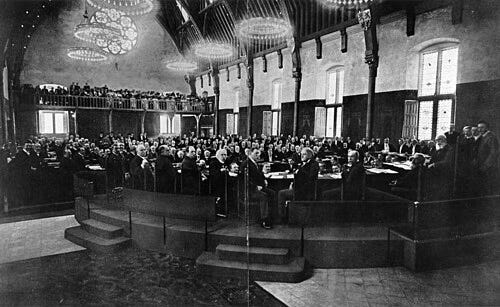
On July 29, 1899, delegates from twenty-six nations signed the first Hague Convention, the product of an international peace conference convened at the initiative of Russia’s Tsar Nicholas II. It was one of the founding moments of modern international law—an attempt, at the close of a violent century, to subject the conduct of war and the resolution of disputes between nations to legal rules rather than raw power.
The 1899 Convention did two enduring things. First, it began the codification of the laws and customs of war—rules on the treatment of prisoners, the protection of civilians, and limits on certain weapons—laying groundwork that would grow into the modern law of armed conflict and, eventually, the Geneva Conventions. Second, and just as important, it created the Permanent Court of Arbitration in The Hague, the first standing international institution designed to let states resolve their disputes through neutral arbitration instead of on the battlefield. The idea was radical for its time: that sovereign nations would voluntarily submit their quarrels to a legal process.
The Hague system was, of course, imperfect—the twentieth century that followed was the bloodiest in human history, and the conventions did not prevent two world wars. But the significance of July 29, 1899 is that it planted the institutional and conceptual seeds of everything that came after: the League of Nations, the United Nations, the International Court of Justice, the international criminal tribunals, and the entire architecture of treaties and adjudication that structures relations between states today. It reflects an enduring aspiration—one that runs through so much of what we cover—that disputes are better settled by law than by force. It’s a fitting backdrop for a day whose stories, in their own ways, are all about turning conflict over to the legal system rather than settling it by other means.
A federal appeals court has revived a proposed class action accusing Chobani of deceiving consumers by marketing some of its Greek yogurt as “zero sugar.” The Seventh Circuit in Chicago ruled that consumers can proceed with claims under state consumer-protection laws, because Chobani Zero Sugar yogurt contains about four grams per serving of allulose, a naturally occurring sweetener. Here’s the wrinkle that makes this interesting. Allulose is chemically a sugar, but the body barely metabolizes it, so the FDA lets manufacturers leave it out of the “sugars” lines on the Nutrition Facts panel. Chobani leaned on exactly that, saying its panel accurately shows zero grams of total and added sugar. But the court focused on the big front-of-package promise—”Zero Sugar”—and found persuasive an FDA brief explaining that “total sugars” actually includes all monosaccharides, allulose among them. Under FDA rules, a product generally can’t be labeled “zero sugar” or “sugar free” unless it has less than half a gram of sugar per serving. Writing for the court, Judge Thomas Kirsch said it was not implausible that consumers—here, a couple who bought the yogurt at a Costco near Chicago—were “fooled” by that absolute promise. The significance is a reminder that the technically-accurate fine print on the back doesn’t necessarily save a bold marketing claim on the front. This is how consumer-protection law polices the gap between what a label shouts and what a product actually contains, and the ruling lets the plaintiffs try to prove that gap misled shoppers.
Chobani must face lawsuit over zero-sugar yogurt claim, US appeals court rules | Reuters
Yahoo Finance · Insurance Journal
eBay and three of its former executives have agreed to pay roughly $56 million to settle a civil suit brought by a Massachusetts couple who were the targets of one of the more disturbing corporate harassment campaigns in recent memory. The couple, Ina and David Steiner, publish an e-commerce trade newsletter, and back in 2019 several eBay employees—furious over the Steiners’ coverage of the company—orchestrated a campaign to terrorize them: shipping cockroaches, live spiders and fly larvae, and a bloody pig Halloween mask to their home, sending threatening messages, and conducting covert surveillance. It grew out of internal communications in which senior executives discussed taking the couple “down.” The criminal side of this played out years ago, with multiple former employees prosecuted and sentenced. This week’s news is the civil resolution: eBay will pay about $46 million to the couple plus millions more in charitable contributions, and the former executives are personally on the hook—two million dollars from former CEO Devin Wenig, and smaller sums from two others. The significance here is corporate accountability, and specifically accountability for retaliation against the press. A powerful company weaponized its resources to punish two journalists for critical coverage—the kind of retaliation that strikes at the heart of a free press—and while the criminal cases addressed the individual foot soldiers, this settlement attaches a very large price tag to the company and the executives at the top. It’s a stark example of the civil justice system doing what the criminal system often can’t: reaching the institution and its leadership, and making them pay.
eBay, former executives to pay $56 million to settle couple’s harassment case | Reuters
And finally, prosecutors have offered their most detailed account yet of why they believe activist Charlie Kirk was killed, arguing in a new court filing that the man accused of shooting him targeted Kirk for his political and religious views. Kirk, a prominent conservative activist and ally of President Trump, was shot and killed in September 2025 at a university in Utah; Tyler Robinson, who is 23, is charged in his death. In the filing, prosecutors pointed to Kirk’s opposition to gay marriage and transgender rights, and cited a letter from a board member of Kirk’s organization describing him as the face of a political and religious movement. They allege Robinson’s own lifestyle ran contrary to Kirk’s views and that he targeted Kirk because of his “political expression.” Robinson’s defense attorney pushed back, arguing that the materials the state is relying on show nothing about whether Robinson actually disagreed with Kirk or what was in his mind. And that disagreement is the legal heart of this. Motive is not, strictly speaking, an element the prosecution must prove to establish murder—but it is powerful evidence, it helps a jury make sense of a killing, and in a serious case it can bear heavily on how the crime is characterized and punished. What we’re watching is the perennial challenge of proving why someone did something: the state assembling external evidence to reconstruct a defendant’s internal state of mind, and the defense insisting that inference isn’t proof. The significance is that a case already saturated with political meaning will now turn, in part, on a genuinely hard legal question—how, and whether, prosecutors can establish motive—and the coming proceedings will test whether their theory holds up under the rules of evidence.
Prosecutors say Charlie Kirk was attacked for his politics, cite anti-LGBT views | Reuters


