


This Day in Legal History: Nelson Mandela Released
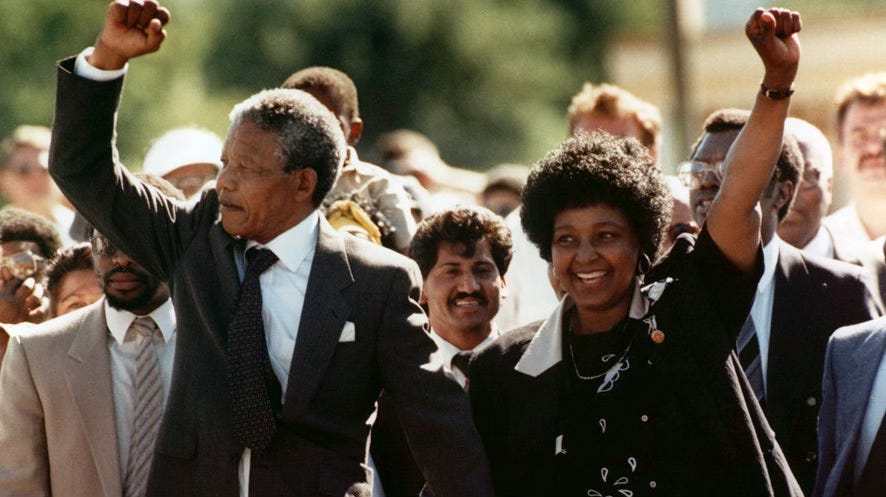
On February 11, 1990, Nelson Mandela was released from Victor Verster Prison in South Africa after 27 years of incarceration, marking a seismic shift in the country’s legal and political landscape. Mandela’s release followed a period of secret negotiations between the apartheid government and the African National Congress (ANC), and it signaled the beginning of the end of apartheid—a system of institutionalized racial segregation and oppression upheld by law. His imprisonment had become a global symbol of the fight against racial injustice and was frequently challenged by international human rights organizations and legal scholars as a violation of fundamental human rights.
Mandela had been convicted in 1964 of sabotage and other charges under South Africa’s Suppression of Communism Act, following the infamous Rivonia Trial. He was sentenced to life imprisonment, spending much of his sentence on Robben Island under harsh conditions. Over the decades, growing international sanctions and internal unrest made apartheid increasingly untenable.
Then-President F.W. de Klerk’s government began rolling back apartheid legislation in the late 1980s, and on February 2, 1990, de Klerk announced the unbanning of the ANC and his intention to release Mandela. Just nine days later, Mandela walked free, delivering a speech in Cape Town that emphasized reconciliation, peace, and the continuation of the struggle for full democratic rights.
Mandela’s release was not just a political milestone—it was a legal one, too. It reflected a move away from laws based on racial supremacy and toward a constitutional order grounded in human rights. This transformation would culminate in South Africa’s 1996 Constitution, often lauded for its rights-based framework and independent judiciary.
The Trump administration’s plan to repeal the EPA’s 2009 endangerment finding—the scientific basis for regulating greenhouse gases under the Clean Air Act—could reignite legal efforts to hold polluters accountable through public nuisance lawsuits. That finding enabled the EPA to regulate emissions from vehicles and power plants, but its reversal removes the legal framework that had previously shielded companies from such claims under a 2011 Supreme Court ruling. In that decision, the Court held that the EPA’s authority under the Clean Air Act displaced common-law nuisance suits against emitters. Without that EPA oversight, legal scholars believe plaintiffs may now argue that the courts are once again an appropriate venue for these claims.
Public nuisance lawsuits, typically filed by states or municipalities, seek to hold companies accountable for harms caused to community health and safety. These cases have been historically difficult to win due to challenges in proving direct causation, but experts say the new regulatory gap could encourage a wave of litigation. Industry groups like the Edison Electric Institute have warned that repealing the endangerment finding could expose utilities to costly legal battles. While federal courts had largely blocked such claims, state courts have shown more openness, and the shift in federal policy may strengthen these legal efforts. Environmental advocates may now have renewed leverage to push power companies and other emitters into court.
Trump’s repeal of climate rule opens a ‘new front’ for litigation | Reuters
Attorney General Pam Bondi is scheduled to testify before the House Judiciary Committee this week amid intensifying legal scrutiny over the Justice Department’s management of the Jeffrey Epstein files. Lawmakers are expected to question Bondi about what they view as excessive redactions and the DOJ’s withholding of key documents, actions that may conflict with a bipartisan federal law passed in 2025 mandating the broad release of Epstein-related materials. Legal analysts suggest the DOJ’s reliance on legal privileges—such as investigatory and deliberative process exemptions—to justify redactions could face stiff challenges in court or through congressional oversight powers.
The situation raises constitutional tensions between legislative oversight and executive privilege, particularly as the House panel, now under Republican control, examines whether the DOJ is shielding politically sensitive information. Some members of Congress have accused the Department of undermining transparency and potentially violating the statutory intent of the Epstein Disclosure Act, which narrowed the DOJ’s discretion in withholding records tied to convicted sex offenders or deceased suspects like Epstein.
Bondi’s DOJ has been accused of prioritizing partisan enforcement over institutional neutrality, illustrated by failed prosecutions of Trump critics and an aggressive posture on immigration and protest-related cases. The sidelining of the DOJ’s civil rights division and the refusal to investigate federal shootings has further fueled concerns over selective enforcement and erosion of prosecutorial independence. Bondi’s testimony will serve as a key moment to defend the Department’s use of legal redactions and its broader approach to politically charged prosecutions.
Bondi to face questions on Epstein files in House testimony | Reuters
Instagram chief Adam Mosseri is set to testify in a Los Angeles courtroom this week in a groundbreaking lawsuit that could reshape how U.S. law approaches the intersection of product design and youth mental health. The case centers on a 20-year-old plaintiff who alleges she became addicted to Instagram as a child due to its deliberately addictive interface—particularly the “endless scroll” feature that loads content continuously to hold user attention. Her lawyers argue that Instagram’s design choices amount to a form of negligent product engineering that failed to account for known risks to children.
This case raises novel legal questions: Can user interface (UI) design be treated as a defective product under tort law? Can tech companies be held liable not just for content but for the architecture of the platforms themselves? If the court accepts these arguments, it could establish precedent for treating addictive design as a public health harm similar to tobacco or opioid marketing practices.
Mosseri is expected to face questioning over internal documents that, according to the plaintiff, show Meta was aware of the app’s mental health impact on vulnerable teens. Meta counters that these documents reflect efforts to mitigate harm, not evidence of negligence. Still, the case may test the limits of Section 230 immunity, as it focuses not on third-party content, but the platform’s own design—potentially sidestepping the traditional legal shield for tech companies.
Hundreds of similar cases are pending, and this trial may serve as a bellwether for litigation nationwide. International developments, including Australia’s ban on social media for children under 16, suggest this is a growing legal frontier.
Instagram’s leader to testify in court on app design, youth mental health | Reuters
Novo Nordisk’s recent patent infringement lawsuit against Hims & Hers marks a pivotal legal development in the pharmaceutical industry’s battle with telehealth providers distributing compounded drugs. The suit, filed in Delaware federal court, targets Hims’ sales of compounded semaglutide—the active ingredient in Wegovy and Ozempic—claiming these formulations infringe Novo’s patents. While compounding is allowed under certain FDA exemptions, those exemptions do not shield pharmacies or telehealth platforms from patent liability. This case challenges the assumption that FDA compliance protects against infringement claims, exposing a gray area where regulatory and intellectual property regimes collide.
Historically, brand-name drugmakers focused on trademark challenges over how compounded drugs were marketed. Novo’s move into patent litigation signals a strategic escalation: it’s not about branding anymore—it’s about the act of making and selling the compound itself. Experts highlight that this is likely the first time a brand drug company has pursued patent claims directly against a compounding pharmacy or telehealth distributor, suggesting the industry now sees these entities as substantial commercial threats.
The case also underscores a novel enforcement strategy: suing the telehealth platform facilitating sales rather than the dispersed network of compounding pharmacies, streamlining legal action and potentially setting precedent for centralized liability. Hims, already under regulatory scrutiny, had just halted plans to sell compounded semaglutide pills but remains a target due to its involvement in injectable forms.
The outcome of this case may clarify how FDA-sanctioned compounding intersects with patent protections and could define the boundaries for how far telehealth companies can go in offering customized versions of patented drugs.
Novo’s GLP-1 Patent Suit Against Hims Takes Aim at Compounding


